eBook - ePub
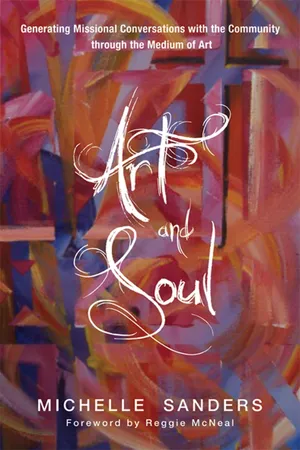
Art and Soul
Generating Missional Conversations with the Community through the Medium of Art
- 108 pages
- English
- ePUB (mobile friendly)
- Available on iOS & Android
eBook - ePub
Art and Soul
Generating Missional Conversations with the Community through the Medium of Art
About this book
The church is in major decline in the Western world. We cannot continue to use past evangelistic models to reach out to our modern world. Art and Soul explores ways of generating missional conversations in the community through the medium of art, offering theological reflections as well as practical strategies on how to connect with people outside of the church.
This book surveys several approaches, including "Art and Soul," a course that teaches people who suffer from depression and anxiety to paint, and introduces youths, refugees, prisoners, and other at-risk people to art in order to better connect with their own personal narrative. Readers will learn about "Art for Justice," or how to use art in the marketplace to begin conversations in their local community.
Art and Soul's initiatives for connecting with people through art will inspire and encourage Christ followers to step out and create places to engage with their community.
Information
Topic
Theology & ReligionSubtopic
Christian Ministry1
The Decline of the Church in the Western World
Australia is in a post-Christian era. Recently I was invited to address the world religions class at a secular university. Over the previous weeks they had a Jewish rabbi, a Buddhist monk, a Muslim Imam and a Hindu visit to speak about their religion. Normally they invite a Catholic or Greek Orthodox priest to address the class, but this year someone had suggested me. So I was invited in to speak about my life as a female Christian minister.
Speaking at the university was confronting or challenging in many ways. It is the largest class in Melbourne of around 450 students, not all of them were there that day, but the session was recorded for the rest of the class. I spoke for an hour about my journey and the teachings of Jesus; this was followed by a time of questions and answers. The questions were not what I expected. I had read up on the atonement and different questions of deep theological significance. The priority for me was not to throw out trite answers to them.
But their questions were surprising. For example: How do you know that it is God speaking to you? If God is an interventionist why was there a holocaust? What is more important, to be in the church praying or to be helping in the community, as I was doing? Is Jesus a chauvinist? Why did he come as a man not a woman? These were the easy ones. Many of these are good, honest questions that people struggle with inside and outside of the church. The questions—and possibly some of the answers—would have been different twenty years ago, as our world is so different. I think it is really important that the church listen to these questions, rather than try to predict what we think the questions will be and supply our practiced responses.
The church in the Western world is in decline. In Australia approximately 90 percent of the population does not regularly attend a church.1 Many of these have no understanding of the gospel message. America is heading the same way. Alvin Reid states that regular church attendance in America sits at 18 percent. He continues that more have a faith than attend a church.2 Stanley Presser goes a step further, stating that at least 41 percent of Americans are hard-core unchurched. Most of these have no clear understanding of the gospel, and have had little or no contact with a Bible-teaching church.3
Ed Vitagliano writes, “Today Christianity is losing its light in the West but rising as the new light in Asia, Africa, and Latin America, West Africa, Latin America and Asia.”4 In the next fifty years, he assumes, those regions will become the new “spiritual home of faith.” He adds that in 1900 there were approximately 10 million Christians in Africa; by 2000, the number had grown to 360 million.
However, the number of members within the Episcopal Church in the United States is declining, whereas in Uganda alone there are more than 8 million Anglicans. In terms of Evangelical Christians (the most thriving group), 70 percent of them live outside of the West.5 David Barrett, coauthor of the World Christian Encyclopedia, reports that Africa is gaining 8.4 million new Christians a year.6 South Korea grew from 300,000 in 1920 to 10 to 12 million, which is about 25 percent of the population.7
To add to the Western church problem, recent studies have shown that Evangelicals are not the fastest-growing faith group in America, neither are Pentecostals. The fastest-growing faith group in America is nonbelievers, in both numbers and percentages. From 1990 to 2001, they more than doubled, from 14 million to 29 million.8
Another startling figure is that out of all baptisms by Southern Baptists, only one in nine adults who were baptized described themselves as previously unchurched. In other words, eight of nine—almost 90 percent, of baptized adults had a connection with a church.9 Reid continues, “Of the 350,000 churches in the United States, less than 1 percent is growing by conversion growth.”10 These statistics are more than frightening. We are going backwards, and it is essential that we look at how we are presenting the gospel.
Frequently, the strategy to reach those who do not have a Christian faith is an attractional model, which has limited success. In effect, the church is asking those outside of the faith to cross the missional road and attend a church. We are barely making an impact on the unchurched community. This book hopes to generate thoughts regarding opportunities to share the gospel with those who will not enter a church building.
Australian culture is different than it was thirty years ago, yet the church employs many of the same methods to reach people. The question that needs to be asked is why unchurched people would step into a church? Most of the unchurched would not consider visiting a church since they consider the church is for Christians, not for them. If the church is to impact community or make inroads into bridging the gap, we need to understand the culture and how ordinary Australians think and relate.
George Barna writes that attempting to get unchurched people to connect with God and his church solely by means of a worship service is shortsighted.11 This form of evangelistic practice is unrealistic, and Christians need to discover how to relate to a postmodern worldview. This means being prepared...
Table of contents
- Title Page
- Dedication
- Foreword
- Introduction: Connecting with People’s Stories
- Chapter 1: The Decline of the Church in the Western World
- Chapter 2: How on Earth Should the Church Operate?
- Chapter 3: God, Art, and Creativity
- Chapter 4: Art as an Integral Expression of Mission
- Chapter 5: Kaleidoscope: A Faith Community
- Chapter 6: Art for Justice: Going into the Marketplace
- Chapter 7: Art and Soul: Teaching People Who Suffer from Depression and Anxiety to Paint
- Chapter 8: Art and Soul: Connecting with the Community
- Conclusion: Where to from Here?
- Bibliography
Trusted by 375,005 students
Access to over 1.5 million titles for a fair monthly price.
Study more efficiently using our study tools.
Frequently asked questions
Yes, you can cancel anytime from the Subscription tab in your account settings on the Perlego website. Your subscription will stay active until the end of your current billing period. Learn how to cancel your subscription
No, books cannot be downloaded as external files, such as PDFs, for use outside of Perlego. However, you can download books within the Perlego app for offline reading on mobile or tablet. Learn how to download books offline
Perlego offers two plans: Essential and Complete
- Essential is ideal for learners and professionals who enjoy exploring a wide range of subjects. Access the Essential Library with 800,000+ trusted titles and best-sellers across business, personal growth, and the humanities. Includes unlimited reading time and Standard Read Aloud voice.
- Complete: Perfect for advanced learners and researchers needing full, unrestricted access. Unlock 1.5M+ books across hundreds of subjects, including academic and specialized titles. The Complete Plan also includes advanced features like Premium Read Aloud and Research Assistant.
We are an online textbook subscription service, where you can get access to an entire online library for less than the price of a single book per month. With over 1.5 million books across 990+ topics, we’ve got you covered! Learn about our mission
Look out for the read-aloud symbol on your next book to see if you can listen to it. The read-aloud tool reads text aloud for you, highlighting the text as it is being read. You can pause it, speed it up and slow it down. Learn more about Read Aloud
Yes! You can use the Perlego app on both iOS and Android devices to read anytime, anywhere — even offline. Perfect for commutes or when you’re on the go.
Please note we cannot support devices running on iOS 13 and Android 7 or earlier. Learn more about using the app
Please note we cannot support devices running on iOS 13 and Android 7 or earlier. Learn more about using the app
Yes, you can access Art and Soul by Michelle Sanders in PDF and/or ePUB format, as well as other popular books in Theology & Religion & Christian Ministry. We have over 1.5 million books available in our catalogue for you to explore.