eBook - ePub
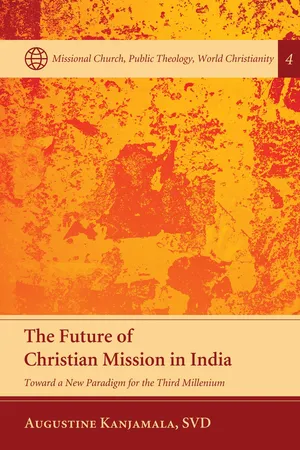
The Future of Christian Mission in India
Toward a New Paradigm for the Third Millennium
- 422 pages
- English
- ePUB (mobile friendly)
- Available on iOS & Android
eBook - ePub
The Future of Christian Mission in India
Toward a New Paradigm for the Third Millennium
About this book
Colonial missionaries, both Catholic and Protestant, arrived in India with the grandiose vision of converting the pagans because, like St. Peter (Acts 4:12) and most of the church fathers, they honestly believed that there is no salvation outside the church (extra ecclesiam nulla salus). At the end of the "great Protestant century," however, Christians made up less than 3 percent of the population in India, and the hope of the missionary was nearly shattered.
But if one looks at mission in India qualitatively rather than quantitatively, one sees a number of positive outcomes. Missionaries in India, particularly Protestant missionaries espousing the social gospel, in collaboration with a few British evangelical administrators, dared to challenge numerous social evils and even began to eradicate them. The scientific and liberal English education began to enlighten and transform the Indian mindset. Converts belonging to the upper caste, although small in number, laid the foundation stone of Indian theology and an inculturated church using Indian genius.
The end of colonialism in India coincided with the painful death of colonial mission theology. Now, the power of the Word of God, extricated from political power, is slowly and peacefully gaining ground, like the mustard seed of the parable. A paradigm shift from the ecclesio-centric mission to missio Dei offers reason for further optimism. In short, the future of mission in India is as bright as the kingdom of God. In today's new context, theologians, despite objections from some quarters, are struggling to discover the Asian face of Jesus, disfigured by the Greco-Roman Church. And the missionary is challenged to become a living Bible that, undoubtedly, everyone will read.
Information
Subtopic
Ministère chrétien1
Seven Images of Churches in India
“The longer you can look back the farther you can look forward”
—Winston Churchill
The Context of India and Its Challenges
India is perhaps the most complex nation in the world because of its nearly unimaginable pluralism and contrasting, often conflicting, diversities as well as affinities at every level. Today’s population of over one billion originated from five distinct racial types and some degree of mixing, with the predominance of the Aryan race in the Indo-Gangetic plain in the North and the Dravidian race in the South. Eighteen official languages, including English, plus 1652 dialects belonging to five language families with twenty-five scripts, create a veritable tower of Babel. The geographical as well as linguistic isolation of innumerable communities in the early period, with hereditary occupations originally laid the foundation for the present day 3,000 ethnic core groups and 10,000 endogamous communities.1 Such a social situation was gradually reorganized and legitimized as four broad Hindu castes by priestly authors of the Hindu sacred scriptures into Brahmins or priests, 8 percent; Kshatriyas or rulers, 16 percent; Vaishyas or commerce, 9 percent; and Sudras or peasants, 52 percent. About 15 percent were classified and treated as outcastes or untouchables. And religious communities like Muslims, Christians, Sikhs, Buddhists, Jains, Jews, Parsees, and animists co-exist with the dominant Hindu community, nearly 80 percent.
In a country nearly as large as a continent is it right and just to speak of one Indian Church and one Indian Mission? While not denying that there are certain unifying all-India perspectives and realities, one is almost compelled to acknowledge that the regional realities and interests of the local churches and missions are more dynamic and challenging than that of the Indian church. For example, what is the relation between the Kerala Church in the South and the Jammu Kashmir Church in the North? Is there any influence of the Patna Latin diocese in Bihar in the eastern zone on the Rajkot Syrian diocese in Gujarat in the western zone? The similarities between the Tribal Church in the North—East and the Tribal Church in western India begin and end with the tasteless legal and Indian Constitutional phrase ‘Scheduled Tribes.’ And the same is true about the Dalit church in Punjab in the North and Dalit church in Tamil Nadu in the South. One might therefore find more justification in focusing on regional levels because missionary activities of the Church are becoming more effective at the linguistic and cultural levels.
The Christian missionaries arrived in India at different zones during different periods of mission history. And the major phases of the missionary movements can be broadly demarcated into the following periods. The Syrian church on the Malabar coast claims its origin, according to a strong oral tradition, to the mission of St. Thomas the Apostle who arrived at Cranganore port, near Cochin, in AD 52. Documented evidences of different waves of migrations of Christians from East Syria and Persia, starting in the third century are undisputed. Their peaceful and passive coexistence with indigenous people for more than a millennium was beneficially disturbed by two major confrontations, first, between the Latin Portuguese missionaries in the sixteenth and seventeenth centuries and second, between the Church Missionary Society (CMS) and the Jacobite church in the beginning of the nineteenth century.
The arrival of Vasco da Gama and the Portuguese in Calicut in 1498, the conquest of Goa in 1510 and the arrival of various missionary Congregations inaugurated the second and aggressive phase of the mission in India under the Padroado, the royal patronage system. The capture of Bassein, Salsette, Thane and Bombay and coastal towns in the following decades prepared the way for the Franciscan missionaries and others to establish small Christian communities in the western region.2 In the aftermath of Reformation and subsequent preoccupation with denominational fights and political upheaval till the Peace of Westphalia in 1648 the Protestant awakening to missionary obligation was a slow process. The arrival of two German Lutheran Missionaries, under the patronage of the Danish King Frederick IV, fired by the Pietistic movement in Halle, Germany, in Tranquebar or Tarangambadi in Tamil Nadu, a Danish colony, in 1706 opened the first chapter of the Protestant Mission in India.3 The entry of William Carrey and two of his missionary companions in Serampore, another Danish colony near Calcutta, in 1793 and the subsequent entry of large number of Protestant missionaries, after the prohibition of entry of missionaries into the territory of the East India company was lifted by the Charter of 1813, was the starting point of the “Great Protestant Century” in India.
The hallmark of the nineteenth and twentieth centuries was mass conversions, inaugurated first by the protestant missionaries, followed by the Catholics. Two German Lutheran Missionaries, C. F. Schwartz and T. E. Rhenius, inaugurated group conversions among the Shannars of Tirunnelveli, Tamil Nadu, at the end of the nineteenth century. More or less in the same period, the Protestant missionaries were pioneers in frontier territories of Chotanagpur and North—East India and the Catholic missionaries would follow them, with their characteristic caution. The undivided Punjab’s successful evangelization was commenced by the American Presbyterians among the Chura and Chamar outcasts. Unfortunately missionaries failed to make any direct inroads into organized religions like Hinduism, Islam and Sikhism. However mission was not without its silver linings on Indian minds and social contours.
On Constructing Images
The nature of missionary activities and people’s responses to them were deeply influenced by various factors, such as ethnicity, caste, class, culture and above all religions. Thus a variety of Christian communities were created across the length and breath of the country. Plurality dominates both the national as well as ecclesiastical ethos. “The singular thing about India that you can only speak of it in the plural. This pluralism emerged from the very nature of the country; it was made inevitable by India’s geography and affirmed by its history.”4 In the context of such a glaring pluralism are we justified to speak about a single image of a Church in India? The idea of one Indian Church is nearly a myth created by foreign missionaries when they reported to their home countries about their work in some unknown remote corner of India. Strictly speaking there is no Indian Church. All images, pictures and models—artistic, cultural and theological—are human constructs. The Indian Christian artist Mr. Jyoti Sahi, observes that many Indians cannot think of an Indian Christ. “For them Jesus has to be foreigner and hence white. They cannot just imagine a blue or a brown Jesus.”5 In the slave era the Blacks painted an African Jesus. Michelangelo’s Jesus was modeled on Apollo. The Justification for creating different theological images of Jesus is found both in the Old as well as the New Testament.6 The images of the Church in India are many which are constructed and reconstructed with the help of local cultural and religious building blocks. The creators of the image or identity of a community are two types. Every community in virtue of believing and behaving in a particular manner validates its subjective image. For the image to come about the group identities are defined in relation to that which they are not. This is an ‘insider view.’ It become...
Table of contents
- Title Page
- Foreword
- Preface
- Acknowledgments
- Chapter 1: Seven Images of Churches in India
- Chapter 2: Varieties of Hindu Responses to Evangelical Mission
- Chapter 3: Violence against Christian Missions
- Chapter 4: Conversions of Marginal Communities to Christian Churches
- Chapter 5: From Confrontations to Dialogue and Partnership
- Chapter 6: Inculturation of the Indian Churches
- Chapter 7: The Spirit of God in Contemporary Social Movements
- Chapter 8: Christian Institutions at the Service of the Gospel
- Chapter 9: The Future of Missions in the Hindu Belt
- Chapter 10: Emerging Missions and Missiologies for the Future
- Appendix
- Bibliography
Trusted by 375,005 students
Access to over 1.5 million titles for a fair monthly price.
Study more efficiently using our study tools.
Frequently asked questions
Yes, you can cancel anytime from the Subscription tab in your account settings on the Perlego website. Your subscription will stay active until the end of your current billing period. Learn how to cancel your subscription
No, books cannot be downloaded as external files, such as PDFs, for use outside of Perlego. However, you can download books within the Perlego app for offline reading on mobile or tablet. Learn how to download books offline
Perlego offers two plans: Essential and Complete
- Essential is ideal for learners and professionals who enjoy exploring a wide range of subjects. Access the Essential Library with 800,000+ trusted titles and best-sellers across business, personal growth, and the humanities. Includes unlimited reading time and Standard Read Aloud voice.
- Complete: Perfect for advanced learners and researchers needing full, unrestricted access. Unlock 1.5M+ books across hundreds of subjects, including academic and specialized titles. The Complete Plan also includes advanced features like Premium Read Aloud and Research Assistant.
We are an online textbook subscription service, where you can get access to an entire online library for less than the price of a single book per month. With over 1.5 million books across 990+ topics, we’ve got you covered! Learn about our mission
Look out for the read-aloud symbol on your next book to see if you can listen to it. The read-aloud tool reads text aloud for you, highlighting the text as it is being read. You can pause it, speed it up and slow it down. Learn more about Read Aloud
Yes! You can use the Perlego app on both iOS and Android devices to read anytime, anywhere — even offline. Perfect for commutes or when you’re on the go.
Please note we cannot support devices running on iOS 13 and Android 7 or earlier. Learn more about using the app
Please note we cannot support devices running on iOS 13 and Android 7 or earlier. Learn more about using the app
Yes, you can access The Future of Christian Mission in India by Augustine Kanjamala SVD in PDF and/or ePUB format, as well as other popular books in Théologie et religion & Ministère chrétien. We have over 1.5 million books available in our catalogue for you to explore.