- 164 pages
- English
- ePUB (mobile friendly)
- Available on iOS & Android
eBook - ePub
About this book
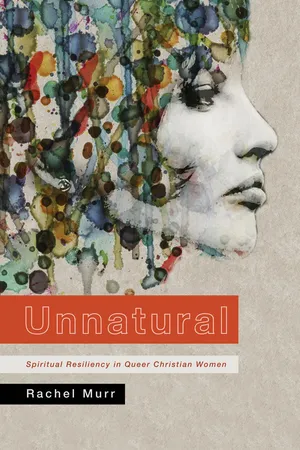
As a freshman in college, Rachel Murr found herself trying to decide which campus social group to join: the gay and lesbian advocacy group or the campus Christian fellowship. She knew it couldn't be both. For the next fifteen years she held onto the belief that she couldn't be both gay and Christian. When the pain involved in trying not to be lesbian called for a change in theology, she came out to her evangelical church. Conflict ensued.
Unnatural is a collection of stories--not only of the harm religiously-inspired negative messages about homosexuality inflict, but also of redemption. Rachel uses her own story as well as personal interviews with ten other queer women and one female-to-male transgender man to tell how they were judged, lectured, kicked out of homes and families, subjected to reparative therapies, and even assaulted. Some faced homelessness, depression, suicide attempts, and pervasive shame. Still, they fought to keep their faith alive. Each demonstrated an Unnatural ability to forgive, love, believe, advocate, and heal.
Information
Topic
Theology & ReligionSubtopic
Biblical Studies1
The Queer Faith Project
I stood alone in my freshman dorm room, thumbing through the list of cocurricular activities that were offered on campus. My original attempts at overcoming my shyness through sheer willpower and forced social interaction were not working out very well. Six weeks into the first semester, I was still short on friends and finding myself sulking alone in my dorm room on Friday nights. I knew I had to get involved in something on campus. As I searched through the list of campus groups provided by the university, I thought about where I might best fit. I had distaste for sororities, I’m not remotely musical, and intramural sports required that you sign up with an entire team already in place. After some deliberation, I narrowed my choices to two options: a campus Christian organization or the gay and lesbian group. I knew it could not be both.
For the next fifteen years I held onto that same belief that I could not be both gay and Christian. At first, this belief came from a fear of being judged or rejected by the Christians rather than a moral objection to being gay. I was well aware of certain Christians’ beliefs that it was wrong to be gay, but I wasn’t persuaded. I hesitated to visit the gay and lesbian group because I had a sense that if I went once, I’d be labeled for life, or that there would be no turning back. I hadn’t yet fully come out to myself, and I wasn’t sure that Fargo, North Dakota, would be the best place to do so. Attending the Christian group would definitely be an easier choice. Besides, I figured, they have to be nice.
Before I came to a decision, a neighbor invited me to the Christian group. (As it turns out, the Christians were better recruiters.) After attending their weekly meeting, I quickly made friends and found myself in the midst of a supportive, fun, and loving community. The community of believers was healing for me, chipping away at my own feelings of isolation and difference. I began to experience a personal and loving God who cared about me. Staff members of the Christian group saw leadership potential in me and encouraged me to take on new challenges: leading small groups, sharing my testimony, and reaching out to others. God and the Christian community changed my life in wonderful ways.
After my newfound spiritual experiences and the decision to follow Jesus, I slowly adopted the teachings of the campus Christian organization and allowed these teachings to define how to interpret the Bible, what God is like, and how I should live out my faith. During this time I thought that Christianity was a very hard truth. I thought it was a tough pill to swallow, that you had to believe things that don’t make a lot of sense—like Jesus is the only way, people go to hell for not believing the right thing, and, of course, that being gay is wrong. I thought that faith was hard and that following Jesus meant being countercultural, even offensive to those outside the faith.
My views have changed a lot since then, but I remain a Christian. I still find meaning in community, worship, solitary prayer, and Scripture. I still seek to follow the way of Jesus and look to the power of the Holy Spirit to live a life of faith. I’ve completely abandoned the belief that same-sex relationships are inherently sinful. After many years of wrestling with the question of what it means to be lesbian and Christian, eventually I came to believe that loving another woman could be okay with God—that it might even be how God created me.
This change in beliefs took some time. Like most major theological shifts, it took place after significant discomfort with the way I’d been living. My belief that God’s laws are for our benefit did not line up with my experience of following what I thought to be God’s law about same-gender relationships. I was miserable. In seeking health, I began to question what I’d been taught about homosexuality. I wondered if God had good news for gay people.
During my process of adopting an affirming faith, I needed to hear from other queer (a catch-all term I use for lesbian, gay, bisexual, transgender, or otherwise nonheterosexual) women who’ve held onto their faith. I needed to know that I did not have to choose between gay or Christian but that it was possible to be both.
Times Are Changing
Many others have shifted their views about homosexuality in the past decades as our culture has become more accepting of queer people. The church, of course, has been slower to change. “The gay issue” is the most fiercely debated topic in the Christian church in America as congregations and denominations continue to split over questions of membership, leadership, and ordination of LGBTQ (lesbian, gay, bisexual, transgender, and queer) people. Somehow, the behavior of about five percent of the population has become the most important issue of the church. Clearly something more is at stake. In her memoir, Sara Miles, author and founder of The Food Pantry at St. Gregory of Nyssa Episcopal Church, explains the dynamics well: “It wasn’t just about gayness, of course, but a more fundamental conflict between believers who craved certainty and those who embraced ambiguity; those who insisted Scripture was inerrant and unchanging, given once and for all time, and those who believed that the Bible was only part of God’s continuing revelation. The struggle was also about how to define a Christian: as one who sought to keep the religion ‘pure’ or one who welcomed outcasts.”1 She explains that those who want to hold on to tradition and preserve the purity of their movement must exclude all threats. Queer people have come to represent the threat of what conservatives fear most about losing their firmly held belief in the inerrancy of Scripture and certainty about their interpretation of the text. As a result of this fear and the actions stemming from it, religious groups have come to represent hatred and bigotry to many in the LGBTQ community and their allies. This leaves queer people of faith with some major challenges in finding safe places to bring their whole selves into community.
These polarizing dynamics are changing as affirming faith communities have played a huge role in combating religious messages of condemnation. In my home state of Minnesota, faith communities and affirming clergy rallied to defeat the Minnesota Marriage Amendment (a constitutional amendment that was on the ballot in 2012 to ban same-sex marriage) and to advocate for legislation in favor of same-sex marriages. People of faith organized marches, summits, and other public statements showing their support for same-sex marriages. No longer can Christians claim that there is one clear and authoritative position of the Christian church. It is truly divided.
As my own church wrestled with these issues a few years ago, I felt the tension. I wondered if staying in my church was good for me. I wondered how others had dealt with the conflict that they may have felt between their faith and sexuality. Did they stay in nonaffirming churches? Did they try to advocate for change? Did they give up on organized religion? I needed to talk to others.
The opportunity to search for other queer believers came about when I was completing my master of social work. Through a year-long research project, I studied the experiences of lesbian and bisexual Christian women from nonaffirming Christian communities to explore how and why they held onto faith. I interviewed eight women, asking about early church culture, messages they heard about LGBTQ people, and their reasons for coming out and reasons for holding onto their faith. I ended each interview by asking participants if their view of God had changed.2 Their stories were rich. They shared openly of their pain and their joy, their doubts and their convictions. After finishing the project, I didn’t want it to be over. I had discovered something beautiful in the lives of these women. They stirred up in me the ridiculous notion to tell my own story, too.
This book is a collection of stories—testimonies about the work of God in the lives of people the church has rejected. In my church tradition, personal testimonies are commonly shared during a Sunday service. Members stand up and tell the community how God has changed their lives in big ways or small. Their stories provide hope to others and reasons for giving thanks to God together. These stories connect people to each other through common life experiences and hardships. On any given Sunday, most of us are far more likely to remember the testimony of a fellow member than the sermon.
There is also something powerful about telling our own stories. Sharing a personal struggle and how God has worked in it is a chance to express our authentic selves, to bring hope to others, and to say, “Look what God has done!” The way we construct our own life stories impacts our sense of self and of the world around us. In mental health professions, there is a specific therapeutic approach, called narrative therapy, which helps clients reconstruct their life stories with new meaning. Narrative therapists seek to point out the larger societal picture, or “meta-narrative,” of their clients’ lives. They highlight oppressive systems or unjust cultural norms and look for a “counter story,” one that highlights the client’s strengths. The meta-narrative for queer women may include messages that they are sinful, gross, unspiritual, unhealthy, man haters, and/or a threat to “family values.” Acknowledging the reality of this cultural meta-narrative can help individuals see how they have been impacted by harmful messages and how they have resisted them. Any resistance to these messages indicates how individuals have courageously fought against strong, oppressive cultural forces. Through narrative therapy, clients begin reframing life events into a story that can be told for a purpose. This storytelling may be a powerful tool i...
Table of contents
- Title Page
- Foreword
- Author Notes
- Acknowledgments
- Chapter 1: The Queer Faith Project
- Chapter 2: Messages: Home and Church
- Chapter 3: Messages: Ex-gay Ministries
- Chapter 4: Messages: Media, Politics, and Wider Communities
- Chapter 5: Impact: Identity Conflict and Mental Health Issues
- Chapter 6: Impact: Violence
- Chapter 7: Impact: Broken Relationships
- Chapter 8: Impact: Conflict and Loss in Faith Communities
- Chapter 9: Reclamation: Integration and Wholeness
- Chapter 10: Reclamation: The Abundant Life
- Chapter 11: Reclamation: Transformation
- Chapter 12: Conclusions
- Bibliography
Trusted by 375,005 students
Access to over 1.5 million titles for a fair monthly price.
Study more efficiently using our study tools.
Frequently asked questions
Yes, you can cancel anytime from the Subscription tab in your account settings on the Perlego website. Your subscription will stay active until the end of your current billing period. Learn how to cancel your subscription
No, books cannot be downloaded as external files, such as PDFs, for use outside of Perlego. However, you can download books within the Perlego app for offline reading on mobile or tablet. Learn how to download books offline
Perlego offers two plans: Essential and Complete
- Essential is ideal for learners and professionals who enjoy exploring a wide range of subjects. Access the Essential Library with 800,000+ trusted titles and best-sellers across business, personal growth, and the humanities. Includes unlimited reading time and Standard Read Aloud voice.
- Complete: Perfect for advanced learners and researchers needing full, unrestricted access. Unlock 1.5M+ books across hundreds of subjects, including academic and specialized titles. The Complete Plan also includes advanced features like Premium Read Aloud and Research Assistant.
We are an online textbook subscription service, where you can get access to an entire online library for less than the price of a single book per month. With over 1.5 million books across 990+ topics, we’ve got you covered! Learn about our mission
Look out for the read-aloud symbol on your next book to see if you can listen to it. The read-aloud tool reads text aloud for you, highlighting the text as it is being read. You can pause it, speed it up and slow it down. Learn more about Read Aloud
Yes! You can use the Perlego app on both iOS and Android devices to read anytime, anywhere — even offline. Perfect for commutes or when you’re on the go.
Please note we cannot support devices running on iOS 13 and Android 7 or earlier. Learn more about using the app
Please note we cannot support devices running on iOS 13 and Android 7 or earlier. Learn more about using the app
Yes, you can access Unnatural by Rachel Murr in PDF and/or ePUB format, as well as other popular books in Theology & Religion & Biblical Studies. We have over 1.5 million books available in our catalogue for you to explore.