eBook - ePub
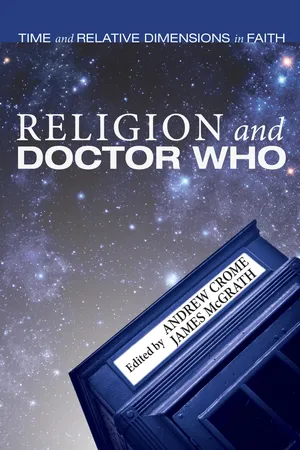
Religion and Doctor Who
Time and Relative Dimensions in Faith
- 366 pages
- English
- ePUB (mobile friendly)
- Available on iOS & Android
eBook - ePub
Religion and Doctor Who
Time and Relative Dimensions in Faith
About this book
Doctor Who has always contained a rich current of religious themes and ideas. In its very first episode it asked how humans rationalize the seemingly supernatural, as two snooping schoolteachers refused to accept that the TARDIS was real. More recently it has toyed with the mystery of Doctor's real name, perhaps an echo of ancient religions and rituals in which knowledge of the secret name of a god, angel or demon was thought to grant a mortal power over the entity.
But why does Doctor Who intersect with religion so often, and what do such instances tell us about the society that produces the show and the viewers who engage with it?
The writers of Religion and Doctor Who: Time and Relative Dimensions in Faith attempt to answer these questions through an in-depth analysis of the various treatments of religion throughout every era of the show's history. While the majority of chapters focus on the television show Doctor Who, the authors also look at audios, novels, and the response of fandom. Their analyses--all written in an accessible but academically thorough style--reveal that examining religion in a long-running series such as Doctor Who can contribute to a number of key debates within faith communities and religious history.
Most importantly, it provides another way of looking at why Doctor Who continues to inspire, to engage, and to excite generations of passionate fans, whatever their position on faith.
The contributors are drawn from the UK, the USA, and Australia, and their approaches are similarly diverse. Chapters have been written by film scholars and sociologists; theologians and historians; rhetoricians, philosophers and anthropologists. Some write from the perspective of a particular faith or belief; others write from the perspective of no religious belief. All, however, demonstrate a solid knowledge of and affection for the brilliance of Doctor Who.
Information
Subtopic
Théologie chrétienne1. Why Time Lords Do Not Live Forever
Courtland Lewis
One might think that a race as powerful as the Time Lords could find a way to live forever. The 1983 serial ‘The Five Doctors’ shows that at least one Time Lord, Rassilon, did discover the secret of immortality. The most intriguing feature of this serial is that immortality is portrayed as something undesirable, as something proper for only the corrupt and evil. ‘The Five Doctors’ is not unique. Other examples include: the Master’s propensity towards evil, which is partly due to his fear of death and his ability to steal and manipulate regenerations; the Cybermen’s desire to be free from death resulting in conquest and destruction; and Omega’s entrapment that fosters a hate-filled desire for revenge. The vast majority of Time Lords are content with their limited mortal existence, and this appears to be the result of an acute awareness concerning the dangers of living forever. They hold a position similar to Bernard Williams, who claims, ‘There is no desirable or significant property which life would have more of, or have more unqualifiedly, if we lasted forever.’1 Not only do they share Williams’ concerns about the boredom of an immortal life and how death brings value to life, but they are also concerned with the hatred, depression, and desire for destruction that seem to result from being immortal. Time Lords, then, do not live forever because such an existence is both undesirable and dangerous.
Most religions and their respective followers hold a different intuition about the desirability of immortality, and offer intricate positive explanations describing immortality and afterlife. These explanations are meant to inspire good behaviour, assuage the fear of death, and among other things, ensure that those who suffer injustices in this life find justice in the next. As a result, many people proclaim a confidence in and sometimes longing for immortality. Doctor Who, on the other hand, suggests that such accounts fail to fully consider what an immortal existence, where an individual continues to have subjective personal experiences for all eternity, is like, and fail to adequately provide answers to the question of what you would do for all eternity. How would you spend your time? Would you work? Would you set goals? What happens when you run out of goals? How many millions of times could you watch every episode of Doctor Who before you get sick of Doctor Who? Could you retain your personal identity over such a long period of time? What do you do when you get tired of those around you? More importantly, what do you do when you get tired of yourself?
In the following pages I will examine the themes of immortality found in Doctor Who, and will show that it teaches viewers that a continual subjective immortality is undesirable. I will use the phrase ‘subjective immortality’ to describe a form of existence in which subjects (i.e. individual persons) continue to have personal subjective experiences, in ways similar to their subjective existence on Earth, for all eternity. I will begin by providing a brief survey of how several different world religions describe immortality and afterlife. Next, I will present Charles Hartshorne’s three arguments against the desirability of a subjective immortal existence, and will use Doctor Who to provide support for each. Finally, I will present a positive account for the desirability of an objective immortal existence where individuals cease to have subjective experiences. I will use the Matrix, as featured in several Doctor Who episodes, to suggest that since such an immortal existence is freely accepted by Time Lords, then we as humans might find such an existence preferable to the two alternatives (complete nothingness and subjective immortality).
Before beginning, let me make some important distinctions that will better focus my chapter and help prevent confusion. First, I will be using ‘immortality’ in a very loose sense to mean ‘a life that appears to exist without end’. Because human minds are finite, it is impossible to fully imagine an infinite existence. Also, we do not know enough about many of the characters in Doctor Who to determine with certainty whether or not they are immortal. For instance, Captain Jack Harkness appears to be immortal, and both Doctor Who and Torchwood talk as though he is, yet the 2007 episode ‘Gridlock’ suggests that the Face of Boe (the being that we are led to believe he will eventually become) is capable of dying. Also, Daleks and Cybermen seem capable of immortality, if they would stop trying to conquer the universe and learn how to get along with others. I will leave conclusions about such matters to someone else.
Second, the way in which I understand the desire to be immortal is as a desire to have an existence similar to the subjective one we currently have, yet free from pain, suffering, injustice, and the other features of mortal life that are undesirable. So, when considering immortality, I will do so from a position that takes an idealised version of our current human existence as its hallmark, which is the same approach Doctor Who takes. I will focus on how we, as finite beings who perceive the world from a particular point of view of time and space, should understand the desirability of an eternal existence; for this is the issue of immortality that Doctor Who is concerned with. The issue of what sort of entity (e.g. soul, pure energy, atoms, etc.) exists as an immortal being will not be addressed. For such an account, I would suggest Paul Edwards’ book Immortality2 and Michael Hand’s essay ‘Regeneration and Resurrection’ in Doctor Who and Philosophy.3
Fear and the Need for Immortality
Death is a mysterious aspect of human existence. As Hiroshi Obayashi states, ‘Questions about death and afterlife … seem thoroughly futile because there are no criteria and no empirical evidence on which to assess the relative merits of the variety of ideas held to be true by people of various cultures.’4 In an age of advanced technologies and exotic treatments, we seem to fear death more than ever. Medicine increasingly treats death as a disease to be cured, and continues to create new technologies capable of keeping us ‘alive’ decades after our internal organs cease functioning. In addition, theologians and philosophers continue to work on new strategies to comfort those who fear death and to provide possible explanations for what happens after one dies. The simple fact is the finality of death is scary. Even the Doctor, who gets to regenerate twelve times, does not ‘want to go’.5
The Tenth Doctor’s sentiment towards not wanting to die is shared by most people, which is why explanations of immortality and afterlife feature prominently in various world religions. In Africa, the Mende of Sierra Leone understand death as a social construction that occurs twice in one’s life. The first death occurs when a child reaches the age in which she or he can enter one of the community’s secret associations.6 At this important stage of life, the child’s spirit leaves the body and is accepted by the spirits. When recognised, the child is born anew as a social person who can enter into the society’s communal associations. The second death occurs when the body dies. Upon the death of the body, the spirit continues its existence in another realm, performing many of the same actions the living person did on Earth.
Ancient Mesopotamians believed that upon death the ghost of the dead journeyed to a netherworld, where it would be judged by its earthly credentials. These credentials were determined by how well the living presided over the deceased’s corpse. The proper offerings had to be made and the body had to be properly interred, or it could not be accepted into the netherworld. Even if one’s credentials were judged favourably, one’s immortal existence would be quite grim. As Obayashi points out, except for the account offered in the poem ‘Gilgamesh, Enkidu and the Netherworld’, where those who have large families or suffered untimely deaths get to enjoy music and other pleasures, most accounts of afterlife suggest a form of existence devoid of any emotional ties and only dimly resembling life on Earth.7
Egyptians used elaborate burial rituals and practices to help overcome death and aid the deceased on their journey through afterlife. The three major monotheistic religions have a variety of explanations. The Hebrew Scriptures lack any clear concept of afterlife. Life begins when God breathes the breath of life into an individual, and life ends when that breath is gone. The physical body turns to dust, and the deceased descends to Sheol – a place where the dead remain lifeless and inert.8 Sheol also appears in the Christian New Testament, under the guise of the Greek notion of Hades – a place where the dead reside. Hades was used to translate Sheol in the Septuagint, the Greek translation of the Hebrew Scriptures. However, the Christian Scriptures also discuss a different sort of afterlife, Gehhenna, where unworthy souls are punished with fire, brimstone, and gnashing of teeth. In both cases, there is disagreement over whether hell is an eternal or temporary residence of the dead.
Christians also maintain that one can avoid hell by having faith in Jesus Christ. Since the formation of Christianity as a religion there have been many attempts to describe the nature of heaven. All appear to agree that heaven is a place where God reigns and it is populated by those whom God finds righteous. Where accounts differ is in the nature of such an existence and who is justified. Some envision heaven as a place where the resurrected are eternally rewarded. Many early Christians envisioned the creation of a new heaven and new earth, with those found righteous populating the new earth. The Christian scriptures describe heaven in many different ways: as a feast, as being filled with mansions, and as a place of justice. As for who is justified, accounts vary greatly. For some, only those who believe in Christ, as the son of God, will enter. Others maintain that God predestines individuals, while some argue that God’s forgiveness of sins is universal; so in the end, all will be welcomed into heaven.
Islam accepts the concepts of resurrection, heaven, and hell, but offers a different explanation of how one is judged. For Muslims, Allah creates people for a specific purpose, and their success in carrying out their respective purpose determines the mode in which they return to Allah. Since Allah creates individuals for specific purposes, individualism is a key characteristic and emphasis of Islam, and even though individuals have free will, each is supposed to surrender him/herself to Allah, thereby releasing themselves from all other forms of slavery that are part of one’s earthly existence.9
For Islam, the human soul is immortal. When a person dies, his or her soul enters the first stage of death, which is known as the Innerworld. In the Innerworld, souls are only in relation to themselves. It is a place of solitude and reflection. The soul stays in the Innerworld until the Day of Resurrection. This second stage of death is a period of judging, where souls encounter their Reckoning. Each soul’s fate is determined by the success or failure it had in carrying out its purpose. If the soul is successful, it will enter the heavens (sometimes referred to as the Garden), but if it fails, it enters the hells (often referred to as the Fire). Both judgements determine the soul’s proper separation from Allah. In the Garden, souls are ‘treated to fountains, cool shades, and chaste houris [virgins]…; to carpets, cushions, goblets of gold, and sumptuous food and drink.’10 In the Fire, souls are treated to ‘burning garments, molten drinks, maces of iron, and fire that splits rocks into fragments.’11 More importantly for both existences, in the Garden souls are in the presence of Allah, which brings great happiness; whereas, in the Fire souls are veiled from Allah, which brings misery. There are some disagreements among Muslims about Reckoning. For instance, some maintain that Allah gives everyone solace eventually, since eternal punishment is inconsistent with Allah’s nature.12 Others avoid this possible inconsistency by maintaining that Allah does not judge souls; instead, souls judge themselves. In other words, Allah gives individuals free will, and if they choose not to follow His plan, then they have freely chosen an afterlife in the Fire.13
There are many polytheistic religions, and several ways of understanding each of them. Three of the most familiar polytheistic religions are Jainism, Hinduism, and Buddhism. As A. Chakrabarti describes, all suggest similar systems of saṃsāra (the continual cycle of death and rebirth) and the eventual release from this cycle; though each one refers to this release by a different name: mokṣa (Jainism), apavarga (Hinduism), and nirvāna (Buddhism).14 According to Charkrabarti, there are four ways of understanding what happens to the soul when one achieves release. From the school of theological thought called Advaita Vedāntin, the soul experiences intense joy at being liberated and sharing in the joy of ‘the bliss-breathing company of his truly beloved Lord (a personal God of some sort)’. The Naiyāyika school of thought maintains that the soul does not enjoy any special happiness beyond the ‘absolute absence of pain’. For them, happiness is a hindrance to release. The third school of thought suggests that happiness is part of release, but that such happiness should not be sought, and the fourth suggests that even though there is no happiness involved in release, one might imagine its inclusion to help overcome worldly desires.15 Regardless of the approach one takes to liberation, saṃsāra suggests a form of immortality of the soul, where the soul continues to exist in a cycle of death and rebirth until it is liberated. As seen in the four schools of thought just described, there is much debate about what happens to the soul upon liberation.
Philosophy has just as many explanations for what occurs when one dies. Here are two, one offered by Plato and the other by Friedrich Nietzsche. In Plato’s Apology, Socrates argues that two possible things occur when one dies: either we cease to be, or the soul changes and migrates.16 Ceasing to be is merely the loss of all consciousness, which is not any different from being in a very deep sleep; whereas change allows souls the chance to migrate closer to the Good. For Socrates, neither of these outcomes is undesirable, and so, death and afterlife are nothing to fear. In another dialogue, Phaedo, Socrates argues that the soul is immortal and that there is strong evidence to believe in reincarnation.17
On the other hand, found throughout Friedrich Nietzsche’s writings is the notion of existence continually repeating itself for all eternity, in what he calls the ‘eternal recurrence’.18 For Nietzsche, we are destined to repeat for all eternity the things we do (or do not do) in this life, so we better get it right.
Besides Socrates’ suggestion that death is the end of all existence, each of the above accounts offers an explanation of one of two types. The first type provides individuals with an explanation of how they can continue their subjective existence, in some way or another, for all eternity, and is exemplified by all except the polytheistic religions (and possibly Nietzsche) mentioned above.19 The second type provides an explanation of how we should live our lives while on Earth, so that we will one day escape our individual subjective existence. This type is illustrated by Jainism, Hinduism, and Buddhism, all of which suggest an ideal state of existence where the individual self, which is only illusory, ceases to exist.
As I will show in the next section, though sharing some similarities with the second type, Doctor Who offers a third type of explanation. It suggests that even though death can be extremely sad, and sometimes devastating, death is good. It brings value to life, it inspires us to live each day to its fullest, and it challenges us to fight for what is right. This is exactly what Rose tries to get across to her mother Jackie and boyfriend Mickey in ‘The Parting of the Ways’ (2005): ‘It was a better life. And I – I don’t mean all the travelling and … seeing aliens and spaceships and things – that don’t matter. The Doctor showed me a better way of living your life.’
The Undesirability of Subjective Immortality
The undesirability of subjective immortality (or, at least, scepticism towards its desirability) is seen throughout Doctor Who. Take, for example, Omega from the 1973 serial ‘The Three Doctors’. Omega (the ‘solar engineer’) is the first Time Lord, and is honoured for his sacrifice which allowed others to master time-travel. Omega was thought to have died while turning a star into a black hole, but unbeknownst to everyone, he survived the transformation and found himself trapped alone for eternity in a universe of antimatter. His only contact with others was with beings he created using his mental powers, and after millions or perhaps billions of years, he changed from a being who was willing to risk his life for the benefit of others to one who was wanting to destroy that life. His never-ending subjective experience of loneliness and feeling abandoned made him bitter and vindictive, sustained by hatred, and wanting to be worshipped as a god.20 His knowledge, power, and subjective immortality caused him to see himself as a...
Table of contents
- Title Page
- Acknowledgements
- Introduction
- 1. Why Time Lords Do Not Live Forever
- 2. Pushing the Protest Button: Doctor Who’s Anti-Authoritarian Ethic
- 3. Divine and Human Nature: Incarnation and Kenosis in Doctor Who
- 4. Breaking the Faiths in ‘The Curse of Fenric’ and ‘The God Complex’
- 5. The Doctor Working on God’s Time: Kairos and Intervention in ‘The Waters of Mars’ and ‘A Christmas Carol’
- 6. ‘You’re this Doctor’s companion. What exactly do you do for him? Why does he need you?’: Doctor Who, Liminality and Martha the Apostle
- 7. ‘Humany-Wumany’: Humanity vs. Human in Doctor Who
- 8. The Monstrous and the Divine in Doctor Who: The Role of Christian Imagery in Russell T. Davies’s Doctor Who Revival
- 9. ‘With proof, you don’t have to believe’: Doctor Who and the Celestials
- 10. ‘Her brain was full of superstitious nonsense’: Modernism and the Failure of the Divine in Doctor Who
- 11. Religion in Doctor Who: Cult Ethics
- 12. Mediating Between the Scientific and the Spiritual in Doctor Who
- 14. ‘There never was a Golden Age’: Doctor Who and the Apocalypse
- 15. ‘Qui Quae Quod’: Doctor Who and the History of Magic
- 16. The Church Militant? The Church of England, humanity and the future in Doctor Who
- 17. Bigger on the Inside? Doctoring the Concept of ‘Religion or Belief’ under English Law
- 18. ‘Something woolly and fuzzy’: The Representation of Religion in the Big Finish Doctor Who Audio Adventures
- 19. Doctoring the Doctor: Midrashic Adventures in Text and Space
- Epilogue
- Appendix: Doctor Who Episodes, Writers and Directors
- Notes
- Notes on Contributors
Trusted by 375,005 students
Access to over 1.5 million titles for a fair monthly price.
Study more efficiently using our study tools.
Frequently asked questions
Yes, you can cancel anytime from the Subscription tab in your account settings on the Perlego website. Your subscription will stay active until the end of your current billing period. Learn how to cancel your subscription
No, books cannot be downloaded as external files, such as PDFs, for use outside of Perlego. However, you can download books within the Perlego app for offline reading on mobile or tablet. Learn how to download books offline
Perlego offers two plans: Essential and Complete
- Essential is ideal for learners and professionals who enjoy exploring a wide range of subjects. Access the Essential Library with 800,000+ trusted titles and best-sellers across business, personal growth, and the humanities. Includes unlimited reading time and Standard Read Aloud voice.
- Complete: Perfect for advanced learners and researchers needing full, unrestricted access. Unlock 1.5M+ books across hundreds of subjects, including academic and specialized titles. The Complete Plan also includes advanced features like Premium Read Aloud and Research Assistant.
We are an online textbook subscription service, where you can get access to an entire online library for less than the price of a single book per month. With over 1.5 million books across 990+ topics, we’ve got you covered! Learn about our mission
Look out for the read-aloud symbol on your next book to see if you can listen to it. The read-aloud tool reads text aloud for you, highlighting the text as it is being read. You can pause it, speed it up and slow it down. Learn more about Read Aloud
Yes! You can use the Perlego app on both iOS and Android devices to read anytime, anywhere — even offline. Perfect for commutes or when you’re on the go.
Please note we cannot support devices running on iOS 13 and Android 7 or earlier. Learn more about using the app
Please note we cannot support devices running on iOS 13 and Android 7 or earlier. Learn more about using the app
Yes, you can access Religion and Doctor Who by Andrew Crome,James F. McGrath, Crome, McGrath in PDF and/or ePUB format, as well as other popular books in Théologie et religion & Théologie chrétienne. We have over 1.5 million books available in our catalogue for you to explore.