eBook - ePub
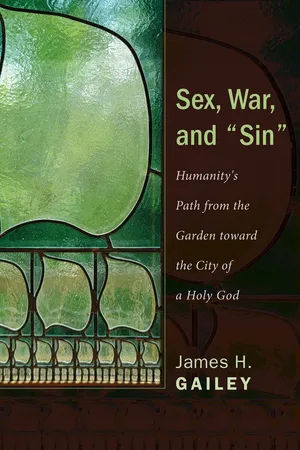
Sex, War, and "Sin"
Humanity's Path from the Garden toward the City of a Holy God
- 352 pages
- English
- ePUB (mobile friendly)
- Available on iOS & Android
eBook - ePub
About this book
An examination of the Hebrew Scriptures reveals the ethical situations in ancient Israel as a structural analysis, and exposes a covenantal triangle that features a dynamic of giving and receiving, taking and paying penalties, as a meme for human relationships. This can be applied to groups as well as individuals and is surprisingly applicable to life in the twenty-first century. Two senses of "Law"--natural scientific discoveries and the rules laid down by a divine creator--lead to frames for considering these covenantal relationships, and even the existence of "Sin." Are we bound to obey the rules laid down by God, or may we decide what is best for us?
Information
Part 1
Biological, Cultural, and Religious Systems of Life
1
Frames for the Experiment of Human Life
According to the scriptures—the Hebrew writings and the Greek New Testament—the most significant problem confronting the human race is the problem of “sin.” Every other problem, medical, economic, inter-tribal or international can be seen as deriving from the failure of humans “to honor God as God, or give thanks to him, but they became futile in their thinking and their senseless minds were darkened” (Rom 1:21). In his letter to the Romans the apostle Paul announced the happy solution in Christ’s redemptive work.
Church fathers and an established Roman priesthood claimed the power to dispense forgiveness for individual sins until Martin Luther called for a Reformation that would allow believers direct access to God. In the spirit of Luther, the French lawyer John Calvin wrote a major systematic statement, “The Institutes of the Christian Religion,” for the purpose of freeing believers from the enforcing of belief in the Roman Catholic system by the arms of the state.
Following Calvin, spokesmen in several European countries wrote “reformed” creeds for the instruction and defense of their followers. The threefold statement produced in 1649 at Westminster Abbey was intended to give maturing believers three levels of theological insight and has remained as one of the creeds in the Book of Confessions of the Presbyterian Church (USA). Having served as documents for advanced study for three centuries, in 1951 the Westminster “Confession of Faith,” and the “Larger Catechism” were published in parallel columns with the “Shorter Catechism” as a “Harmony.”1 The heart of this system is in two covenants that propose to frame the relationship between God and the human race.
Covenants of Works and of Grace
As a child in a Presbyterian church and later as a theological student in the first third of the twentieth century I learned that my church focused on a particular form of evil known as “sin.” The Shorter Catechism defines “sin” as “any want of conformity unto or transgression of the law of God,” and the Westminster catechisms and Confession of Faith explain that “sin” is endemic in human societies, as a sort of infection passed on from “first parents” to “posterity by natural generation.”2
The human race, descended from Adam as a “public person, . . . sinned in him, and fell with him” in the first transgression, which occurred when he and his wife ate the forbidden fruit in the garden of Eden. Question 12 of the Shorter Catechism explains: “When God had created man, he entered into a covenant of life with him, upon condition of perfect obedience, forbidding him to eat of the tree of the knowledge of good and evil, upon pain of death.” As a result of Adam’s imperfect obedience to a command of God, the whole human race is now in a condition of “sin and misery,” which could be remedied by God’s gracious administration of a covenant of grace through “the preaching of the word” and the sacraments of baptism and the Lord’s supper.3
It thus appeared that God had laid upon Adam a “covenant of works” as an experimental test of obedience, and failing that, the human race must live in sin and misery until a covenant of grace would offer salvation to all who believe in the redemptive work of Jesus Christ. The second covenant could be seen as a gracious offer by the Triune God, since the acquisition of “salvation” was no longer contingent on perfect obedience, but on the individual acceptance of the offer by each member of the race, all of whom suffered the consequences of disobedience to the moral law—a body of law including the Ten Commandments and laid out largely in books of the Pentateuch, but also detailed throughout the Holy Scriptures as laws to be obeyed.
Not all Protestants adopted this Calvinist frame but in a scientific age it haunts popular thinking about human life with large numbers of the world’s people expecting a final judgment. In an age dominated by science both covenants can be interpreted as experiments conducted by God. Without focusing attention on a single man and his wife, the modern Calvinist can see all human beings confronted either with the test of obedience to the law of God or with the test of personal acceptance of the gospel.
New Uses for “Law”
A different confrontation developed after the term “law” was borrowed by the sciences from Roman and Church judicial practice. It involved two kinds of law—natural law and “the moral law”—and grew in intensity in the mid-eighteenth century and continues into the present “post-modern” twenty-first century when thoughtful clerics, journalists, political leaders and philosophers seek ways to relieve the tensions of the conceptual universe we all inhabit. There is perhaps a third conceptual regime that includes the term “law.” It is Hebrew Torah, commonly translated “law,” but it may be understood as one of many cultural forms of morality laid down by religious authorities on behalf of still Higher Authority.
In the 60’s, during the days of the flower children, we experienced one of many collisions between nature and culture. More recently some Native Americans have been calling attention to the disastrous cultural clash between “natural law” and “man’s law.” Assured by Steve Wall and Harvey Arden that they only wanted to hear whatever he wanted to tell them, the Onondaga Elder Oren Lyons said,
that’s good, because there are no secrets. There’s no mystery. There’s only common sense. . . . What law are you under? United States law and you pay a fine or go to jail—maybe. That’s the way it is with Man’s law. You can break it and get around it. Maybe you won’t get punished at all. It happens all the time. People figure they can get away with anything and half the time they do. But they forget there’s another law, the creator’s law. We call it Natural Law . . . Natural law prevails everywhere. It supersedes Man’s law. If you violate it, you get hit. There’s no judge and jury, there’s no lawyers or courts, you can’t buy or dodge or beg your way out of it. If you violate this natural law you’re going to get hit and get hit hard.4
The Native American confronted a people whose established laws were published in books for the guidance of courts. The Native American thought of the moral law as an aspect of the natural law, not radically distinct from every other law, except when law courts may or may not decide what they will do.
People’s law: God’s Law
The arena, “Man’s law,” originates with community agreement as to what is good and what is bad behavior. Thoughtful elders have always offered guidance through pronouncements that are frequently phrased as direction for the behavior of individuals. Such directions are often articulated as terse commands, “Just say no!” “Leave no child behind!” “Maintain family values!” or even shorter, “Stop!” “Danger!” “Slow!”
The traditional biblical saying, “An eye for an eye, a tooth for a tooth,” expressed a common sense guide for insuring fairness in settling disputes over injuries. Public law grew out of these intuitive bits of advice when communities agreed to present them as formal rules for everyone’s conduct.
The law codes of western civilization define crimes and assign penalties for those judged to have committed them. All legal structure testifies to a deep community need to describe the criteria for a workable society. In addition, much of the human race believes that the established rules of families, villages, states and nations are not simply systems of ad hoc social agreements, but are also reflections of a fundamental “law of God.”
The biblical story of Moses receiving two tablets containing ten “words” from God on Mount Sinai has obscured the social origins of most moral laws. When Moses told his followers, “I was standing between the Lord and you to declare the words of the Lord” or a later prophet announced, “thus saith the Lord,” Israelites believed that what they heard was divine revelation. But people seldom pay attention to the fact that the commandments were composed in language which identified and attempted to manage social problems common among the people. Likewise, when Hammurabi credited the sun god with giving him a code of two hundred eighty two laws, many people accepted them as a divine gift for the ordering of the state of ancient Babylon. When the stone that bore that writing was set up, Hammurabi may have called the people together to praise and thank the god Shamash for intervening to establish order in the region. The old Babylonians might have said to each other, “We needed Someone to tell us how to settle our disputes without killing too many valuable people.” No doubt customs already existed. With Hammurabi’s code posted in the ancient “courthouse,” divinely-given “law” certified that those customs belonged to the orderliness of the world which the gods had created and their human deputies ruled.
Whatever procedures were followed among an ancient people for the settling of disputes probably developed out of incidents in which elders intervened to cool the tempers of hotheaded youth. These events were formed into stories; which could be recalled as precedents when they were needed. Customary procedures developed long before the communities identified judges and wrote laws. The first to function as judges were no doubt the recognized heads of families, clans and tribes. Proto-law existed in the common consent of people to judgments made by the eldest respected members of the community. When it became time to write laws, the particular names and places of incidents were set aside and the law took one of two abstracted forms, “if a person does . . . , then he/she will be . . . .” or more s...
Table of contents
- Title Page
- Part 1: Biological, Cultural, and Religious Systems of Life
- Chapter 1: Frames for the Experiment of Human Life
- Chapter 2: The Biological Family and its Ancient Variations
- Chapter 3: Understanding Sexual and Social Systems
- Chapter 4: Discovering Sexuality
- Chapter 5: Covenants and Sin
- Chapter 6: Learning to Drive, and . . .
- Part 2: Sex and Power Relationships in Some Israelite Stories
- Chapter 7: Sin Lurking at Ancient Doors
- Chapter 8: A Family Misstep Involving Sex
- Chapter 9: A Childless Widow and a Lusty Patriarch
- Chapter 10: Samson’s Amorous Adventures
- Chapter 11: Hannah and the Sons of Eli
- Chapter 12: David’s Wives and His Wars
- Chapter 13: The Rhythms of Life and David’s Adultery
- Part 3: A Natural History of Biblical “Sin”
- Chapter 14: Sin’s Reality
- Chapter 15: How Innocent Anxiety Morphs into Guilt
- Chapter 16: From Family Stories to the Adultery Commandment
- Chapter 17: From “Unclean Lips” to Confessions of Sin
- Chapter 18: Afterthoughts: Sin and Forgiveness in Retrospect
- Part 4: Using the Hebrew Scriptures Today
- Chapter 19: The Civilized Jigsaw Puzzle
- Chapter 20: The Sustaining of Healthy Families
- Chapter 21: Creating and Sustaining Cultural Entities
- Chapter 22: Caregivers Not Anonymous
- Part 5: In the Perspective of Hero Tales
- Chapter 23: Moses and the Name of God: Israel’s Hero Tale
- Chapter 24: More Hero Tales
- Chapter 25: Creatio ex Nihilo, Imago Dei, and Talk with God
- Bibliography
Trusted by 375,005 students
Access to over 1.5 million titles for a fair monthly price.
Study more efficiently using our study tools.
Frequently asked questions
Yes, you can cancel anytime from the Subscription tab in your account settings on the Perlego website. Your subscription will stay active until the end of your current billing period. Learn how to cancel your subscription
No, books cannot be downloaded as external files, such as PDFs, for use outside of Perlego. However, you can download books within the Perlego app for offline reading on mobile or tablet. Learn how to download books offline
We are an online textbook subscription service, where you can get access to an entire online library for less than the price of a single book per month. With over 1.5 million books across 990+ topics, we’ve got you covered! Learn about our mission
Look out for the read-aloud symbol on your next book to see if you can listen to it. The read-aloud tool reads text aloud for you, highlighting the text as it is being read. You can pause it, speed it up and slow it down. Learn more about Read Aloud
Yes! You can use the Perlego app on both iOS and Android devices to read anytime, anywhere — even offline. Perfect for commutes or when you’re on the go.
Please note we cannot support devices running on iOS 13 and Android 7 or earlier. Learn more about using the app
Please note we cannot support devices running on iOS 13 and Android 7 or earlier. Learn more about using the app
Yes, you can access Sex, War, and "Sin" by James H. Gailey in PDF and/or ePUB format, as well as other popular books in Theology & Religion & Biblical Criticism & Interpretation. We have over 1.5 million books available in our catalogue for you to explore.