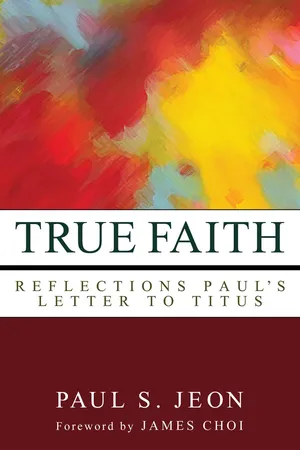
It is difficult today to discern much of a difference between Christians and non-Christians. The person who claims to be a Christian with saving faith seems no different from the one who claims otherwise. In this context, many are left wondering what true faith is. This brief study on Paul's letter to Titus addresses the question of what it means to be a genuine follower of Jesus Christ. May this book challenge you to explore afresh the necessity of pursuing good works in view of God's free gift of salvation!
- 64 pages
- English
- ePUB (mobile friendly)
- Available on iOS & Android
eBook - ePub
About this book
Information
Topic
Teologia e religioneSubtopic
Religione1
Introduction
Brief Background Comments to Titus
Saint Paul wrote this letter to Titus and the believers1 in Crete to help establish order among the churches and to remind them to call one another to live commendably in view of their hope of eternal life. Trouble was brewing among the churches with the increasing influence of rebellious and deceitful individuals who were upsetting the faith of many by teaching what they should not for greedy gain (1:101–1).2 From the outset, therefore, Paul highlights both his authority as a slave of God and apostle of Christ Jesus and his unique status in God’s plan of salvation as one who was entrusted with the very word of God (1:3). Moreover, for this reason the letter begins with a reiteration to Titus, Paul’s reliable colleague, to appoint elders in every town who will alongside Titus deal with the troublemakers (1:5).
While we do not have a great deal of information on Titus, Paul’s other letters indicate he was one of the apostle’s most trustworthy partners for gospel ministry. Galatians 2:3 suggests that Titus joined the apostle early on in Paul’s ministry. In 2 Corinthians (see 2:13; 7:6–16; 8:16–24) Titus seems to play the role of an intervention-specialist, addressing difficult issues among believers in Corinth and overseeing the special collection for the saints in need. In the letter addressed to him, Titus continues this role of carrying out Paul’s directives under precarious and difficult circumstances.
The quote by the Cretan prophet in 1:12 aptly summarizes the notoriety of Crete: “Cretans are always liars, evil beasts, and lazy gluttons.” Crete was an island located south of Greece and west of Asia Minor. It was an ideal location for sea trade and piracy and quickly became a place of debauchery, violence, gluttony, and duplicity. The Cretans were perhaps best known for their high claim of being the guardians of Zeus’s birthplace and tomb on Mount Ida. Thus, consistent with the infamy of Zeus himself, the Cretans earned the reputation of being proud liars who viewed lying as an admirable quality. This historical context helps explain Paul’s careful description of God as the one “who cannot lie” (1:2) and his repeated emphasis on living consistently with one’s embrace of the truth (1:1).
Key Themes
Paul’s letter to Titus can be summarized under five themes, which are covered by the acronym “TITUS”: (1) True Faith (1:1–4); (2) Irreproachable Leaders (1:5–16); (3) Theocentric Household (2:1–15); (4) Upright Citizens (3:1–8a); and (5) Steadfast Devotion to Good Works (3:8b–15). The chapters that follow will go into more detail on each theme. Here I want to discuss how these five themes are interconnected under the broader theme of “Exhorting and Reproving One Another to Good Works according to the Hope of Eternal Life.”
Paul never deviates in this letter from his gospel, which declares that a person is not saved by works but through faith in Jesus Christ. That is, salvation comes to those who do not trust in their own good works but believe that Jesus lived the life that they should have lived, died the death that they should have died, so that by his life, death, and resurrection they would share in the hope of eternal life. That Paul maintains this gospel message is reflected in his description of the letter’s recipients as “God’s elect” (those who have been chosen by God, 1:1) who have been redeemed through Christ’s self-sacrifice (2:14) not according to their righteous works but according to God’s mercy (3:5).
Nevertheless, there is a strong emphasis in this letter on living a life characterized by commendable works. Paul’s basic contention is that while a person is not saved by his good works, good works demonstrate that a person is truly saved. In other words, while good works do not result in salvation, they evidence the reality of one’s salvation. Specifically, in this letter Paul asserts that those who await the hope of eternal life (1:2; 2:13; 3:7) ought to exhibit lifestyles characterized by the renunciation of wickedness and the pursuit of godliness, expressed namely in a steadfast devotion to good works both inside and outside of the church. Such is the nature of true faith, which couples an embrace of the truth with the pursuit of righteousness.
Such a pursuit by those within a theocentric household, i.e., the community of faith united by its common hope, depends directly on mutual exhortation and reproof. Specifically, it depends on the exhortation and reproof of irreproachable leaders—in contrast to false teachers—who live commendably, especially within their own homes, and who hold fast to the word of truth that was first given through the apostle (1:5–9). These leaders model the kind of lifestyle and commitment to speaking truth that should be true for all who belong to the household of God.
Approach of the Study
Each theme in Titus will be explored from three angles: (1) Reflections on the Bible, (2) Reflections on Church, and (3) Reflections on Culture.
Reflections on the Bible
Chapters Two to Six each begins with a basic outline of the selected Bible passage. The...
Table of contents
- Title Page
- Foreword
- Preface
- Chapter 1: Introduction
- Chapter 2: True Faith
- Chapter 3: Irreproachable Leaders
- Chapter 4: Theocentric Household
- Chapter 5: Upright Citizens
- Chapter 6: Steadfast Devotion to Good Works
- Chapter 7: Conclusion
- For Further Study
Trusted by 375,005 students
Access to over 1.5 million titles for a fair monthly price.
Study more efficiently using our study tools.
Frequently asked questions
Yes, you can cancel anytime from the Subscription tab in your account settings on the Perlego website. Your subscription will stay active until the end of your current billing period. Learn how to cancel your subscription
No, books cannot be downloaded as external files, such as PDFs, for use outside of Perlego. However, you can download books within the Perlego app for offline reading on mobile or tablet. Learn how to download books offline
Perlego offers two plans: Essential and Complete
- Essential is ideal for learners and professionals who enjoy exploring a wide range of subjects. Access the Essential Library with 800,000+ trusted titles and best-sellers across business, personal growth, and the humanities. Includes unlimited reading time and Standard Read Aloud voice.
- Complete: Perfect for advanced learners and researchers needing full, unrestricted access. Unlock 1.5M+ books across hundreds of subjects, including academic and specialized titles. The Complete Plan also includes advanced features like Premium Read Aloud and Research Assistant.
We are an online textbook subscription service, where you can get access to an entire online library for less than the price of a single book per month. With over 1.5 million books across 990+ topics, we’ve got you covered! Learn about our mission
Look out for the read-aloud symbol on your next book to see if you can listen to it. The read-aloud tool reads text aloud for you, highlighting the text as it is being read. You can pause it, speed it up and slow it down. Learn more about Read Aloud
Yes! You can use the Perlego app on both iOS and Android devices to read anytime, anywhere — even offline. Perfect for commutes or when you’re on the go.
Please note we cannot support devices running on iOS 13 and Android 7 or earlier. Learn more about using the app
Please note we cannot support devices running on iOS 13 and Android 7 or earlier. Learn more about using the app
Yes, you can access True Faith by Jeon in PDF and/or ePUB format, as well as other popular books in Teologia e religione & Religione. We have over 1.5 million books available in our catalogue for you to explore.