eBook - ePub
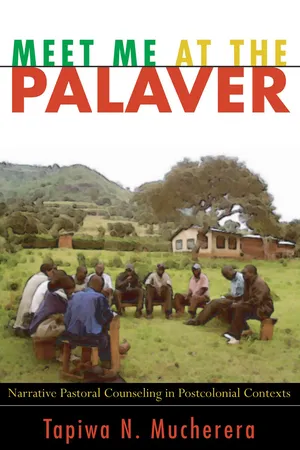
Meet Me at the Palaver
Narrative Pastoral Counseling in Postcolonial Contexts
- 152 pages
- English
- ePUB (mobile friendly)
- Available on iOS & Android
eBook - ePub
About this book
Meet Me at the Palaver makes the case for a particular approach to pastoral counseling as a response to the destructive impact of colonial Christianity on indigenous African communities. The book opens with stories of destructive change brought to indigenous contexts (such as Zimbabwe, Africa), wherein the culture, values, religion, and humanity of African peoples were often marginalized. Mucherera demonstrates that therapy or counseling as taught in the West will not always suffice in such contexts, since these approaches tend to promote and focus on individuality, autonomy, and independence. Counselors in indigenous contexts need to "get off their couch or chair" and into the neighborhoods--into those places made vulnerable to disease and poverty by the collapse of "the palaver" and other traditional institutions of social stability. Since storytelling was at the heart of the practices of the palaver and continues to be a way of life in African cultures, Mucherera argues for a holistic narrative pastoral counseling approach to assess and service the three basic areas of human needs in indigenous African communities: body, mind, and spirit.
Information
Topic
Theology & ReligionSubtopic
Christian Ministry1
Introduction
Remembering Our History, and Forging
Stories of a Hopeful Future
Stories of a Hopeful Future
“Mudzimu weshiri uri mudendere.”
(“The ancestry, roots, and survival of a bird are in its nest.”)
(“The ancestry, roots, and survival of a bird are in its nest.”)
—Shona proverb
“Usakanganwe chezuro ngehope” literally translates from Shona to mean, “Do not forget yesterday’s experiences because of a good night’s sleep.” Even in situations where one experiences a bad night, one does not forget other past experiences because of the night experience. A common saying among the Shona is, “When you forget your past, you will never know the truth.” For how can we know where we are going if we don’t know where we’ve come from or where we are presently located? When one loses the memories of one’s past, one is most likely to lose one’s present grounding, and ultimately one’s place of embeddedness in the future as well.
History is a contextual story. People create history out of stories rooted in their ancestry. Past stories, when weaved together with narratives from modern indigenous communities, contribute to the constructing or forming of both individual and communal identities. This chapter serves both as an introduction to the accounts of a common encounter of the indigenous peoples (colonization and Christianity) and as an introduction to the whole book (how the past and the present narratives of indigenous Africans can be woven together to create a hopeful future using narrative pastoral counseling). This book is about how narrative pastoral counseling—or how stories (personal, family, community, folk, biblical)—can be used in pastoral care and counseling to restore hope in contemporary indigenous communities such as Zimbabwe, despite stories of subjugation from the past, and in light of the present context of the HIV and AIDS pandemic, poverty, and other problems. The palaver (pachiara, padare), a traditional narrative-counseling approach common in many traditional indigenous settings and still present in many African contexts, will also be explored for how it could be reintroduced in most of today’s African contexts.1 As much as this book focuses on Africa, and more specifically on the Shona of Zimbabwe, the material it covers can be easily generalized to many of the indigenous contexts that experienced colonialism and who are faced with poverty and the HIV/AIDS pandemic. In order to understand the indigenous people’s story, one cannot ignore a people’s past historical experiences, since these still have great impact on the people today. Thus this book presents their struggles, and in the last chapters closes with how hope can be restored in such contexts as Zimbabwe. Finally, the work of African churches and communities will be highlighted—these beacons bringing hope to the grim context of poverty and the HIV/AIDS pandemic.
Indigenous People: A History in Synopsis
The contexts and life narratives of indigenous peoples have been a “mixed bag,” given that indigenous people have been viewed both as blessed and as the “wretched of the earth”2 due to imperialism. They are blessed in that these contexts have persevered and preserved a rich source of humanity’s traditional religiocultural values. Still today anthropologists study these communities to understand the origins of humanity’s traditional wisdom and ways of life. In most of these contexts where there was and is less “invasion,” they are still rich in natural resources and uncharted lands.
One of the root causes of the “wretchedness” of indigenous peoples came by way of subjugation through colonial imperialism. These stories are filled with pain and suffering. Today suffering continues under neocolonial governments, unjust economic structures (locally and globally), and the pandemic diseases, such as HIV and AIDS. However, these experiences of pain and suffering have not totally eroded the hope for a better future.
Survival is the dominant story one hears even in these desperate situations. As the old adage states, “In times of drought, the survival of a tree is in the depth of its roots.” History has taught indigenous people that there is always hope if they are rooted in God and remember that God always raises a “stump, the holy seed” (Isa 6:13). In these difficult situations, stories from precolonial and colonial times are shared, reminding the younger generation not to focus only on the painful neocolonial present, but to also imagine what the future would and will look like. Even under this inescapable net of neocolonialism, hope is found as indigenous people groups seek to remember the story of who they are as a people, and as they focus on alternative possibilities to the present story.
Surely, Simba, one of the strongest and wisest lions, knew who he was. But hunters, still searching for the extent of their boundaries, came to capture and dominate Simba. With guns aimed, they engulfed the lion in a large net made of complex systems of knots, the likes of which Simba had never before experienced. The hunters kept Simba trapped under the net for a very long time, all the while working to convince the great lion that he was no longer strong, that he was no longer wise. But Simba remembered his Father’s stories of how fast a younger Simba was able to run and how deep his sharp teeth could cut. Simba longed to run free again, and so he began using his teeth to gnaw through the captors’ net, bit by bit, until he was free. One big roar and the captors ran away. Simba stretched his muscles and rose up, but he found that he was not altogether free yet, for he had forgotten how to act as a free lion he had once been. He asked himself, “Who is Simba? Where is his home? What is Simba to be doing?” What will become of Simba? It took Simba time to remember what it meant to be a strong and wise lion of Africa. He had to walk the path he had once trod, but it was no longer the same. The path he had walked before his capture was now thick with mounds of grass. To take the same path the hunters had followed seemed foolish. Simba would have to create a new path and a new future.3
Much change has taken place in the religiocultural and psychological worldview of neocolonial indigenous nations, and more specifically in Africa, since the advent of Christianity and colonialism. Three different layers of stories exist in the African context: the precolonial or traditional, the colonial, and the post- or neocolonial stories. All three levels are important in addressing situations of narrative pastoral crisis intervention or counseling. The stories of precolonial or traditional times still form some of the foundations and are highly influential for indigenous people around the world. As much as the histories of most indigenous people were passed down orally, one cannot ignore this part of their story and expect to fully understand them.
The arrival of the colonialists marked the start of written history, since in these contexts history was passed down orally. Colonial history writers did not bother to include the oral history of the indigenous peoples. Written history, therefore, in most indigenous contexts was written or presented to the exclusion of precolonial eras. Some Westerners regard the stories of the indigenous people as an unnecessary inconvenience. It is as if they are saying, “If we could just rid them of their precolonial history and educate all the indigenous people to a Western way of life, then this world would be a better place.” A joke is usually shared about a colonizer who said: “Our country [the colonized country] would be a better place without you natives.” The colonizers forgot they were the foreigners. Besides distorting historical facts, another violation the colonists committed was taking native lands.
The Subjugation of Natives’ Land through Violence
From indigenous people colonizers stole land—one of the greatest resources, which native peoples held dear. The natives did not believe in owning the land, but instead saw it as a gift from the Creator. The land was guarded by the “living dead,” or ancestors, in order to feed the living. Of the Shona belief about the land Bourdillon says:
‘Ownership’ of the land by the spirits is bound up with the relationship between the spirits and the living community. The land forms a close and enduring bond between the living and the dead—through their control of the fertility of the land they once cultivated, the spirits are believed to continue to care for their descendants and the descendants are forced to remember and honor their ancestors. . . . The association between the spirits and the land is expressed in the tradition of chisi, days sacred to the spirits, on which people should not work the soil in any way.4
The earth is not “dirt” as it is referred to in the West, but was and still is the source of life. It is a generally held belief by most indigenous peoples that they were created out of “mother earth—the soil,” and from her they receive nourishment, livelihood, and their sustenance. When colonizers came, they did not live by these same values. Land, and all that was on it, was to be subdued and plundered for personal gain. The colonizers took the hospitality of the natives as stupidity. Musa W. Dube, a professor at the University of Botswana, relates the common story that she quotes from Mofokeng’s article on how the Africans lost their land in exchange for the Bible. Dube writes:
The story is held that ‘when the white man came to our country he had the Bible and we had the land. The white man said to us, ‘let us pray.’ After the prayer, the white man had the land and we had the Bible.’ The story summarizes the sub-Saharan experience of colonization. It explains how colonization was connected to the coming of the white man, how it was connected to the use of the Bible, and how the black African’s possession of the Bibl...
Table of contents
- Title Page
- Acknowledgments
- Preface
- Chapter 1: Introduction
- Chapter 2: Clashing Cultures and Ethical Values in the Age of HIV/AIDS
- Chapter 3: A Culture of Death
- Chapter 4: Signposts of Hope
- Chapter 5: The Palaver and Beyond
- Bibliography
Trusted by 375,005 students
Access to over 1.5 million titles for a fair monthly price.
Study more efficiently using our study tools.
Frequently asked questions
Yes, you can cancel anytime from the Subscription tab in your account settings on the Perlego website. Your subscription will stay active until the end of your current billing period. Learn how to cancel your subscription
No, books cannot be downloaded as external files, such as PDFs, for use outside of Perlego. However, you can download books within the Perlego app for offline reading on mobile or tablet. Learn how to download books offline
We are an online textbook subscription service, where you can get access to an entire online library for less than the price of a single book per month. With over 1.5 million books across 990+ topics, we’ve got you covered! Learn about our mission
Look out for the read-aloud symbol on your next book to see if you can listen to it. The read-aloud tool reads text aloud for you, highlighting the text as it is being read. You can pause it, speed it up and slow it down. Learn more about Read Aloud
Yes! You can use the Perlego app on both iOS and Android devices to read anytime, anywhere — even offline. Perfect for commutes or when you’re on the go.
Please note we cannot support devices running on iOS 13 and Android 7 or earlier. Learn more about using the app
Please note we cannot support devices running on iOS 13 and Android 7 or earlier. Learn more about using the app
Yes, you can access Meet Me at the Palaver by Tapiwa N. Mucherera in PDF and/or ePUB format, as well as other popular books in Theology & Religion & Christian Ministry. We have over 1.5 million books available in our catalogue for you to explore.