eBook - ePub
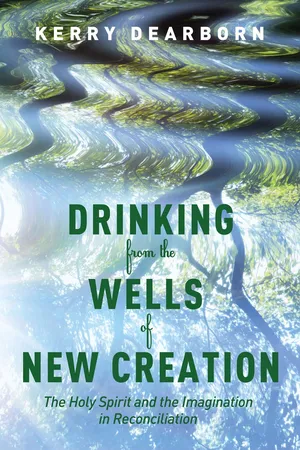
Drinking from the Wells of New Creation
The Holy Spirit and the Imagination in Reconciliation
- 172 pages
- English
- ePUB (mobile friendly)
- Available on iOS & Android
eBook - ePub
Drinking from the Wells of New Creation
The Holy Spirit and the Imagination in Reconciliation
About this book
"Dearborn provides us with the gift of deep insight into the heart of God and the ways of the Spirit to open our eyes, our hearts, our homes, and our lives to God and others. Through profound theological reflection interwoven with compelling stories, this book draws us into God's healing love and new creation. I pray God uses this great book to release the vision of Amos to which I've dedicated my life."
--John Perkins
author of Let Justice Roll Down
Information
Topic
Theology & ReligionSubtopic
Christian Theology1
The Reconciling God
[Reconciliation is God’s gift,] “because we cannot, on our own, become reconciled to God. It is the divine sacrifice of Jesus Christ on the cross that made reconciliation possible.”22
Radical Atonement
Much of the focus of studies and teaching on reconciliation, especially for Protestants, has been on the cross of Jesus Christ and the individual’s restored relationship with God.23 It is his sacrificial death that cleanses us from sin and creates the way for a new relationship with God the Father. Acknowledging the centrality of Jesus as the good news of who God is and what God has done is a vital emphasis. Both Barth and Bonhoeffer endeavored to correct theology that was losing this center and becoming more anthropocentric than theocentric. They discovered that a message focused more on human experience of God than the God of human experience can become dangerously manipulated for human ends, rather than leading to transformation into Christlikeness.24 Barth and Bonhoeffer worked to reclaim the centrality of Christ’s life, death, and resurrection for the church and its participation in God’s purposes for the world.
This Christ-centered emphasis correlates with the emphasis of much Christian theology throughout the ages. Paul stated, “I longed to know nothing but Jesus Christ and him crucified” (1 Cor 2:2).25 Luther stated, “true theology and recognition of God are in the crucified Christ. The cross of Christ is the only instruction in the Word of God there is, the purest theology.”26 Eberhard Jüngel wrote that “the basic aporia into which European theology has blundered” under the dictatorship of metaphysics is to “think of God without thinking of him simultaneously as the Crucified.”27 Miroslav Volf more recently affirmed Paul’s central focus on the cross as the basis from which Volf’s reflections on “exclusion and embrace” derive.28
However, there have been times in which certain views of the cross and certain Christ-centered emphases have been used to obscure the biblical focus on salvation as reconciliation with God and with others, and to marginalize the Holy Spirit in particular. As central and wondrous as the cross is to healing and restoring our relationship with God, problems arise when the cross is seen exclusively through the interpretive lens of penal substitution.29 Such framing of God’s work of salvation can both inhibit our willingness to trust a Father who demands such sacrifice and eclipse the union with God that Jesus’ life, death, and resurrection create. In other words, it can obscure the ontological reality that we are saved in and through our having become united with God in Jesus Christ.30
Rather, atonement begins in Jesus’ birth, when he comes to be one with us and to share fully in our frail humanity. Jesus is tempted in every way as we are, yet offers a perfect response of obedience on our behalf and in our place. Reconciliation is not merely the paying of a debt but the healing and re-creation of defiled humanity through Jesus’ uniting his life with ours, and turning our fleeing humanity, through his love and obedience, back toward the welcoming arms of the Father. Because our oneness with Christ begins with his birth and life,31 Paul clarifies that we share in his baptism and in his death.32 “We have been crucified with Christ, it is no longer we who live but Christ, and the life we now live, we live by the faith of him who loved us and gave his life for us” (Gal 2:20).
If we are going to let reconciliation bear its real fruit in our lives, we must accept that these are no longer our lives, that we have died, and the life we live is Christ’s alone. Thus, Christians are not merely justified by grace, but transformed by grace, for we have been put to death by grace and given a new life and identity.33 Even so, the Holy Spirit is to be honored as the one who indwells God’s people and enlivens us to live as those who have been re-created in Christ and are in the process of being recreated daily. As Christoph Schwöbel writes, “The Spirit is the transforming power that allows believers to participate in Christ’s way from death to life and so establishes, on the basis of the reconciliation achieved in Christ, a relationship to the love of God in Christ that cannot be broken by any power, not even by the most powerful cosmic forces.”34
Three Moments of Salvation
Creation in God’s Image
Because Karl Barth took so seriously the revelation of God in Jesus Christ, he understood salvation as being composed of three great moments of God’s work among us. Jesus points continually to the Father and the Father’s great love. Salvation, seen as communion with God, begins when God from all eternity chooses to create us as part of God’s own people.35 Creation instantiates the first moment of salvation, with grace, freedom, and intimate relationship for humans with God.36 Human identity is stamped with God’s own regal image, with the gift of participation in God’s gracious rule and creativity. As Rikk Watts writes, “the biblical language indicates that all human beings—not just the Pharaohs of Egypt—in their physicality, their maleness and femaleness, and their interplay between individual and collective, are intended to be living pictographs of Yahweh the Creator, enlivened by his breath . . . and ultimately by his indwelling Spirit.”37 Shalom with God, with others, and with all creation offers a hopeful image of God’s saving intentions in this first moment of creation.
Wonderful Exchange in Christ
Barth describes Jesus’ life, death, and resurrection as the second aspect of salvation since God’s original gift of shalom was shattered by humans who refused grace. “And this is our rebellion: the fact that we want everything, all that is noble, helpful and good . . . but not this thing, namely, to allow ourselves to be made open, prepared and made fit for God by God. Grace is God’s sovereign realm. But our enmity toward God . . . the evil that we do; this precisely is our hostility toward Grace. . . . We cannot abide deity.”38 As Bonhoeffer writes, we have claimed a false identity of “sicut deus” rather than “imago Dei.”39
Not content to trust God and God’s ways, humans have asserted their own self-defined identity and the pretense that they could be “like God” making their own judgments as “authors” of their own lives. J. R. R. Tolkien offers a powerful depiction of such hubris in The Silmarillion with Melkor, who is not content to draw his life and creativity from the flame of the One, Iluvatar. He withdraws to the barren places to seek his own autonomous source of life and creativity, and thus provokes dissonance and distortion. As with human history, dominance and oppression become Melkor’s ways, rather than loving resonance with God’s gracious creativity.40
God’s intentions of shalom for humankind...
Table of contents
- Title Page
- Acknowledgments
- Introduction
- Chapter 1: The Reconciling God
- Chapter 2: Who Is the Holy Spirit and How Does the Spirit Effect Reconciliation?
- Chapter 3: Gifts from the Holy Spirit for Reconciliation
- Chapter 4: The Holy Spirit’s Work of Reconciliation through the Imagination
- Chapter 5: The Imagination’s Third Way
- Chapter 6: Facing the Shadows
- Chapter 7: Signposts and Oases of the New Creation
- Bibliography
Trusted by 375,005 students
Access to over 1.5 million titles for a fair monthly price.
Study more efficiently using our study tools.
Frequently asked questions
Yes, you can cancel anytime from the Subscription tab in your account settings on the Perlego website. Your subscription will stay active until the end of your current billing period. Learn how to cancel your subscription
No, books cannot be downloaded as external files, such as PDFs, for use outside of Perlego. However, you can download books within the Perlego app for offline reading on mobile or tablet. Learn how to download books offline
Perlego offers two plans: Essential and Complete
- Essential is ideal for learners and professionals who enjoy exploring a wide range of subjects. Access the Essential Library with 800,000+ trusted titles and best-sellers across business, personal growth, and the humanities. Includes unlimited reading time and Standard Read Aloud voice.
- Complete: Perfect for advanced learners and researchers needing full, unrestricted access. Unlock 1.5M+ books across hundreds of subjects, including academic and specialized titles. The Complete Plan also includes advanced features like Premium Read Aloud and Research Assistant.
We are an online textbook subscription service, where you can get access to an entire online library for less than the price of a single book per month. With over 1.5 million books across 990+ topics, we’ve got you covered! Learn about our mission
Look out for the read-aloud symbol on your next book to see if you can listen to it. The read-aloud tool reads text aloud for you, highlighting the text as it is being read. You can pause it, speed it up and slow it down. Learn more about Read Aloud
Yes! You can use the Perlego app on both iOS and Android devices to read anytime, anywhere — even offline. Perfect for commutes or when you’re on the go.
Please note we cannot support devices running on iOS 13 and Android 7 or earlier. Learn more about using the app
Please note we cannot support devices running on iOS 13 and Android 7 or earlier. Learn more about using the app
Yes, you can access Drinking from the Wells of New Creation by Kerry Dearborn in PDF and/or ePUB format, as well as other popular books in Theology & Religion & Christian Theology. We have over 1.5 million books available in our catalogue for you to explore.