eBook - ePub
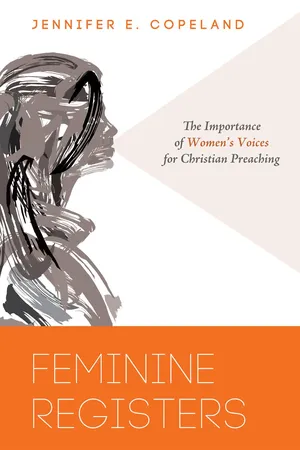
Feminine Registers
The Importance of Women’s Voices for Christian Preaching
- 168 pages
- English
- ePUB (mobile friendly)
- Available on iOS & Android
eBook - ePub
About this book
Women have been adding their voices to the proclamation of the gospel for as long as there has been a gospel to proclaim, but only in the last half-century have these voices become part of the official catalogue of Christian preaching. Diagnosing the distinctiveness of women's voices and exploring the richness they convey about the presence of God requires a detailed look at the meaning-making strategies used by those who preach and those who listen. Register provides a tool for analyzing not only the theological and semantic contributions of women, but also demonstrates how gender impacts the meaning-making possibilities of the sermon. Feminine Registers offers a gendered analysis of preaching that does not rely on essentialist claims about gender and moves the analysis of the preaching beyond sermon content to include the relational dynamics operating between the communicating parties and the medium used to communicate. A critical examination of this constellation of meanings, influenced by gender-related issues of authority and self-disclosure, helps illuminate the production of meaning within the church and expands the homiletical possibilities for the Christian faith.
Information
Subtopic
Ministère chrétien1
Women Then—How We Got Here
“Preach if you must, but don’t call it that!”1
From the moment Mary Magdalene proclaimed, “I have seen the Lord,” women have been preaching the gospel. More often than not, as John Wesley intoned to Sarah Crosby, they have not called it that. The struggle over whether women might legitimately and authoritatively preach the gospel begins with the first proclamation of the resurrection and continues into the present through a series of dueling definitions and juxtaposed job titles. Over the centuries women have proved exceedingly creative at working around the restrictions placed upon them. When women were not allowed to preach, they renamed their pronouncements prophecy. When women were cloistered from society, they emerged as teachers. When women were denied access to the pulpit, they testified from the pew.
In a twist of nomenclature, when the prophesying, teaching, or testimony of women was at odds with church prescriptions, those opposed to what the women had to say would accuse them of preaching. Such a charge could then be used to silence their voices even though the women had taken great care to label their discourses according to the acceptable precepts of their day. Thus, not only were women told repeatedly that they could not preach, they were also silenced with the charge of illegitimate preaching. Such semantic maneuvering did little to keep women “silent in the churches” (1 Cor 14:34). Indeed, the subject of silence would never have been mentioned in the First Letter to the Corinthians if the women had not been speaking out.
Next to presiding over the Eucharist, the component of worship most vested with claims to authority is preaching. Historically, the church has understood God’s word to be present in the act of preaching through the preacher and in the words preached, thereby investing the person of the preacher with extraordinary significance. An attempt to reconstruct, in broad strokes, how and when women functioned as preachers—whether they called it that or not—in the earliest centuries of the church can provide clues for how certain attitudes toward women have become entrenched in church tradition. Obviously, the roles women constructed for themselves, as well as the parts that were scripted for them by others, continue to inform our opinions about women as preachers in the church today. A closer look at this history can help us understand some of our current practices and some of our ingrained assumptions, but more importantly it can move us all, men and women, toward a more faithful construction of the Christian community in which “there is no longer Jew or Greek, there is no longer slave or free, there is no longer male and female” (Gal 3:28).
Assumptions
The case has been made repeatedly that women occupied Jesus’ inner circle, they worked alongside their male counterparts to spread the gospel in the first decades of Christianity, and they died alongside men as early Christian martyrs.2 The question, therefore, is not whether women participated in church leadership, including preaching, but what brought about their exclusion and why did it happen? Though the leadership of women in the church was never free from contestation, the progression of the church through the first few centuries shows a regression of women from leadership in the life of church. Mapping this reality will help us understand the ramifications of this systematic exclusion for women preachers today.
In order to understand when and how women participated in the proclamation of the word during the first few centuries of the church, it is first necessary to know something about preaching during those years. While the New Testament contains speech fragments that might broadly be defined as sermons, there is no extant sermon recorded in scripture.3 Even Jesus’ Sermon on the Mount is widely acknowledged to be a compilation of sayings, to say nothing of the fact that assigning the designation of “Christian preaching” to the one who inaugurated Christianity creates a different dilemma. The speeches of Paul and some of the other apostles cataloged in the Acts of the Apostles might be claimed as missionary sermons, yet nearly all of them follow a similar formula that indicates more about what an early church sermon should be than the text of a specific sermon. From these sermons we can infer that preaching during the first few decades of the church began with a section from the Hebrew Bible, added the claim that Jesus represents the fulfillment of that promise as verified by the witness of the apostles, and concluded with a call for those listening to repent and believe. This basic outline was repeated in large assemblies (Acts 2:14ff.) and secluded areas (Acts 16:13ff.), to hostile crowds (Acts 7:2ff.) and receptive audiences (Acts 11:19ff.).
Sparse information about preaching in the early decades of Christianity is compounded by the paucity of information about women during this time. We learn about the role of women in the first few centuries of the church primarily from three kinds of sources.4 The first source, official documents such as council canons and church orders, provides valuable information about women’s leadership roles by virtue of describing the church’s official position on women and prescribing the roles for women in the church. Examples of such official statements include 1 Timothy 3 and later documents such as the Apostolic Tradition5 and Didascalia Apostolorum. These sources should be considered very close to the reality for women during the time period they were composed, or at least close to the church’s official policy, even if local practices might have reflected a slightly different reality.
The next source is less reliable as an authentic depiction of women. It includes popular narratives and celebratory accounts of women, both fictitious and historical, and tells us more about the social construction of women. The women in these accounts are presented as heroines of the faith, heroism often taking the guise of defying the cultural expectations for women in favor of ascetic purity. Often the script reflects popular Hellenistic literature of the time, replete with exotic travel, dangerous barbarians, and daring rescues. At the end of these stories, however, union with one’s beloved is replaced by a life of “inspiring virtue.”6 The Acts of Paul and Thecla and stories about Maximilla, a leader in the New Prophecy,7 figure prominently in this category.
The final category, formal theological works, provides descriptions of women that reflect the author’s model of ideal womanhood. While generally positive, material in this category can be couched negatively so as to link theological distinctions between sin and salvation with women’s bodies. Examples of this source include biographies such as The Life of Saint Macrina or The Life of Melania, the Younger, both of which provide examples of the “purity” of women who avoid sexual activity.
Within the category of formal writing there are only four texts from these early centuries believed to have been written by women,8 and only one of them, The Martyrdom of Perpetua and Felicitia, relates explicitly to the role of women in ecclesiology. The other three are not overtly ecclesial: The Martyrdom of St. Cyprian,9 written by Eudokia, the wife of a high-ranking court official in the first half of the fifth century; The Pilgrimage of Egeria,10 by a woman who apparently occupied the highest social strata of the late fourth or early fifth century; and Cento,11 written in the middle of the fourth century by Faltonia Proba. The fact that we can name all four of these texts also accentuates the paucity of material available about the early church from the women themselves.
The value of these writing samples is, chiefly, to demonstrate the difference between how women write about themselves and how men write about women. This is seen clearly in The Martyrdom of Perpetua and Felicitia. Unlike the other three writings, this text, dating from the early third century, describes a specific ecclesial subject. Embedded within the narrative is a first-person account of the events leading up to the martyrdom of Perpetua and those who were martyred with her. The work is an intimate and detailed account of the environment of the early church, specifically from the perspective of a woman. Her refusal to recant the Christian faith demonstrates her rejection of conventional society in order to make Christianity the highest claim on her life. The text vividly portrays how this rejection was not a callous disregard for those around her. In fact, Perpetua writes with great pathos of the pity she felt for her father, who “was the only member of my family who would find no reason for joy in my suffering.”12 The most poignant parts of the narrative, however, deal with Perpetua’s love for her child. She writes of the terror she felt for the health and safety of the child and the tra...
Table of contents
- Title Page
- Acknowledgments
- Introduction
- Chapter 1: Women Then—How We Got Here
- Chapter 2: Women Now—The Current Situation
- Chapter 3: What, Who, and How —The Real Meaning
- Chapter 4: Sermon Registers at Work
- Chapter 5: Listening for the Register
- Chapter 6: A New Register
- Bibliography
Trusted by 375,005 students
Access to over 1.5 million titles for a fair monthly price.
Study more efficiently using our study tools.
Frequently asked questions
Yes, you can cancel anytime from the Subscription tab in your account settings on the Perlego website. Your subscription will stay active until the end of your current billing period. Learn how to cancel your subscription
No, books cannot be downloaded as external files, such as PDFs, for use outside of Perlego. However, you can download books within the Perlego app for offline reading on mobile or tablet. Learn how to download books offline
Perlego offers two plans: Essential and Complete
- Essential is ideal for learners and professionals who enjoy exploring a wide range of subjects. Access the Essential Library with 800,000+ trusted titles and best-sellers across business, personal growth, and the humanities. Includes unlimited reading time and Standard Read Aloud voice.
- Complete: Perfect for advanced learners and researchers needing full, unrestricted access. Unlock 1.5M+ books across hundreds of subjects, including academic and specialized titles. The Complete Plan also includes advanced features like Premium Read Aloud and Research Assistant.
We are an online textbook subscription service, where you can get access to an entire online library for less than the price of a single book per month. With over 1.5 million books across 990+ topics, we’ve got you covered! Learn about our mission
Look out for the read-aloud symbol on your next book to see if you can listen to it. The read-aloud tool reads text aloud for you, highlighting the text as it is being read. You can pause it, speed it up and slow it down. Learn more about Read Aloud
Yes! You can use the Perlego app on both iOS and Android devices to read anytime, anywhere — even offline. Perfect for commutes or when you’re on the go.
Please note we cannot support devices running on iOS 13 and Android 7 or earlier. Learn more about using the app
Please note we cannot support devices running on iOS 13 and Android 7 or earlier. Learn more about using the app
Yes, you can access Feminine Registers by Jennifer E. Copeland in PDF and/or ePUB format, as well as other popular books in Théologie et religion & Ministère chrétien. We have over 1.5 million books available in our catalogue for you to explore.