eBook - ePub
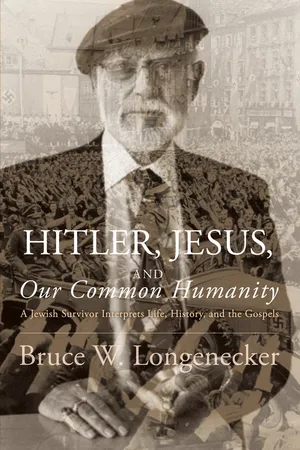
Hitler, Jesus, and Our Common Humanity
A Jewish Survivor Interprets Life, History, and the Gospels
- 202 pages
- English
- ePUB (mobile friendly)
- Available on iOS & Android
eBook - ePub
Hitler, Jesus, and Our Common Humanity
A Jewish Survivor Interprets Life, History, and the Gospels
About this book
This book follows the journey of a Jew who fled Nazi Germany but could not exorcise its evils from his theological and literary imagination. Having spent his early years trying to escape from his encounters with Nazism, Rolf Gompertz spent his later years trying to interpret the contours of evil that he had experienced in Hitler's Germany.
The spiritual journey of Rolf Gompertz offers intrigue, instruction, and challenge. It is the story of how a small Jewish boy, cowering under the talons of prejudice and protected only by the love of his parents, emerged to craft a life that directly refuted the ideology that propped up the power structures of Nazi Germany.
Along the way, Gompertz came to recognize in the folds of the Christian Gospels the story of another Jew who had stood in opposition to a similar configuration of ideology and power. In retelling that story as a committed Jew, Gompertz offered a robust "response to Hitler"--a refutation of the malevolent forces that seek to dismantle "our common humanity."
Information
Part 1
Kristallnacht: The Narrative
1
November 7, 1938
Bismarckstrasse 118, Krefeld, Lower Rhineland, Germany;
10:15 PM
“Why did he have to be a Jew?”
“Who?” asked Selma Gompertz. She stopped dusting the stairway banisters and joined her husband in the parlor of their apartment, located on the second and third floors of Bismarckstrasse 118. “Do you mean Jesus of Nazareth?” she proposed with a smile.
“No, no. I’m being serious. Listen to the radio. A Jewish boy shot a German diplomat in Paris . . . a man named vom Rath.”
Selma’s face darkened abruptly as she seated herself on the floor by her husband’s side. “Is he dead?”
“No. At least, not yet.”
Oskar turned up the volume on the parlor radio, slightly. The two listened carefully until martial music began to play. He turned the radio off.
“Who was the shooter?” asked Selma.
“Grynszpan. Herschel Grynszpan. He’s only seventeen. His parents are Polish Jews who were being deported from Germany with about 15,000 others. Apparently they’re caught up in that mess at the border, and Grynszpan became angry about it. The Poles don’t want any Jews back, you know, and now that group of Jews is in limbo between Germany and Poland. Neither country is accepting them.”
Selma nodded. “Nobody wants them.”
“Nobody wants us, you mean.”
“Don’t take this too far, Oskar,” said Selma, softly.
“Too far? You heard how angry that radio announcer was.”
“Well, that boy Grynszpan had no business shooting a helpless man.”
“I never said that he did,” said Oskar. “I just wished he wasn’t a Jew. If vom Rath dies, things will get worse for us than they already are.”
Suddenly nervous, Selma cast a look at the stairway leading up to her son’s third-floor bedroom. “At least it was in Paris and not Berlin,” she said. “And the shooter’s only seventeen and the son of immigrants. It’s not like a German Jew did this.”
“Selle, think about it for a minute. He’s a Jew and he shot a German diplomat. It doesn’t matter that it happened in Paris. You know what the Nazis will do with this. Have you forgotten the Jewish boy from America they executed last June?”
“They didn’t do that simply because he was Jewish. He was a radical, conspiring to assassinate Hitler.”
Oskar left his upholstered chair and began to pace. “And now a Jewish boy shoots vom Rath in cold blood in his office. If that man dies, Selle, it will be a Jewish crime. And in case you’ve forgotten, we are Jews.”
Selma smiled. “I’ve not forgotten, Oskar.” Selma led her husband to a wooden chair where she removed a bandage from his right eye to examine the incisions he received from a minor surgery in the previous week.
“You see what is happening, don’t you?” Oskar said, tilting his head backward as she performed her short inspection.
Selma stiffened, and said nothing. She was not blind, but neither was she one to abandon hope easily.
Released from his wife’s examination, Oskar walked to his parlor window to watch from the second floor as a stream of taillights passed along the rain-slicked street below. His town had blossomed under Hitler, as had the whole of Germany. For that he was glad, but while prosperity blossomed for some, it was often different for most Jews.
“You’ve seen the placards against Jews that are plastered all throughout the city,” said Oskar. “Hideous, insulting cartoons.”
“Of course. I try to make sure that Rolf doesn’t see them.”
“They’re getting worse,” said Oskar. “Every week there are new ones, and every week they become increasingly blatant in condemning us.” He shook his head. “I saw enough hatred in the trenches of the Great War to last ten lifetimes. It scares me, Selle, how hatred can grab hold of people and erode any sense of their common humanity.”
Selma went to her husband. “There is always hope, Oskar, and we Jews never abandon hope.”
Her hand slipped into his. Oskar was silent, and continued looking out the window. She tugged at his arm, trying to pull him back into the room. He turned to her, gave a gentle smile, but he didn’t budge. When she put her full weight into it, the pair lurched awkwardly into the room, stumbling over each other until they both landed on the familiar comfort of the old davenport sofa. Selma tossed her head back in laughter, while Oskar pulled the right side of his suit coat out from under his hip.
Selma reached over and adjusted Oskar’s tie. “We must cling to moments of hopefulness, Oskar. Some of those placards have been ripped down. Frau Probst baked us a Strudel last week. And your eye doctor . . . he’s not a Jew, but he keeps you as a patient.”
“Selle, you are burying your head in the sand. You hear the radio; you read the newspaper!”
“Maybe the soup is not always served as hot as it’s cooked.”
Oskar closed his eyes and drew a deep breath. “Selle, think about it. Even your good friend Trude won’t allow Doris to play with Rolf anymore. The boundaries of society are being redrawn, Selle, and we Jews are on the outside.”
“But Trude probably didn’t want to keep Doris away from Rolf.”
Oskar turned toward his wife. “You are a good woman, Selle. But don’t let hope cloud your judgment. Remember that awful parade when Jews were mocked? What did our neighbors do?”
“Yes,” replied Selma quietly, “they laughed.”
“They enjoyed watching Jews being mocked. Our neighbors did that! And last week you told me that Frau Merkel won’t buy her family’s food from Baum’s Deli anymore. Then there’s Pfarrer Schmidt from the Lutheran church; he’s been one of the ‘Brown Shirts’ doing Hitler’s dirty work against Jews for the past five years. And, of course, you remember the incident in the swimming pool when Rolf nearly died!”
“Yes, yes, I remember,” clipped Selma. “I will never forget the look in Rolf’s eyes when he told me about it. He was so confused.”
Oskar shifted uneasily in his place, then self-consciously touched his bandage. “I just want us to be realistic about all this.”
Selma nodded. “I understand, Oskar. But I still believe they will only let it go so far and no further.”
“You believe, or you hope? And haven’t they already gone too far already?” Oskar sighed, heavily. “I really do wish I could see things your way, Selle, and I will try to hope for the best. But I’ll never forget my Papa reading that Viennese archbishop’s speech in the newspaper: ‘The Catholic bishops promise their cooperation with National Socialism.’ Their cooperation, Selle. If Christian leaders are supporting all this, why should we expect our neighbors to be any different?”
Selma reluctantly released some information of her own. “One of Rolf’s school mates called him an ‘alien’ the other day—a ‘non-Aryan guest’ of Germany,” she said, her...
Table of contents
- Title Page
- Acknowledgments
- Abbreviations
- Introduction
- Part 1: Kristallnacht: The Narrative
- Chapter 1: November 7, 1938
- Chapter 2: Early Night, November 9, 1938
- Chapter 3: Deep Night, November 9–10, 1938
- Chapter 4: Early Morning, November 10, 1938
- Part 2: Kristallnacht: Before and After
- Chapter 5: The Immediate Aftermath of Kristallnacht
- Chapter 6: Before Kristallnacht
- Chapter 7: Interpreting the Gompertz Kristallnacht
- Part 3: Crafting a Contribution
- Chapter 8: Crafting a Jewish Life
- Chapter 9: Crafting a Literary Corpus
- Part 4: The Gompertz Jesus-Novel
- Chapter 10: Corollaries of Violence
- Part 5: The Voice of Rolf Gompertz
- Chapter 11: Speeches of the Heart
- Chapter 12: An Appreciation
- Part 6: Gompertz in His Own Words
- Chapter 13: Snapshots
- Chapter 14: Rolf Gompertz’s First Diary, Extracts
- Chapter 15: Rolf Gompertz’s Second Diary, Extracts
- Chapter 16: Rolf Gompertz’s Third Diary, Extracts
- Bibliography
- Appendix 1: Who am I to Write This Book?
- Appendix 2: A Reading of Matthew 27:25: “His blood be on us and on our children”
- Appendix 3: Further Reading
Trusted by 375,005 students
Access to over 1.5 million titles for a fair monthly price.
Study more efficiently using our study tools.
Frequently asked questions
Yes, you can cancel anytime from the Subscription tab in your account settings on the Perlego website. Your subscription will stay active until the end of your current billing period. Learn how to cancel your subscription
No, books cannot be downloaded as external files, such as PDFs, for use outside of Perlego. However, you can download books within the Perlego app for offline reading on mobile or tablet. Learn how to download books offline
Perlego offers two plans: Essential and Complete
- Essential is ideal for learners and professionals who enjoy exploring a wide range of subjects. Access the Essential Library with 800,000+ trusted titles and best-sellers across business, personal growth, and the humanities. Includes unlimited reading time and Standard Read Aloud voice.
- Complete: Perfect for advanced learners and researchers needing full, unrestricted access. Unlock 1.5M+ books across hundreds of subjects, including academic and specialized titles. The Complete Plan also includes advanced features like Premium Read Aloud and Research Assistant.
We are an online textbook subscription service, where you can get access to an entire online library for less than the price of a single book per month. With over 1.5 million books across 990+ topics, we’ve got you covered! Learn about our mission
Look out for the read-aloud symbol on your next book to see if you can listen to it. The read-aloud tool reads text aloud for you, highlighting the text as it is being read. You can pause it, speed it up and slow it down. Learn more about Read Aloud
Yes! You can use the Perlego app on both iOS and Android devices to read anytime, anywhere — even offline. Perfect for commutes or when you’re on the go.
Please note we cannot support devices running on iOS 13 and Android 7 or earlier. Learn more about using the app
Please note we cannot support devices running on iOS 13 and Android 7 or earlier. Learn more about using the app
Yes, you can access Hitler, Jesus, and Our Common Humanity by Bruce W. Longenecker in PDF and/or ePUB format, as well as other popular books in History & Social Science Biographies. We have over 1.5 million books available in our catalogue for you to explore.