- 218 pages
- English
- ePUB (mobile friendly)
- Available on iOS & Android
eBook - ePub
About this book
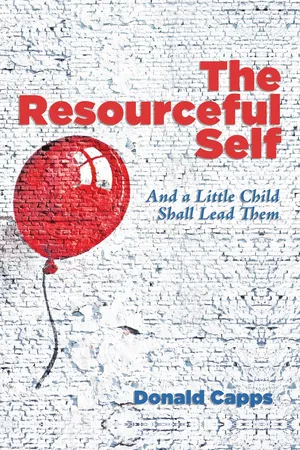
Erik Erikson, best known for his life-cycle theory and concept of the identity crisis, proposed that we are comprised of a number of selves. In several earlier books, including At Home in the World, Donald Capps has suggested that the emotional separation of young children--especially boys--from their mothers results in the development of a melancholy self. In this book, Capps employs Erikson's assignment of an inherent strength to each stage of the life cycle and proposes that the life-enhancing strengths of the childhood years (hope, will, purpose, and competence) are central to the development of a resourceful self, and that this self counters the life-diminishing qualities of the melancholy self.
Focusing on Erikson's own writings, Capps identifies the four primordial resources that Erikson associates with childhood--humor, play, dreams, and hope--and shows how these resources assist children in confronting life's difficulties and challenges. Capps further suggests that the resourceful self that develops in childhood is central to Jesus' own vision of what we as adults may become if we follow the lead of little children.
Information
Topic
PsychologieSubtopic
Psychologie du développementI
Reconciling Selves
1
The Melancholy Self
In my book Men, Religion, and Melancholia I focused on four authors—all men—who wrote texts that have been central to the course I teach on the psychology of religion.1 These men and their texts are William James, author of The Varieties of Religious Experience; Rudolf Otto, author of The Idea of the Holy; C. G. Jung, who wrote Answer to Job; and Erik H. Erikson, who authored Young Man Luther.2 I use these texts in my course on psychology of religion because viewed together they provide students with a sense of what counts as important work in the psychology of religion, of what its major preoccupations have been, and of how the psychology of religion has been shaped by modern Western religion, reflecting its preoccupations.
I also suggest to students that they read these four books as, in a sense, autobiographical, because the four authors appear to be writing about issues that concern them personally. Unlike most texts—and certainly textbooks—in the psychology of religion, these four seem to have been written with considerable self-investment. Their authors were not simply writing about religion but struggling to articulate their own stake in religion, its personal meaning and significance for them. While these books are not overtly autobiographical, I suggest nonetheless that we look for what Erikson calls “the sense of ‘I’” in them,3 to discern the ways each author locates himself in the text. What makes this proposal natural is that I always start the class with James’s Varieties and point out that James included autobiographical material in his chapter “The Sick Soul” but concealed his identity, so that his original readers may not have known that the account was his own.4 This serves to illustrate my point that the authors are in their texts, but often surreptitiously or in disguise.
This illustration, however, enables me to make another, related point. James begins his autobiographical account with the claim that “the worst kind of melancholy is that which takes the form of panic fear,” and suggests that the case he is about to relate is “an excellent example.”5 Over the years leading up to the writing of Men, Religion, and Melancholia, I had been slowly evolving an argument that I presented in the book alongside the four authors’ own arguments regarding religion, one that derived from the view that these texts reflected the personal interests and struggles of their authors. This argument consisted of two interrelated points. The first is that each author was struggling with the relationship between religion and psychopathology, but, more specifically, the psychopathology they knew as melancholy. For reasons that I made clear in the course of the book, I indicated my preference for the word melancholy over the more contemporary term depression. I also suggested that when one discovers the “sense of ‘I’” in these texts, one finds that this is a melancholic I, one that is acquainted not only with sadness and a sense of loss but also with feelings of abandonment, despair, rage, fury, and perhaps even hate.
The second interrelated point of my argument was that the melancholy may be traced, ultimately, to the author’s relationship with his own mother. The sadness, despair, and rage characteristic of melancholy have an object, and in these four cases this object is the author’s mother. This point is more difficult to establish, as none of the authors writes about his relationship to his mother. But this, I suggest to students, is precisely where their own capacities as psychologists of religion come in. It becomes their task to try to understand how religion serves as a stand-in for the mother, or for the son’s relationship to his mother, and how, within his mature views on religion, there is a personal prehistory, as it were, that has to do with this relationship. Thus, a book in the psychology of religion needs to be read psychologically, and one way to do this is to read it as a text in which the author is searching in religion for the lost object who is his natural mother as he experienced her in infancy and the earliest years of childhood. An assumption that lies behind this argument is that one would not have become so personally invested in religion had one not experienced as a child the emotional loss of one’s intimate relationship with one’s mother.
I also argued that for these four authors this emotional loss of their intimate relationship with their mothers when they were small boys had complications that, while not unique, are not necessarily the experience of all children. There were traumas associated with the loss that were perhaps more severe, or more deeply felt, than is usually the case. A commonplace of the developmental literature is talk about the boy’s separation from his mother in early childhood, and it is typically noted that the boy’s separation may be more decisive or thoroughgoing than the girl’s, as he needs to achieve gender differentiation from his mother and to identify with his father instead. Thus, separation is assumed, and it is considered normal, therefore, that all boys will feel a sense of loss. But I believe that this natural separation process was more traumatic for these four boys than is normally the case (for example, Jung’s mother was hospitalized for several months when he was three years old), and that the trauma of separation disposed these four boys to melancholia, on the one hand, and toward a certain receptivity to religion, on the other.
In Men, Religion, and Melancholia, I suggested that the boy experiences in fact two losses in this regard. One is that the boy experiences a loss of his mother: even though she is still present, and the two of them continue to relate to each other, he has in a sense lost the mother he had previously experienced, the mother who held him close and made no effort to help him achieve the separation. The other loss concerns himself as the boy who has lived in the aura of his mother’s unmitigated love and has experienced himself as her beloved son. In the process of separation, this self-image proves untenable and altogether too simplistic. The boy finds it necessary to separate from the original boy so as to become a different boy, a boy who will not take his mother’s unmitigated love for granted. The new boy feels—and rightly so—that his mother’s love now needs to be earned, that her love is no longer an unconditional love. If the separation is fraught with unusual anxiety, the loss both of his original mother and of his original self will create a disposition toward melancholia.
I believe that Erik Erikson is correct when he observes that young adulthood allows for a return to one’s origins, and especially for a revisiting of the separation process, in search of grounds for trust and reassurance. At this time, the fact of the young man’s disposition to melancholia may become evident to himself, whether or not he uses the actual word melancholia. He discovers within himself an unexplainable sadness, exacerbated, but not fully accounted for, by broken relationships, difficulties in finding what he wants to do with his life, and so on. He also discovers within himself a silent anger, even rage, he did not know was there, and he has great difficulty understanding its source, because the frustrations he encounters in his struggle to come into his own do not seem to warrant such depth of feeling, such negative affect. However, the way he now relates to his mother, if she is still living, is a clue to its source, as he has feelings toward her that are disproportionate to her actual provocations. Such feelings are rooted, I suggest, in the early separation process, when he lost her unconditional love, and experienced the unbridgeable gulf that separated him from the child he was before the separation.
The argument that I am making here raises an issue that needs to be addressed with the utmost sensitivity. At the time I was writing Men, Religion, and Melancholia, various authors were cautioning us against the tendency of an earlier generation of psychologists to blame mothers for whatever may have gone wrong in a child’s formation. While her role in such formation is certainly formidable, the tendency to blame mothers for “poor outcomes” (however defined) was being challenged—and appropriately so, for we know so little about what makes a child turn out well or badly. This explicit or implicit attack on mothers was being recognized for what it was: a social and cultural prejudice against women and against the social involvements and responsibilities typically associated with women. Also, as all four of the male authors discussed in the book had succeeded in life, the issue of where to place the blame was, in a sense, beside the point.
Yet, the issue of blame could not be so easily dismissed, because it had importance within the mother-son relationship itself. Whether mothers are to blame for how their boys turn out was, in my view, a nonissue, a fallacy I did not wish to perpetuate. But the issue of blame was a very important one in terms of the relationship between this mother and this son, as there is e...
Table of contents
- Title Page
- Preface
- Acknowledgments
- Part 1: Reconciling Selves
- Chapter 1: The Melancholy Self
- Chapter 2: Dual Mothers and Artistic Inhibition
- Chapter 3: The Resourceful Self
- Part 2: The Primordial Resources
- Chapter 4: The Ease of Humor
- Chapter 5: The Power of Play
- Chapter 6: The Beneficence of Dreams
- Chapter 7: The Promise of Hope
- Epilogue
- References
Trusted by 375,005 students
Access to over 1.5 million titles for a fair monthly price.
Study more efficiently using our study tools.
Frequently asked questions
Yes, you can cancel anytime from the Subscription tab in your account settings on the Perlego website. Your subscription will stay active until the end of your current billing period. Learn how to cancel your subscription
No, books cannot be downloaded as external files, such as PDFs, for use outside of Perlego. However, you can download books within the Perlego app for offline reading on mobile or tablet. Learn how to download books offline
Perlego offers two plans: Essential and Complete
- Essential is ideal for learners and professionals who enjoy exploring a wide range of subjects. Access the Essential Library with 800,000+ trusted titles and best-sellers across business, personal growth, and the humanities. Includes unlimited reading time and Standard Read Aloud voice.
- Complete: Perfect for advanced learners and researchers needing full, unrestricted access. Unlock 1.5M+ books across hundreds of subjects, including academic and specialized titles. The Complete Plan also includes advanced features like Premium Read Aloud and Research Assistant.
We are an online textbook subscription service, where you can get access to an entire online library for less than the price of a single book per month. With over 1.5 million books across 990+ topics, we’ve got you covered! Learn about our mission
Look out for the read-aloud symbol on your next book to see if you can listen to it. The read-aloud tool reads text aloud for you, highlighting the text as it is being read. You can pause it, speed it up and slow it down. Learn more about Read Aloud
Yes! You can use the Perlego app on both iOS and Android devices to read anytime, anywhere — even offline. Perfect for commutes or when you’re on the go.
Please note we cannot support devices running on iOS 13 and Android 7 or earlier. Learn more about using the app
Please note we cannot support devices running on iOS 13 and Android 7 or earlier. Learn more about using the app
Yes, you can access The Resourceful Self by Donald Capps in PDF and/or ePUB format, as well as other popular books in Psychologie & Psychologie du développement. We have over 1.5 million books available in our catalogue for you to explore.