eBook - ePub
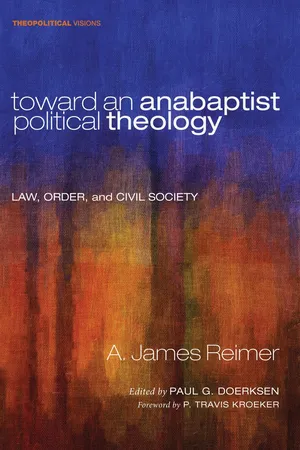
Toward an Anabaptist Political Theology
Law, Order, and Civil Society
- 214 pages
- English
- ePUB (mobile friendly)
- Available on iOS & Android
eBook - ePub
Toward an Anabaptist Political Theology
Law, Order, and Civil Society
About this book
A. James Reimer's (1942-2010) theopolitical project, intended to be a fully theologically conceptualized political theology, offers a constructive and creative contribution to this burgeoning field of theological inquiry. Reimer's thesis for this theologically derived politics focuses on the necessity to take seriously the biblical-Trinitarian foundations for all Christian social ethics, but also on the importance of astute and faithful engagement by Christians in public institutional life, including the political realm. While Reimer understood himself to be working as an Anabaptist, and hoped to invite that tradition to embrace a more positive view of civil institutions than has historically been the case, he was not limited by that tradition or beholden to take only its sources into account. Ever alert to the problems inherent in every kind of reductionism, and especially so in cases where theology is reduced to either ethics or politics, Reimer's political theology pursues the investigation of theological realities that are to serve as the engine, the generative force of a political theology that seeks to articulate both a critical and a positive-constructive approach to public/political life and institutions.
Information
Topic
Theology & ReligionSubtopic
Christian Denominationschapter 1
An Anabaptist-Mennonite Political Theology: Theological Presuppositions
Paul Doerksen has suggested that in a monograph on Christian social-political theory that I am currently working on, I seek “to offer an Anabaptist version of [Oliver O’Donovan’s] Desire of the Nations, a theologically conceptualized political theology . . . a theopolitical project that will serve as an alternative Anabaptist vision to that of John Howard Yoder, whose work Reimer has often criticized even while acknowledging its importance.”1 O’Donovan is a widely published and influential Anglican ethicist now teaching in Edinburgh, Scotland, and the late John Howard Yoder is the most important Mennonite theological ethicist of the twentieth century. Doerksen has characterized my project quite accurately, although I am perhaps slightly more Yoderian than he here acknowledges. I seek not so much to provide an alternative view to that of Yoder but to think through certain elements in Yoder’s ethics that he hints at but does not systematically develop; namely, that the state when functioning properly is there to restrain evil and promote and further the good. In the following pages I outline as simply as possible the intended goals of my present research and writing on the subject of theology and politics, as it might be understood not only by Mennonites but by Christians living in the so-called postmodern situation.
My current work on political ethics, tentatively titled “Political Theology: Law, Order and Civil Society,”2 might be considered the second volume of a trilogy beginning with Mennonites and Classical Theology: Dogmatic Foundations of Christian Ethics, in which I sought to identify the basic dogmatic grammar of Christian social ethics, and a third projected volume (were I to live long enough) titled “Theology as Doxology: Spiritual Formation and Ethics,” in which I hope to engage Eastern Orthodoxy and the mystical tradition in general to give a more holistic view of the religious life. In the latter volume I would deal with the liturgical, sacramental, and aesthetic resources of ethics, viewing it (ethics) as a form of praise and worship of God (doxology). Although these three projects respectively correspond loosely to the Trinitarian structure of Christian theology (Patrology, Christology, Pneumatology), this parallel should not be drawn too strictly.
Thesis
The thesis of my “Political Theology” is that a theologically derived politics (not a politically derived theology) for those in the Anabaptist-Mennonite tradition ought to take seriously the biblical-Trinitarian foundations for all Christian social ethics, but also the importance of engagement by Christians in public institutional life, including the political realm. Not only is political involvement a mandate for Christians, it is unavoidable. Those who deny the legitimacy of such engagement are being dishonest; they engage with every facet of their lives, whether consciously or not. In our daily lives, whether we like it or not, we are all deeply enmeshed in multiple layers of civil (cultural, economic, and political) society. Those who withdraw from public life as we normally understand it are doing so only in a very facile sense. They cannot escape the public sphere altogether and are being political in their own way, in their own communities, and as a negative political witness to larger, dominant society.
Academically, we have justified our Mennonite dissident peace position biblically, historically, and ethically, but we have not developed a systematic political theory in which the positive role of civil institutions outside the church is elaborated from the perspective of our Historic Peace Church heritage. We have elaborated our Christian social ethics from within the womb of the church (moral purity and discipleship), usually as a form of negative witness to the state, but have thought little about the positive role of institutions outside church and parachurch agencies, participation in which requires ambiguous choices. It is this larger task, in which I seek to articulate both a critical and a positive-constructive approach to public and political life and institutions, to which I turn my attention in this second volume of my so-called trilogy.
Originally, I tentatively titled this project “When Law and Civil Institutions Are Just: Honesty in Pacifist Thinking.” It was a twist on the 1984 book by Yoder, When War Is Unjust: Being Honest in Just-War Thinking. In this remarkable book, Yoder, a pacifist, uses the arguments of the just war tradition to call its adherents to greater honesty and faithfulness to what they espouse, and consequently to join with pacifists in consistently condemning war. I agree with Yoder, but I reverse the challenge to think honestly and apply it to those of us in the pacifist tradition. I urge Mennonites and others in the Historic Peace Church tradition to overcome their frequently dishonest disjunction between abstract theories of pacifism and nonresistance, on the one hand, and the way they actually live within civil society, on the other. I am not recommending the giving up of our venerable proclamation of the gospel of peace and nonviolence, but am encouraging us to be honest: not to use high-sounding theological and moral rhetoric (1) ideologically to disguise the situation in which we actually find ourselves in our family, professional, business, political, civil, and church lives; nor (2) selectively to read the Bible and history, undervaluing the positive mandate for institutional life found in the biblical narrative as well as in our own Anabaptist-Mennonite heritage.
I propose that we ought, with some qualifications, to retrieve a modified form of “two kingdom” thinking as a way of appropriating early Anabaptist thinking on social ethics, and of understanding our lives within a highly complex global religious, cultural, social, economic, and political system. By “qualifications” I mean the following: (1) the term kingdom is an anachronism when applied to the spheres of reality within which we participate—they are more like realms or dimensions; and (2) the number two is a gross oversimplification, even a distortion of the polyvalent spheres of activity and influence within which we find ourselves in contemporary societies. Yet two kingdoms are better than one (three even better), and there is value in retaining a soft and modified version of this duality in order to distinguish between our primary home (our basic biblical-confessional set of commitments) and our provisional, secondary home (our larger, relative, and more tenuous abode, and our changing set of responsibilities within and for the whole).
My primary home is the Christian one, and within that, the Mennonite room with its allegiance to certain fundamental, biblically based doctrines (Believers’ Church community, discipleship, nonviolent love, witness to peace and reconciliation, and so on). My secondary home is our local, national, global, and cosmic home in which we live with those of other faiths, ideologies, and cultures. It is the common space within which we all live, not only the “in between” space but the whole space of which we occupy one part. It might be thought of as “the world,” the common good, the created order that is to be preserved and within which life is to flourish, not essentially a common evil (although fallen) from which we need to keep ourselves pure. This public realm is not neutral and value-free, as some liberals would have it, but is always itself defined by some form of “public orthodoxy.”3 The boundary between our primary Christian home and our secondary “worldly” home is not rigid but porous, and we move back and forth as conscience dictates and as the Christian community discerns. The sixteenth-century Anabaptist thinker Pilgram Marpeck is a good example of how this movement between the two homes, on the basis of conscience, might be conceptualized.4
The danger for “sectarian” Christians is to remain within, and even to absolutize, the particular, primary home. My focus on law as a way of exploring the possibility of developing a more positive theology of public institutions is an attempt to give greater credence to the notion of the universal (the common good, or “common grace” as some have called it) for Mennonites. Whether we like it or not, we occupy a space in the large world. All of us are citizens and carry passports of one country or another (some carry two), and we unapologetically draw on the benefits that such citizenship offers. Let’s be honest about this and reflect theologically on it without ideological distortion. We call the police when being burgled. Most of us would support the enactment of laws compatible with Christian understandings of the value of the individual, communal rights and freedoms, and social and economic justice. We support a strong state and police to maintain law and order. In the following pages I consider briefly the theological presuppositions for my argument and how it unfolds.
A Trinitarian Hermeneutic
I consider the Christian doctrine of the triune God (God as three in one: Father, Son, and Holy Spirit, or their gender-inclusive equivalents) to be the central teaching of the Christian faith and pivotal for all Christian social ethics, a claim I have articulated in many of my writings.5 I refer above to a Trinitarian hermeneutic in the sense that, as I contend, the doctrine of the Trinity emerges organically out of the Scriptures and in turn is a hermeneutical key for interpreting the Bible and all of reality. I consider the Trinity not only as the metaphysical and ontological structure of reality, grounding and shaping our ethics, but as the living reality of God that informs and empowers our ethics. Although I hold strongly to the unity and simplicity of God, I do maintain that the distinctions between the three within God are important, perhaps a bit more along the line of Eastern Orthodoxy, in which the distinctions are emphasized slightly more than in the Latin West,6 although neither East nor West sacrifices the unity of God for the distinctions, or the distinctions for the unity. These distinctions might be seen as three ways of God’s being, not in the way the ancient heresy of modalism thought of the plurality as three faces (personae) of God, with the real God still not known, but rather as three manifestations of God’s ontological and relational reality, or three “energies,” as Eastern theologians have sometimes argued.
Patrology
God as “Father Almighty” is the unbegotten origin of all things, seen and unseen. God in this first way of being (creator and providential preserver of creation) is the inexhaustible mystery of all that is and transcends our understand...
Table of contents
- Title Page
- Foreword
- Introduction
- Chapter 1: An Anabaptist-Mennonite Political Theology: Theological Presuppositions
- Chapter 2: “I came not to abolish the law but to fulfill it”: A Positive Theology of Law and Civil Institutions24
- Chapter 3: Trinitarian Foundations for Law and Public Order
- Chapter 4: Constantine: From Religious Pluralism to Christian Hegemony
- Chapter 5: Revelation, Law, and Individual Conscience
- Chapter 6: Law, Freedom of Conscience, and Civil Responsibility: Marpeck, Mennonites, and Contemporary Social Ethics
- Chapter 7: An Anabaptist-Mennonite Political Theology, Part II: Historical Manifestations and Observations
- Chapter 8: Public Orthodoxy and Civic Forbearance: The Challenges of Modern Law for Religious Minority Groups
- Chapter 9: Anabaptist-Mennonite Political Theology:Conceptualizing Universal Ethics in Post-Christendom
- Bibliography
Trusted by 375,005 students
Access to over 1.5 million titles for a fair monthly price.
Study more efficiently using our study tools.
Frequently asked questions
Yes, you can cancel anytime from the Subscription tab in your account settings on the Perlego website. Your subscription will stay active until the end of your current billing period. Learn how to cancel your subscription
No, books cannot be downloaded as external files, such as PDFs, for use outside of Perlego. However, you can download books within the Perlego app for offline reading on mobile or tablet. Learn how to download books offline
Perlego offers two plans: Essential and Complete
- Essential is ideal for learners and professionals who enjoy exploring a wide range of subjects. Access the Essential Library with 800,000+ trusted titles and best-sellers across business, personal growth, and the humanities. Includes unlimited reading time and Standard Read Aloud voice.
- Complete: Perfect for advanced learners and researchers needing full, unrestricted access. Unlock 1.5M+ books across hundreds of subjects, including academic and specialized titles. The Complete Plan also includes advanced features like Premium Read Aloud and Research Assistant.
We are an online textbook subscription service, where you can get access to an entire online library for less than the price of a single book per month. With over 1.5 million books across 990+ topics, we’ve got you covered! Learn about our mission
Look out for the read-aloud symbol on your next book to see if you can listen to it. The read-aloud tool reads text aloud for you, highlighting the text as it is being read. You can pause it, speed it up and slow it down. Learn more about Read Aloud
Yes! You can use the Perlego app on both iOS and Android devices to read anytime, anywhere — even offline. Perfect for commutes or when you’re on the go.
Please note we cannot support devices running on iOS 13 and Android 7 or earlier. Learn more about using the app
Please note we cannot support devices running on iOS 13 and Android 7 or earlier. Learn more about using the app
Yes, you can access Toward an Anabaptist Political Theology by A. James Reimer, Paul G. Doerksen, Doerksen in PDF and/or ePUB format, as well as other popular books in Theology & Religion & Christian Denominations. We have over 1.5 million books available in our catalogue for you to explore.