- 226 pages
- English
- ePUB (mobile friendly)
- Available on iOS & Android
eBook - ePub
About this book
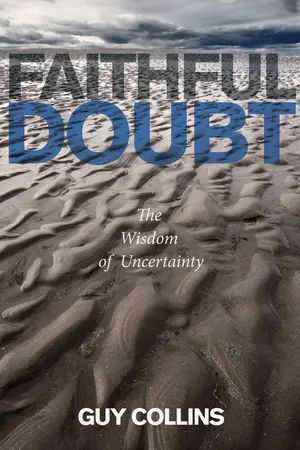
In Faithful Doubt Guy Collins explores the role of doubt within theology and philosophy. Focusing on three philosophers--Giorgio Agamben, Jacques Derrida, and Slavoj Žižek--Faithful Doubt argues that atheism can be redeeming. Far from being inhospitable to faith, doubt is increasingly necessary for theology.
As well as introducing the thought of contemporary philosophers, Faithful Doubt examines the significance of popular entertainment and narrative. Novels of Ursula Le Guin, Neal Stephenson, China Mieville, and others are read alongside Star Wars, Star Trek, and Battlestar Galactica. Fiction highlights the fluid nature of the sacred and the secular.
On the question of evil, Faithful Doubt suggests that wisdom lies in acknowledging uncertainty. Weaving the story of Job together with St. Augustine, Donald MacKinnon, and Eleonore Stump, evil exemplifies the necessity for doubt within theology.
Faithful Doubt brings a new perspective to debates about the relationship between faith and reason. Concluding with a discussion of Soren Kierkegaard, Collins presents a compelling case for harnessing atheism and doubt in service to Christian faith. In order to "doubt wisely" we need to heed the "faith of the faithless."
Information
Topic
PhilosophySubtopic
Philosophers1
Uncertain Truths
I propose to establish progressive stages of certainty . . . But the mental operation which follows the act of sense I for the most part reject; and instead of it I open and lay out a new and certain path for the mind to proceed in, starting directly from the simple sensuous perception.
—Francis Bacon1
But eventually I am forced to admit that there is nothing among the things I once believed to be true which it is not permissible to doubt - and not out of frivolity or lack of forethought, but for valid and considered reasons.
—René Descartes2
At the dawn of the seventeenth century two thinkers laid down foundations for modern science and modern philosophy. Francis Bacon affirmed the importance of the empirical, and matters of sense. René Descartes took the opposite approach, denying that anything could be proved other than the existence of the mind, and whether it was doubting or cogitating. Both thinkers have come to influence successive centuries of scientific and philosophical thought. While science has taken the Baconian “new and certain path,” philosophy has found it difficult to escape the Cartesian emphasis on both doubt and the centrality of the reasoning mind, the cogito. Each in their own way sought a solid foundation for their respective discipline. Yet the treatment of doubt within each thinker was remarkably different.
Today it is philosophically and theologically fashionable to critique the Cartesian reliance on the cogito, especially in light of the negative consequences this has had for our understanding of the status of the body. The dualism that places mind over body has not been healthy for society or theology. In turn, the Cartesian emphasis on the cogito has been connected with the production of other disconcerting dualisms, such as the hierarchical ordering of male over female. However, in the legitimate rush to exorcise theology from an over-dependence on the mind, or cogitation, the important role of doubt within the Cartesian cogito has been neglected. It can be argued that religion and theology have also found themselves divided between Baconian and Cartesian approaches to certainty and doubt. Both are strategies for dealing with doubt, but while both saw doubt as something to be overcome, Descartes also intuits that doubt is uniquely important in developing deeper understanding.
Both Descartes and Bacon assumed that it was ultimately possible to escape doubt by providing solid rational foundations for knowledge. Yet in their different approaches, each created a different route for subsequent scientists and philosophers. As has recently been comprehensively argued, while science has continued to thrive using the empirical foundation developed by Bacon, subsequent philosophy has never been able to agree that Descartes’s solid foundations were any bit as firm as he believed.3 While the history of science is the history of building on the sturdy empirical foundations of Bacon, the subsequent history of philosophy is the story of a continuing questioning and doubting of whether reason alone can ever provide a firm foundation.
The desire to evade doubt was common to both Descartes and Bacon. But Descartes also recognized that doubt played an important role in constituting the subject. It was not simply something to be avoided, it was also a mechanism for helping discover the true foundation of thought. By contrast, doubt for Bacon was merely something to be avoided. At the same time, while Descartes assumed that belief in God was essential to the foundations of his rational system, Bacon’s system had no need of God. And so while Bacon’s system was able to thrive without God, Descartes’s system was undermined both by its inability to totally exclude doubt, and also, in time, by the apparent idiosyncrasy of a rational system that incorporated monotheistic belief. Neither Bacon nor Descartes could ever rid themselves of doubt, and as Giorgio Agamben has written scientific method may well have encouraged doubt for Descartes:
The view through Galileo’s telescope produced not certainty and faith in experience but Descartes’s doubt, and his famous hypothesis of a demon whose only occupation is to deceive our senses.4
Doubts about God and doubts about whether reason could really provide certainty undid Descartes. Yet trust in the verifiable and empirical reality of the external world ensured Bacon’s views would remain abidingly influential. While Descartes continues to have a reputation as an arch-rationalist, his thought was never completely able to avoid something theology has always struggled with: the question of uncertainty.
While doubts are important to theology, there are many examples of Christian practice that appear to leave no room for doubt. Christianity has a far from perfect record in accommodating doubters, and for large sections of the faithful doubt appears to be anathema. This chapter examines why doubt presents such difficulties. It will consider the problems raised by uncertainty, and why this creates challenges both for theology and also for some of its ardent critics. The division between certainty and uncertainty, what for simplicity’s sake we will telescope as a division between the Baconian and Cartesian, cannot simply be mapped onto the difference between religious and secular thought. Instead, it will become clear how even quite different religious and secular discourses come to resemble one another in the way that they prioritize either certainty or uncertainty. While religious faith can be strengthened when it is recast as a practice of radical uncertainty, too often it has instead been presented as providing ultimate assurance. If, as Descartes thought, doubt is the origin of wisdom, this chapter will explore what happens to theology when doubt is suppressed and only certainty remains.5
Bacon, like modern science, allows us to articulate and interpret the world in a more certain kind of way. However, in seeking certainty, this approach has to exclude anything that cannot be verified empirically. God clearly cannot be verified through sense experience, and so God can never be the subject of scientific study for Bacon. By contrast, Descartes was willing to broaden the remit of philosophy to incorporate matters of non-sense experience, like the divine. The tragedy of Descartes is that in seeking to discover a universal framework for reason, he ends up creating a rational system that ultimately has just as negative an effect on divinity and doubt as Bacon. Bacon’s exclusion of both divinity and doubt in the construction of his system was successful, and the subsequent history of science bears this out. By contrast, Descartes’s attempt to provide certain reasons for God at the same time as affirming the revelatory potential of doubt were not as long-lasting. One legacy of this is seen in the comparative strengths of the scientific and theological communities in academia and public life. Most intellectuals assume that somehow science and philosophy cannot coexist with belief in God. Equally, most Western societies today assume that philosophical or religious beliefs are inherently private matters open to doubt. Neither of these positions would have made sense to either Bacon or Descartes. The rest of this chapter will investigate how it is that the drift toward certainty continues to displace God. Along the way it will also become apparent how doubt is of more utility to religion and theology than has previously been recognized.
The Logic of Certainty
Religious fundamentalism and militant atheism have a number of compelling similarities.6 Each brooks no opposition, and both are powerfully certain of the rightness of their cause. Despite their very different responses to the question of God, both firmly believe they have a monopoly on truth. Given that many atheists start out as Christian, this is not itself particularly surprising. The corollary of this is that the religiously flexible and the agnostic also have a great deal in common. While an agnostic is uncertain about the existence of the divine, the flexible tend to be circumspect about their deeply held beliefs. Part of this is because they are, legitimately enough, simply unsure. Such a lack of certainty arises out of the intellectual recognition that faith really does not make an awful lot of sense. While some might see this as evidence that such beliefs are shallow or superficial, by contrast, the question that arises here is the status of imagination in religious belief. Imagination in all its accompanying uncertainty, opacity, and mystery can be a route into religious belief. Yet, for those not inclined to surrender themselves to ambiguity the uncertainties of imagination are something to be shunned. While imagination can be celebrated as a gift, it can also be feared as a distraction.
The religiously flexible and the religiously agnostic are both uncomfortably aware that they do not know all that there is to know. They are open to the possibility of being wrong, and they are aware of the multiplicity of different ways in which others respond to ultimate questions. The key division in faith is therefore not between those who believe and those who do not. Rather, the real religious demarcation is between those who have the hubris to suggest that they “know what is what,” and those who have the humility to agree with John Caputo that “we do not know who we are.”7
As we learn more about the seemingly infinite variety of human life choices it is clear that life is irreducibly complex. While some, like the Amish of Pennsylvania, shun the innovations of technology, most are increasingly dependent on technologies that less than a generation ago were the height of science-fiction. Thanks to the internet, cellular communication technology, and wireless communications we live in a world in which information is now more freely available than ever before. On the other hand, there is a growing digital divide between those who have unlimited access to new technologies and those whose access is controlled or impeded for economic, political, or social reasons. New technology in itself has not resolved the problem of economic inequality. Despite the new-found freedom offered by the internet we are only starting to recognize, let alone respond to, new problems of social exclusion generated by the way new technologies are implemented.
Even when access itself is not a problem, part of the conundrum facing inhabitants of twenty-first-century cyberspace is knowing who to trust. The United States Postal Service or the British Royal Mail rarely concern themselves with seeing mail intercepted or destroyed on an industrial scale. And readers of newspapers and books rarely worry about their purchase infecting other papers and books with an information-destroying plague that renders all literary artifacts useless. However, as digital consumers know, even the most risk-averse constantly place their own data and information at risk. Whether the threat is from spyware, malware, trojans, viruses, or even the virus-protection software itself, we live in an age of information overload and overkill.
Just as we are becoming more fluent in navigating competing information streams, we are also discovering new vulnerabilities in records and data. Where the library of Alexandria stood for centuries, today the life-cycle of a computer is officially accounted as at best five years. And while we can drink from a cornucopia of information on the internet we also have to contend with an entire ecosystem of out-of-date, misleading or purposefully incorrect information. Once one leaves a few select portals whose credentials are trustworthy we find ourselves in the data equivalent of no-man’s land. Examining the phenomena of our interconnected age it is hard not to agree with Taylor: “In the midst of these webs, networks, and screens, I can no more be certain where I am than I can know when or where the I begins and ends.”8 Bewilderment is both natural and ubiquitous in the face of such complexity.
This brings us to the paradox of the information age. Marshall McLuhan defined information as a difference that makes a difference. Yet how willing are we to expose ourselves to different thoughts? Just as potential access to information increases so too can reluctance to engage with difference or diversity. This is not a rule for all people and all places, but it does help explain why an exponential increase in the availability of information has coincided not with a great burgeoning of human understanding, but with increasing polarization and failure to understand. There is no common culture transcending economic, political or religious divides. Society today bears less resemblance to the Roman forum or medieval marketplace where everyone had access to the same public space, and more to a series of autonomous silos of affiliation and information that rarely intersect.9 It is against this cultural pandemonium that we need to locate, and understand, religion.
The explosion of knowledge in the information age is just one small ...
Table of contents
- Title Page
- Acknowledgments
- Introduction
- Chapter 1: Uncertain Truths
- Chapter 2: After Reason
- Chapter 3: The Impossible
- Chapter 4: Diabolical Deities
- Chapter 5: Holy Agnosis
- Chapter 6: True Fiction
- Chapter 7: Redeeming Atheism
- Chapter 8: Breach
- Bibliography
Trusted by 375,005 students
Access to over 1.5 million titles for a fair monthly price.
Study more efficiently using our study tools.
Frequently asked questions
Yes, you can cancel anytime from the Subscription tab in your account settings on the Perlego website. Your subscription will stay active until the end of your current billing period. Learn how to cancel your subscription
No, books cannot be downloaded as external files, such as PDFs, for use outside of Perlego. However, you can download books within the Perlego app for offline reading on mobile or tablet. Learn how to download books offline
Perlego offers two plans: Essential and Complete
- Essential is ideal for learners and professionals who enjoy exploring a wide range of subjects. Access the Essential Library with 800,000+ trusted titles and best-sellers across business, personal growth, and the humanities. Includes unlimited reading time and Standard Read Aloud voice.
- Complete: Perfect for advanced learners and researchers needing full, unrestricted access. Unlock 1.5M+ books across hundreds of subjects, including academic and specialized titles. The Complete Plan also includes advanced features like Premium Read Aloud and Research Assistant.
We are an online textbook subscription service, where you can get access to an entire online library for less than the price of a single book per month. With over 1.5 million books across 990+ topics, we’ve got you covered! Learn about our mission
Look out for the read-aloud symbol on your next book to see if you can listen to it. The read-aloud tool reads text aloud for you, highlighting the text as it is being read. You can pause it, speed it up and slow it down. Learn more about Read Aloud
Yes! You can use the Perlego app on both iOS and Android devices to read anytime, anywhere — even offline. Perfect for commutes or when you’re on the go.
Please note we cannot support devices running on iOS 13 and Android 7 or earlier. Learn more about using the app
Please note we cannot support devices running on iOS 13 and Android 7 or earlier. Learn more about using the app
Yes, you can access Faithful Doubt by Guy Collins in PDF and/or ePUB format, as well as other popular books in Philosophy & Philosophers. We have over 1.5 million books available in our catalogue for you to explore.