eBook - ePub
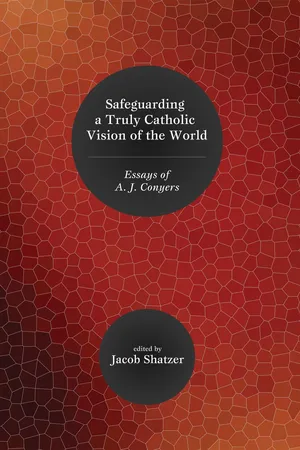
Safeguarding a Truly Catholic Vision of the World
Essays of A. J. Conyers
- 138 pages
- English
- ePUB (mobile friendly)
- Available on iOS & Android
eBook - ePub
About this book
A. J. Conyers (1944-2004) was a Baptist theologian with wide-ranging interests and a founding faculty member of the George W. Truett Seminary at Baylor University. He published books ranging from basic Christian doctrine to political theology, but his many essays show his true range and depth of insight. This work collects ten of his most important and provocative essays in order to introduce Conyers--who died of cancer in 2004--to theologians and pastors unfamiliar with his contribution to the theological task of the church.
Information
Topic
Theology & ReligionSubtopic
Christian Church1
Teaching the Holocaust
The Role of Theology (1981)1
Not a few professional and learned societies are looking into the topic “Teaching the Holocaust” in hopes of introducing the study of this twentieth century experience to secondary and college classrooms. What they are discovering should be of no small consequence to theologians: namely, that theology has an indispensable role to play in the adequate treatment of such studies. It makes an arresting discovery indeed if we consider that the chief impetus has come from the faculties of state universities and public school systems, and not generally from theological faculties. As momentum is gained, and more avenues come to light, it has occurred not only to theologians, but to others as well, that the subject matter almost compels us to raise questions that are more akin to theology than any other discipline. This means that now, while great interest is shown in the public sector of education, where history and other liberal arts subjects are often treated to almost fastidious secularity, one is faced with the task of teaching that which seems to call urgently upon a theological response.
In this paper, therefore, I simply want to underline and reinforce this initial intuition on the part of educators: that the Holocaust cannot be taught adequately without reference, at some point, to the theological questions it raises. That is to say, any attempt to do so without a theological point of reference leaves interpreters to deal with what is nothing less than a historical “black hole” in the midst of Western civilization. It is not that theologians have answers that ring with clarity and assurance while all the rest struggle. Quite the contrary: these problems should bring the theologian as much anguish as anyone. It is precisely because the Holocaust strikes at the roots of his confession, and calls into question the validity of his discipline, that he is called into the arena. And furthermore, that responsibility devolves upon him not because it is his private province, but because the questions are broadly human questions for which he has taken some responsibility.
Why is this so characteristic of the Holocaust? It is no accident that the Holocaust of the 1930’s and 1940’s has become the topic of wide ranging theological discussion in the 1970’s and 1980’s. The Holocaust is not the kind of event that one might elect to view theologically, along with other options. It is essentially a theological problem. This is true for at least two reasons:
1. To put it most simply, the Holocaust is different from most other calamities and human disasters in history. True, life has been counted cheap before: more have lost their lives in a shorter period of time; the weight of monstrous crimes has fallen upon specific ethnic or religious groups and even upon the Jews before; in all of remembered history, in fact, the scales of justice are never balanced and the blood never ceases to flow. However, what we deal with here is different in two specific ways:
a. It is different from the standpoint of the oppressors, because here is the story not simply of men presuming to take the lives of others for, say, temporal gain, or out of passion. But here are men, acting in Promethean defiance against the given order of reality, to violently reshape history itself: to bring in a new order—a millenium—a Thousand Year Reich. In order to achieve this transcendent goal, some at least, are willing to make human sacrifice.
b. It is different from the standpoint of the oppressed. Here, after all, is an event that, for many Jews, could and did call into question their covenant relationship with God.
2. Additionally, the Holocaust raises, in the most dramatic way, the problem of evil: the origin of evil, the persistence of evil, evil and human nature, evil and the nature and/or existence of God. Even if it is negatively stated (e.g. Wiesel’s “Never shall I forget those moments which murdered my God and my soul and turned my dreams to dust”2), the events inevitably raise questions about the relationship between pervasive, planned, and prolonged evil and the transcendent meaning of our existence that includes such evil. This sort of question is inevitably part of the Holocaust experience, and to deal with it at any level is to resort to theological categories.
Even as we advance the reasons for looking at the Holocaust as a theological problem, I think that we are already suggesting the two areas in which theology might be the greatest help. The first has to do with the problem of man and evil: how could twentieth-century man so easily have surrendered to his darkest impulses? Why should this have happened in the context of what we had come to believe (and not without justification) was the apex of civilization—not only in the twentieth century, but in twentieth-century Europe? The other line of questioning has to do with the problem of God and evil—theodicy: how is it that such evil as one encounters in the Holocaust exists at all? We are faced with the dilemma, in the words of Archibald MacLeish, “If God is God he is not good; if God is good he is not God.” We will attempt now to indicate some helpful directions that have been taken in theology, beginning with these two problems. In the first instance Richard Rubenstein, a Jewish theologian, and Helmut Thielicke, a Christian theologian, provide arguments upon which to focus. With regard to the second problem, attention is given to Jürgen Moltmann, a Christian theologian whose insights in this area owe much to Abraham Heschel, the Jewish theologian.
The Holocaust and the Problem of Evil in Human History
The penultimate problem of the Holocaust comes to one’s attention first. The ultimate problem is a problem of theodicy, of justifying God or of understanding existence itself in the light of stultifying evil. But before that we must face the less comprehensive, but no less necessary, question of the nature of humanity as this concept is affected by the possibilities for human evil that were revealed at Auschwitz and Treblinka.
One approach has been to place these events within the context of certain historical forces and attempt to understand, in terms of social and political theory, how these events might have come about. The question that emerges runs like this: How does it happen that ideological excesses in the twentieth century, not altogether different from those found in earlier centuries but which were then confined to fringe elements, suddenly erupted into huge mass movements capturing reputedly civilized nations? What defenses against these ideological excesses are missing in the twentieth century that have opened the flood gates, as Rubenstein has pointed out, on a century of mass death—a phenomenon by no means confined to Germany of the Third Reich? “We are more likely to understand the Holocaust,” Rubenstein says, “if we regard it as the expression of some of the most profound tendencies of Western civilization in the twentieth century.”3
The most characteristic feature of Rubenstein’s attempt at a theoretical basis for the Holocaust is that he refuses to see these events, monstrous though they be, as isolated in history, wholly attributable to the Germans, and divorced from other peoples and movements in the twentieth century. Instead he presses his investigation to discover the similarities in thinking which made possible the mass deaths directed by the American use of the atomic bomb in Japan, and associated with the administration of British colonial rule, as well as with the Bolshevik revolution and its consequent intensification of terror and mass death. These and many other instances suggest to him a certain pattern of events in our century apart from which the Holocaust cannot adequately be considered.
If one refuses to isolate the Holocaust from its historical context, and from the broader context of Western culture, he immediately is faced with a complex web of events and attitudes which present themselves as possible contributors. Rubenstein focuses basically upon three developments of greatest significance, as he believes, in understanding the Holocaust. The first relates to the way modern nations have faced and dealt with their population problems. For at least three centuries Europe exported its surplus population to North and South America. By the beginning of the twentieth century the American frontier had closed; possibilities for solving population problems in this way diminished. At the same time the twentieth century witnessed untold slaughter in World War I, the loss of hundreds of thousands of young men who were considered expendable for the sake of the goals of war. The problems of population became acute after World War I when the drawing of new national boundaries and the relocation of whole nationalities...
Table of contents
- Title Page
- Introduction
- Chapter 1: Teaching the Holocaust
- Chapter 2: Protestant Principle, Catholic Substance (1996)
- Chapter 3: Cloning and the Moral Imagination (1997)
- Chapter 4: The Changing Face of Baptist Theology (1998)
- Chapter 5: Three Sources of the Secular Mind (1998)
- Chapter 6: Simms’s Sabbath Lyrics and the Reclaiming of Sacred Time in the Religious Imagination (2000)
- Chapter 7: Vocation and the Liberal Arts (2003)
- Chapter 8: As Bad as We Get
- Chapter 9: Can Postmodernism Be Used as a Template for Christian Theology? (2004)
- Chapter 10: The Real Old-Time Religion (2004)
- Conclusion
- Bibliography
Trusted by 375,005 students
Access to over 1.5 million titles for a fair monthly price.
Study more efficiently using our study tools.
Frequently asked questions
Yes, you can cancel anytime from the Subscription tab in your account settings on the Perlego website. Your subscription will stay active until the end of your current billing period. Learn how to cancel your subscription
No, books cannot be downloaded as external files, such as PDFs, for use outside of Perlego. However, you can download books within the Perlego app for offline reading on mobile or tablet. Learn how to download books offline
Perlego offers two plans: Essential and Complete
- Essential is ideal for learners and professionals who enjoy exploring a wide range of subjects. Access the Essential Library with 800,000+ trusted titles and best-sellers across business, personal growth, and the humanities. Includes unlimited reading time and Standard Read Aloud voice.
- Complete: Perfect for advanced learners and researchers needing full, unrestricted access. Unlock 1.5M+ books across hundreds of subjects, including academic and specialized titles. The Complete Plan also includes advanced features like Premium Read Aloud and Research Assistant.
We are an online textbook subscription service, where you can get access to an entire online library for less than the price of a single book per month. With over 1.5 million books across 990+ topics, we’ve got you covered! Learn about our mission
Look out for the read-aloud symbol on your next book to see if you can listen to it. The read-aloud tool reads text aloud for you, highlighting the text as it is being read. You can pause it, speed it up and slow it down. Learn more about Read Aloud
Yes! You can use the Perlego app on both iOS and Android devices to read anytime, anywhere — even offline. Perfect for commutes or when you’re on the go.
Please note we cannot support devices running on iOS 13 and Android 7 or earlier. Learn more about using the app
Please note we cannot support devices running on iOS 13 and Android 7 or earlier. Learn more about using the app
Yes, you can access Safeguarding a Truly Catholic Vision of the World by Jacob Shatzer, Shatzer in PDF and/or ePUB format, as well as other popular books in Theology & Religion & Christian Church. We have over 1.5 million books available in our catalogue for you to explore.