eBook - ePub
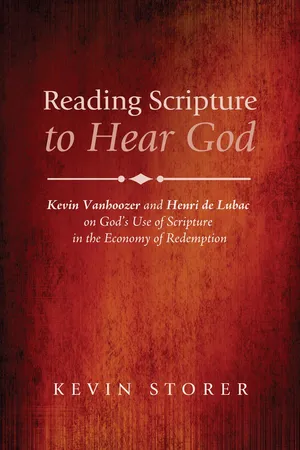
Reading Scripture to Hear God
Kevin Vanhoozer and Henri de Lubac on God’s Use of Scripture in the Economy of Redemption
- 186 pages
- English
- ePUB (mobile friendly)
- Available on iOS & Android
eBook - ePub
Reading Scripture to Hear God
Kevin Vanhoozer and Henri de Lubac on God’s Use of Scripture in the Economy of Redemption
About this book
Recent theological discussions between Catholics and Evangelicals have generated a renewed appreciation for God's ongoing use of Scripture for self-mediation to the Church. Noting the significant influence of Henri de Lubac (one of the drafters of Dei Verbum and proponent of a renewal of the Patristic and Medieval emphasis on a spiritual sense of Scripture), and Kevin Vanhoozer (the leading Evangelical proponent of a theological interpretation of Scripture), Kevin Storer seeks to draw Evangelical and Catholic theologians into dialogue about God's ongoing use of Scripture in the economy of redemption. Storer suggests that a number of traditional tensions between Catholics and Evangelicals, such as the literal or spiritual sense of Scripture, a sacramental or a covenantal model of God's self-mediation, and an emphasis on the authority of Scripture or the authority of the Church, can be eased by shifting greater focus upon God's ongoing use of creaturely realities for the building of the Church in union with Christ. This project seeks to enable Evangelicals to appropriate the insights of de Lubac's Catholic Ressourcement project, while also encouraging Catholic theologians to appreciate Vanhoozer's Evangelical emphasis on God's use of the literal sense of Scripture to build the Church.
Information
Topic
Theology & ReligionSubtopic
Christian Churchchapter 1
God’s Use of Scripture for Self-Communication
Divine Speaking in the Literal and Spiritual Sense
Introduction: Vanhoozer and de Lubac and the Literal and Spiritual Senses
On first read, Vanhoozer and de Lubac would seem a most unfit choice of dialogue partners of the topic of God’s use of Scripture. Vanhoozer insists on the sufficiency of the literal sense, while de Lubac insists on the indispensability of the spiritual sense. Vanhoozer develops an elaborate proposal for God’s authorship based on speech-act theory, while de Lubac largely ignores divine authorship and instead focuses attention on God’s sacramental presence in Scripture. Vanhoozer focuses on Scripture’s determinate meaning, while de Lubac focuses on Scripture’s infinite meaning. Yet what the two have in common is their persistent emphasis on God’s active use of Scripture for self-communication to the church. In this chapter I will compare Vanhoozer and de Lubac’s understanding of God’s use of Scripture in order to show that there is significant agreement between Vanhoozer’s proposal for God’s communication in the literal, canonical sense and de Lubac’s proposal for Christ’s communication in the spiritual sense. Furthermore, I will suggest that Vanhoozer’s argument that the Spirit’s present speaking is best described as the perlocutionary effect of Scripture and de Lubac’s argument that the Spirit’s present speaking is best described as the spiritual senses of Scripture lead to quite similar conclusions about the theological interpretations of Scripture. Finally, I will observe a persistent tension in the work of each, and will suggest that these could be overcome through mutual dialogue.
Kevin Vanhoozer: God’s Authorship of Scripture and the Sufficiency of the Literal Sense
Vanhoozer’s primary emphasis throughout his career is to show that the Scriptures, as the authoritative Word of God, are God’s communication to the church, and consequently that readers must employ a method of interpretation which will allow them to understand and submit to the plain meaning of Scripture. Vanhoozer argues that because meaning is encoded in a text by an author to be discovered by the reader, the meaning of a text can only be grasped as readers seek to understand the speech act of the author. The Scriptures are understood, then, by readers who rightly perceive what the author communicated in the text. Yet while this argument remains central to Vanhoozer’s work, Vanhoozer develops the argument in a considerably different way in his early career than he does in his later career. Vanhoozer’s early work focuses primarily on discerning the meaning of the text as it has been communicated by the author.55 This stage of Vanhoozer’s career is marked by an almost exclusive focus on human authorial intent as basis for understanding the meaning of the text. While this early work employs the useful tools of speech-act theory and clarifies Vanhoozer’s understanding of Scripture’s determinate meaning which will remain throughout his career, Vanhoozer’s later work exhibits a distinct shift in perspective. During the early 2000’s, Vanhoozer began to recognize that his focus on the role of the author actually caused him to focus more on the human author than the divine author of Scripture.
More importantly, Vanhoozer began to recognize that his early project, by focusing so persistently on human speech-acts, had actually contributed to the very problem that he was attempting to overcome. Vanhoozer began to realize that the real problem causing impasse between revisionists and postliberals was a nearly exclusive focus on the relationship between text and reader which led to the neglect of theological description about God’s use of Scripture in the economy of redemption. In his later work, then, Vanhoozer switches his focus from a consideration of human authorial intent to a more focused exploration of divine authorial intent, and seeks to explain Scripture’s location within the economy of redemption as a unique and integral part of God’s self-communicative action.56 In dialogue with postliberal and revisionist theologians, Vanhoozer argues that Scripture is authoritative for the church because Scripture is a unique set of documents which can be identified as God’s communicative action. Proper reading of Scripture, then, can only start with a right First Theology, a stance of faith that the Scripture is God’s speaking action.57 Viewing God as the primary author of Scripture, Vanhoozer works out the implications of God’s self-communicative action within the economy of redemption, specifying how God speaks (God’s being is described as triune self-communicative act), what Scripture is (Scripture is described as God’s covenant document to the church), and where Scripture fits in the economy of redemption (Scripture is described as constituting the church).58 Throughout his later work, then, Vanhoozer seeks to articulate the relationship between God, Scripture, and church in a way that establishes the communication of God, through Scripture, to the church in the economy of redemption.
Establishing a First Theology: From God as Ground of Communication to God as Pure Communicative Act
Vanhoozer’s early work: listening to the author as an other: In his early work, Vanhoozer works to overcome what he perceives to be the growing problem of postmodern relativism by proposing a particular method for reading which will establish the authority of scriptural meaning. Vanhoozer’s goal is to establish the determinate meaning of Scripture and to safeguard biblical meaning from postmodern “undoers” (esp. deconstructionists and reader response theorists) who reject the claim that the biblical texts (or any other texts) possess determinate meaning. In response to such “undoers,” Vanhoozer suggests that because all human communication is a gift grounded in the communicative action of God, the act of reading is an inherently moral and theological activity. Vanhoozer proposes a “theological general hermeneutic” in which “the Bible should be read like any other book, and . . . every other book should be read like the Bible.”59 This morality of reading obligates readers to respect the author of any text. Vanhoozer claims that “[a]ll texts . . . invoke a certain debt that readers owe authors,”60 and thus responds to Barthes’s declaration of the “death of the author” by suggesting that interpretive “understanding” leads to the “death of the reader.”61 In all texts, “The voice of the communicative agent confronts us with a moral demand: ‘Heed me. Hear me. Understand. Do not bear false witness.’”62
Since the “undoing of interpretation,” is based on the immoral treatment of the author, Vanhoozer claims that “Christian theology, not deconstruction, is the better response to the ethical challenge of the ‘other.’”63 Vanhoozer draws two theological analogies to emphasize the moral obligation to listen to authors, and thus to rehabilitate the quest for authorial intent. First, Vanhoozer suggests that the author is like a creator.64 Drawing a parallel from God’s creation ex nihilo, Vanhoozer asks, “Why is there something rather than nothing in texts? Because someone has said something about something to someone.”65 The author “is responsible both for the existence of the text (that it is) and for its specific nature (what it is).”66 Hence the author “is the one whose action determines the meaning of the text—its subject matter, its literary form, a...
Table of contents
- Title Page
- Introduction
- Chapter 1: God’s Use of Scripture for Self-Communication
- Chapter 2: Vanhoozer’s Covenantal Ontology and de Lubac’s Sacramental Ontology
- Chapter 3: God’s Use of Scripture and Church in the Economy of Redemption
- Conclusion
- Bibliography
Trusted by 375,005 students
Access to over 1.5 million titles for a fair monthly price.
Study more efficiently using our study tools.
Frequently asked questions
Yes, you can cancel anytime from the Subscription tab in your account settings on the Perlego website. Your subscription will stay active until the end of your current billing period. Learn how to cancel your subscription
No, books cannot be downloaded as external files, such as PDFs, for use outside of Perlego. However, you can download books within the Perlego app for offline reading on mobile or tablet. Learn how to download books offline
Perlego offers two plans: Essential and Complete
- Essential is ideal for learners and professionals who enjoy exploring a wide range of subjects. Access the Essential Library with 800,000+ trusted titles and best-sellers across business, personal growth, and the humanities. Includes unlimited reading time and Standard Read Aloud voice.
- Complete: Perfect for advanced learners and researchers needing full, unrestricted access. Unlock 1.5M+ books across hundreds of subjects, including academic and specialized titles. The Complete Plan also includes advanced features like Premium Read Aloud and Research Assistant.
We are an online textbook subscription service, where you can get access to an entire online library for less than the price of a single book per month. With over 1.5 million books across 990+ topics, we’ve got you covered! Learn about our mission
Look out for the read-aloud symbol on your next book to see if you can listen to it. The read-aloud tool reads text aloud for you, highlighting the text as it is being read. You can pause it, speed it up and slow it down. Learn more about Read Aloud
Yes! You can use the Perlego app on both iOS and Android devices to read anytime, anywhere — even offline. Perfect for commutes or when you’re on the go.
Please note we cannot support devices running on iOS 13 and Android 7 or earlier. Learn more about using the app
Please note we cannot support devices running on iOS 13 and Android 7 or earlier. Learn more about using the app
Yes, you can access Reading Scripture to Hear God by Kevin Storer in PDF and/or ePUB format, as well as other popular books in Theology & Religion & Christian Church. We have over 1.5 million books available in our catalogue for you to explore.