- 288 pages
- English
- ePUB (mobile friendly)
- Available on iOS & Android
eBook - ePub
About this book
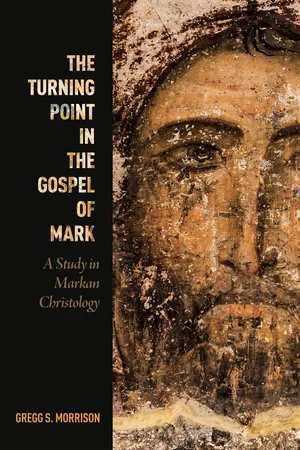
Based on linguistic and thematic links in the narrative, The Turning Point in the Gospel of Mark argues that the twin pericopae of Peter's confession (8:27-38) and the Transfiguration (9:2-13) together function as the turning point of the Gospel and serve in a Janus-like manner enabling the reader to see the author's main focus: the identity of Jesus and the significance of that reality for his disciples. Peter's confession of Jesus as Messiah faces backward toward the Prologue (1:1-13) and functions as a mid-course conclusion. The declaration by God on the mountain faces forward and foreshadows the end-course conclusion (14:61-62; 15:39; Son of God). Jesus, in response, teaches that the Son of Man must suffer and die before being raised from the dead (8:31). Christologically, the images of Messiah, Son of Man, and Son of God converge and present Jesus, the crucified, as king, ushering in the kingdom of God in power (9:1 acting as the key swivel between the twin pericopae). When one is confronted with this Jesus, though there remains something elusive about him and the kingdom of God in the narrative, the only wise decision (after calculating the costs, 8:34-38) is to follow.
Information
1
Introduction
The question I will confront in this monograph is whether there is a turning point in the Gospel of Mark, that is, a pivot on which the entire narrative turns. A second and related question is: If such a pivot exists, then what is it? I believe there exists such a turning point in the Gospel of Mark and I hold it to be (broadly stated for now) in Mark’s middle section (8:22—10:52).1 I am not alone in this determination. Several scholars have observed a major climax and turning point in this section of the narrative. The second question—what precisely is the turning point?—is more difficult to answer and constitutes the burden of this book. If, as I will argue, the author constructed the Gospel with a decisive midpoint in mind, then how or in what way does the presentation of the turning point have an impact on the primary objective in writing, namely, the presentation or identity of Jesus?2 To put it another way, what is the relationship of the narrative’s turning point to Markan Christology?
In order to introduce this topic, I need to establish the context for determining the turning point in the Gospel, which will involve an examination of the structure or sequencing of the Gospel. After reviewing the proposals surrounding the various ways to outline the Gospel, I will examine the literary device of “turning point,” including how the question of gospel genre influences the discussion. Finally, I will provide a general overview of the plot of Mark’s Gospel, which will serve to introduce my proposal for the identification of Mark’s turning point.
The Structure of Mark’s Gospel
Interpreters interested in the structure of Mark’s Gospel have searched diligently for a coherent organizing principle in order to make sense of the narrative. Coming up with a conclusive outline or structure to the Gospel of Mark is difficult.3 One reason may be the seemingly disjunctive manner in which Mark assembled the materials at his disposal. Eusebius, for example, says that Papias claimed that (according to “the Presbyter”) Mark did not arrange the stories of Jesus in any particular order.4 Toward the end of the nineteenth century, Martin Kähler insisted that all the Gospels are “passion narratives with extended introductions.”5 Accordingly, scholarly opinion regarding the structure of the Gospel abound.6 While it is possible to oversimplify matters, the Gospel of Mark has generally been outlined in one of four ways: (1) topographically, along geographic movements in the Gospel; (2) thematically, highlighting a particular theme or the development of a theme such as Christology, discipleship, or faith; (3) topically, with Jesus’ teaching and healing ministry as the first major section and Jesus’ death and resurrection as the second; or (4) rhetorically, seeking some literary or persuasive device by which to distinguish the material. 7
Topographical Outlines
One of the first commentators of Mark’s Gospel in the twentieth century, Benjamin W. Bacon, divides the material topographically.8 Simply stated, he sees two major divisions of material: Part I relates to Jesus’ Galilean ministry (1:1—8:26) and Part II concerns Jesus’ Judean ministry (8:27—16:8). More recently, James R. Edwards shares the view of Bacon by stating that the narrative falls naturally into the same two halves.9 Vincent Taylor expands this twofold structure into six major divisions (after a prologue) in his outline of the Gospel: (1) the Galilean ministry (1:14—3:6); (2) the height of the Galilean ministry (3:7—6:13); (3) the ministry beyond Galilee (6:14—8:26); (4) Caesarea Philippi and the journey to Jerusalem (8:27—10:52); (5) the ministry in Jerusalem (11:1—13:37); (6) the passion and resurrection narrative (14:1—16:8).10 Many other commentators use topography as a means of examining the makeup of the Gospel.11
Using topography as the signal feature in developing a Markan outline is not, however, without problems, especially within the portrayal of Jesus’ Galilean ministry (1:14—8:26). For example, in the so-called parable chapter (Mark 4), Jesus teaches in a boat alongside the sea (4:1–9). In 4:10, when he was alone, those around him with the T...
Table of contents
- Title Page
- Foreword
- Preface
- Abbreviations
- Chapter 1: Introduction
- Chapter 2: Surveying the Possible Turning Points
- Chapter 3: A Look at Another Approach
- Chapter 4: Reading Peter’s Confession and the Transfiguration Together
- Chapter 5: Converging Lines in Markan Christology
- Chapter 6: Conclusion
- Appendix 1
- Appendix 2
- Appendix 3
- Bibliography
Trusted by 375,005 students
Access to over 1.5 million titles for a fair monthly price.
Study more efficiently using our study tools.
Frequently asked questions
Yes, you can cancel anytime from the Subscription tab in your account settings on the Perlego website. Your subscription will stay active until the end of your current billing period. Learn how to cancel your subscription
No, books cannot be downloaded as external files, such as PDFs, for use outside of Perlego. However, you can download books within the Perlego app for offline reading on mobile or tablet. Learn how to download books offline
Perlego offers two plans: Essential and Complete
- Essential is ideal for learners and professionals who enjoy exploring a wide range of subjects. Access the Essential Library with 800,000+ trusted titles and best-sellers across business, personal growth, and the humanities. Includes unlimited reading time and Standard Read Aloud voice.
- Complete: Perfect for advanced learners and researchers needing full, unrestricted access. Unlock 1.5M+ books across hundreds of subjects, including academic and specialized titles. The Complete Plan also includes advanced features like Premium Read Aloud and Research Assistant.
We are an online textbook subscription service, where you can get access to an entire online library for less than the price of a single book per month. With over 1.5 million books across 990+ topics, we’ve got you covered! Learn about our mission
Look out for the read-aloud symbol on your next book to see if you can listen to it. The read-aloud tool reads text aloud for you, highlighting the text as it is being read. You can pause it, speed it up and slow it down. Learn more about Read Aloud
Yes! You can use the Perlego app on both iOS and Android devices to read anytime, anywhere — even offline. Perfect for commutes or when you’re on the go.
Please note we cannot support devices running on iOS 13 and Android 7 or earlier. Learn more about using the app
Please note we cannot support devices running on iOS 13 and Android 7 or earlier. Learn more about using the app
Yes, you can access The Turning Point in the Gospel of Mark by Gregg S. Morrison in PDF and/or ePUB format, as well as other popular books in Theology & Religion & Biblical Criticism & Interpretation. We have over 1.5 million books available in our catalogue for you to explore.