- 240 pages
- English
- ePUB (mobile friendly)
- Available on iOS & Android
eBook - ePub
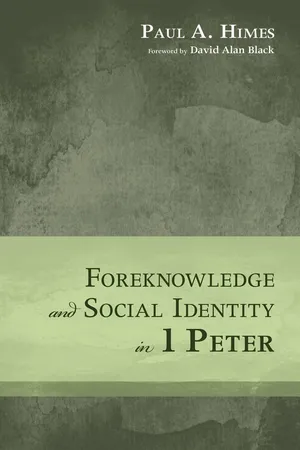
Foreknowledge and Social Identity in 1 Peter
About this book
What is the meaning and significance of foreknowledge in the book of 1 Peter, and how does the concept relate to the circumstances of its first recipients? Himes attempts to answer these questions by examining the concepts of both foreknowledge and social identity within the first century and how they fit into the theology of 1 Peter.
In the process of elaborating the concepts of foreknowledge and social identity, this study provides one of the first thorough examinations of the words prognosis and proginosko in the literature of the time period when 1 Peter was composed and circulated. Himes argues that these words are linguistically relevant to how early hearers and readers would have understood the message of 1 Peter.
In addition, this volume provides a thorough analysis of social-scientific criticism in 1 Peter, paying special attention to the various views about the social circumstances of the epistle's recipients. Finally, this book concerns itself with the biblical theology of 1 Peter, and with how the concept of foreknowledge functions as a word of comfort and hope to the beleaguered audience of this epistle.
Information
Topic
Teología y religión1
Thesis, Survey of Scholarship, and Methodology
The context of 1 Peter must, to a certain degree, be viewed through the lens of interaction, even “conflict,” between the Christian community and the society around it.1 Yet this conflict in 1 Peter is tied to the “otherness” of believers, i.e., their status as strangers and their distinction from those outside of their group.2 For such strangers, their own lack of social status always lurks at the door, threatening to overwhelm them with despair. To this community of strangers, however, Peter offers the following word of hope: despite their sense of physical and spiritual displacement, their new social identity is forever bound up in the foreknowledge of God. Who they were, who they are, and who they are becoming is no surprise, but rather part of the cosmic master plan, tied inseparably to their identity in Christ.3
The concepts of church, community, and social identity have, of course, been thoroughly explored in the Petrine literature of the past few decades. Indeed, fortunately gone are the days when John Elliott could sadly point out that “1 Peter suffers second-class status in the estimation of modern NT exegetes . . . [I]t is generally treated as one of the step-children of the NT canon.”4 First Peter is no longer the “exegetical stepchild” it once was. It now sits in the banquet hall with the other epistles, though still, perhaps, at a somewhat lower seat than its Pauline cousins.
Yet a few gaps remain in Petrine scholarship. While social identity in 1 Peter has been explored, virtually no one has yet to link the social identity of the Petrine audience with the concept of foreknowledge in 1 Peter, despite the fact that the latter plays a prominent role in the first major section of the epistle. This study will attempt to demonstrate just how foreknowledge functions in 1 Peter’s discussion of the audience’s social identity. In the process, this study will challenge the scholarly consensus on two items: first, it will argue that foreknowledge in 1 Peter primarily possesses sociological, rather than strictly soteriological, significance. Secondly, this study will argue that foreknowledge in 1 Peter (both the concept and the terminology) should be viewed strictly in prescient or mantic terms rather than being considered synonymous with foreordination (determining something ahead of time) or loving beforehand. Ultimately, the prescient terminology in 1 Pet 1:2; 1:10–12; and 1:20 functions as a word of encouragement to the believers and plays a major role in explaining the “how” and “why” of their new social identity in Christ.
The Problem Stated
That 1 Peter deals with the concept of believers as a community is not debated. Indeed, as Theophil Spörri noted almost one hundred years ago, despite the lack of the specific term ἐκκλησία, 1 Peter still remains a fruitful ground for an investigation of early Christian ecclesiology and community.5 Furthermore, to a certain degree, this development of a theology of church/community relies on Old Testament terminology.6 Thus the study of Gemeindegedanke in 1 Peter is intertwined with the study of 1 Peter’s use of the Old Testament, including its discussion of OT prophets and their foreknowledge of future events (incomplete though that might have been).
Furthermore, 1 Peter exists as a “letter of consolation” (5:12) designed to help Christians experiencing hostility from those around them.7 The believers are in dire straits. Consequently, William Kirkpatrick paints the following picture:
Adverse social conditions threatened to undermine the faith of these new converts. At the same time, these same conditions called into question the meaning and relevance of the church as a divinely initiated community. However, the circumstances of these chosen immigrants, who are expected to live as strangers in the world, as well as that of the church as a gathered community, has not been left to chance, nor is their circumstance of suffering an accident of history.8
Despite the above statement, surprisingly little work has been done linking either foreknowledge or Old Testament prophecy with that sense of community that 1 Peter develops, even though both foreknowledge and prophecy (the prophets in 1:10–12; foreknowledge in 1:1 and 1:20) play a prominent role in 1 Peter’s opening discourse. Furthermore, prophecy is, by its very nature, related to the concept of foreknowledge in the ancient biblical world (note, for example, Josephus, J.W. 8.231–234 and Judith 11:16–19), and 1 Pet 1:2 and 1:20 contain the noun πρόγνωσις and the verb προγινώσκω respectively, effectively bracketing the disc...
Table of contents
- Title Page
- Foreword
- Preface
- Acknowledgments
- Abbreviations
- Chapter 1: Thesis, Survey of Scholarship, and Methodology
- Chapter 2: Displacement Terminology and Social Identity in 1 Peter
- Chapter 3: The Significance of Semantic Range and Context for Interpretation
- Chapter 4: The Semantic Range of Πρόγνωσις and Προγινώσκω in First-Century Writings and the Septuagint
- Chapter 5: The Concept of Foreknowledge in Three Key Texts in First Peter (1:2; 1:10–12; and 1:20)
- Chapter 6: The Significance of Foreknowledge for a New Social Identity in 1 Peter
- Chapter 7: Conclusion
- Bibliography
Trusted by 375,005 students
Access to over 1.5 million titles for a fair monthly price.
Study more efficiently using our study tools.
Frequently asked questions
Yes, you can cancel anytime from the Subscription tab in your account settings on the Perlego website. Your subscription will stay active until the end of your current billing period. Learn how to cancel your subscription
No, books cannot be downloaded as external files, such as PDFs, for use outside of Perlego. However, you can download books within the Perlego app for offline reading on mobile or tablet. Learn how to download books offline
Perlego offers two plans: Essential and Complete
- Essential is ideal for learners and professionals who enjoy exploring a wide range of subjects. Access the Essential Library with 800,000+ trusted titles and best-sellers across business, personal growth, and the humanities. Includes unlimited reading time and Standard Read Aloud voice.
- Complete: Perfect for advanced learners and researchers needing full, unrestricted access. Unlock 1.5M+ books across hundreds of subjects, including academic and specialized titles. The Complete Plan also includes advanced features like Premium Read Aloud and Research Assistant.
We are an online textbook subscription service, where you can get access to an entire online library for less than the price of a single book per month. With over 1.5 million books across 990+ topics, we’ve got you covered! Learn about our mission
Look out for the read-aloud symbol on your next book to see if you can listen to it. The read-aloud tool reads text aloud for you, highlighting the text as it is being read. You can pause it, speed it up and slow it down. Learn more about Read Aloud
Yes! You can use the Perlego app on both iOS and Android devices to read anytime, anywhere — even offline. Perfect for commutes or when you’re on the go.
Please note we cannot support devices running on iOS 13 and Android 7 or earlier. Learn more about using the app
Please note we cannot support devices running on iOS 13 and Android 7 or earlier. Learn more about using the app
Yes, you can access Foreknowledge and Social Identity in 1 Peter by Paul A. Himes in PDF and/or ePUB format, as well as other popular books in Teología y religión & Crítica e interpretación bíblicas. We have over 1.5 million books available in our catalogue for you to explore.