eBook - ePub
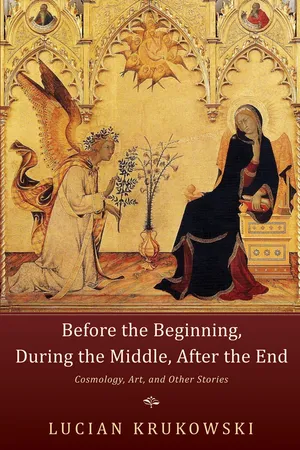
Before the Beginning, During the Middle, After the End
Cosmology, Art, and Other Stories
- 248 pages
- English
- ePUB (mobile friendly)
- Available on iOS & Android
eBook - ePub
Before the Beginning, During the Middle, After the End
Cosmology, Art, and Other Stories
About this book
The divisions that mark my subject are three. The first is that point where the world begins--where it appears from out of the mystery of non-being. The second lies somewhere between its progeny and its future--the times between beginnings and ends where we, the beneficiaries of our being-here, come together to sing a celebration of the wonder that it happened at all, and then intone the fear of its ending. The third division is a speculation on ends--our own and the ending of the world.
I use these divisions to locate a something that comes from nothing onto a historical tradition that imposes a value on the progression of that something, and so requires a judgment on all that has passed. I first discuss these through religious attempts to invest life and history with purpose--for they form the major explanatory traditions of Western culture and are a thematic source of much of its greatest art. I continue with an art-critical approach where themes of process and purpose are located in artworks through their stylistic histories and ambitions. I indicate how present art, when open to reconstitute such themes, could change the nature of today's efforts to give art polemical purposes, and so provide new reasons for its making. I conclude with some stories, unevenly biographical, partly fictional, which I offer as parables for the developed themes and their transformations. This last aim is to elucidate a view of art as providing specific symbols for a cosmology of beginning, living, and ending.
Information
Topic
PhilosophieI
First Things
The world continues on while we attest to its coming and going by writing and singing, by making art, war, and love. How our world began and how it will end are less clear than how it is being lived. The first and last of these are imprisoned in theory—conjectures about how (if) it was before beginning began—and inferences to the state of affairs after we, or something like us, ends. Neither state of affairs—if they are such—has a witness. Of course, conjecture and inference look for support—whether this comes from the mystical, rational, or empirical camps of thought. But the stretch back is awfully long, and the notion of nothing into something is obdurately vague. We do not even know whether anything ever did begin; we only know that about ourselves. Equally, when we talk about the end of the world, we still seem only to be talking about ourselves—for who (or what) else could describe what remains after the world (our world) has ended. We can extend the difficulty by saying that we have no knowledge about what preceeded the beginning of the universe (which includes our world as a proper part), nor do we have any idea of what the universe is like after all cognition (of our kind) has disappeared.
To find some clarity—and also retain our uniqueness—we wrap the world around ourselves by speaking of creation, redemption, and judgment, and of a source, a god or a process, as cause and reason for these transformations. In this sense, we and the world are alike in origin and conclusion in that something, of which we know little, provides for the mysteries of the beginning and the end.
I write here about three themes, which have to do with the passage of our world. I first identify them in the theological sense—as Creation, Annunciation, and Judgment. These are religous terms which, in one form or another, have been central in coping with the mysteries of being—the worlds we recall, inhabit, and anticipate. I do not endorse the cogency of these terms through my discussion, but I do offer them as a good vantage for a historical path into the limits of existence, and as support for my later attempts to find imagistic equivalents in both the history—and practice—of art.
Questions about the beginning, middle, and end of the world are typically approached through philosophic conjecture or scientific analysis. But such themes also have currency in art—not as questions evidently, but as evocative images. Here, I take a critical and hermeneutic approach within which themes of process and purpose can be located in artworks through their stylistic histories and ambitions. To further this, I indicate how present art, when open enough to reconsider or reconstitute such themes, could change the nature of today’s efforts to give art polemical purposes, and so provide other (better?) reasons for its making. I conclude this writing with some stories, unevenly biographical, partly fictional, which can be taken as parables for the developed themes and their transformations. The aim here is to elucidate a view of art as providing symbols of specific sorts for beginning, living, and ending.
This is a large order. But we who are agnostic, and so have less youth but more patience than do others, need to embrace large panoramas against which to pit our tools of invention and insight—even as we (grudgingly) try to stay within the limits of what we know. Notwithstanding these and other limits, I will project my best images of this journey into otherness through the transformation of my three themes into questions of how they came to be, what their internal changes are, and where their futures lie. However imaged, I try to keep these themes free of acrimonies, whether in the market place or in formal polemics, that would constrict their lives. Rather, as with all sources of good images—these themes should hover over but not rest on their material origins—nor be limited to the beliefs they have variously exemplified. I believe that themes and artworks should both be suspicious of chronology—they should not seek their justification in the uncertain histories of their makers or their times. These are best rethought with every reading or looking.
But images, like persons, have a fear of freedom: Does an image (or a theory) want to free itself from the security, and the limitations, of its material sources—and wander into what, for it, is not thinkable? Do persons (even those we esteem for their derring-do) ever free themselves from the supportive, yet restrictive, matter of the beliefs that they select to form their lives? Imagine Leibnitz’s disappointment at reading Carnap—or Michaelangelo’s at seeing a Rothko. But, as well, can such persons acknowledge—perhaps to their greater advantage—the impetus behind these beliefs, and so form a picture of the antinomic power these beliefs need to succeed themselves?
Even with these caveats—which I accept but do not submit to, for I have often said (to unbelievers) that I do not really care about the weighty lessons of the past or the looming trivialities of the future. But I write this in my own late time; and so must try—as do those others who are primed to bypass the inertia of old bodies and stagnant styles—to write as if free of place and precedent: We, you and I, will, as we must—no?—engage the grandiosiest themes to be found in our imagination, and then suffuse the unwarned world with their juices. Juices are mostly good! We cannot worry that interpretations of these themes do not conform to extant theories. “Extant” is good enough for those who are not habituated to parse and pick at how the world is—who do not admit to a warranted dislike of “present” (when was that?) affairs. I try, here, to say more than I have said before—to suggest new options about how it all first came together; and to suggest a standpoint, or two, from which to treat the question of what it all is like after it ends.
Themes, to be public, do not always need material bodies—but they can often be seen or heard, and sometimes smelled, felt and tasted. Then there are the other, more speculative, themes which do not want to be so identified—they are at two as regards the senses. We have a long history of ideas without bodies—which, when we think of it, has often caused the most grievous hurts to the bodies that they disdain. But here, although I shudder at the slaughters perpetrated in the name of disembodied principles, my aim is not recrimination. I want to put ideas and bodies into a continuum that is aware of past histories—including the histories that attempt to extend their own interests through special pleading, past the later times that offer contrary evidence. The subjects of my themes not only derive from physical history, they are also about speculative realities that extend beyond the before and after of our world. But these are realities we would want to, but cannot yet, maintain through causal claims that encompass the farthest parameters of what we call existence.
II
Three Themes
The divisions that mark my subject are three: The first is that point where the world begins—where it appears from out of the mystery of non-being. The second lies somewhere between its progeny and its future—that point between beginnings and ends where we, the beneficiaries of our being-here come together to sing a celebration of the wonder that it happened at all, and then intone the fear of its ending. The third division is a speculation on ways that mark the end—our own and the ending of the world. I use these to consider the logical difficulties of locating a something that comes from nothing (an uncaused cause), onto a linear historical tradition that imposes a value on the progression (progress?) of that something, and so requires a judgment which imparts a (final) verdict onto all that has happened before. I then look at putative distinctions between “before, now, after” to see if concepts of stasis, duration, and change can be made broad enough to clarify what it means to each to say the world began, is enduring, and will end. I first offer these through categories that are consonant with religious attempts to invest life and history with purpose—for these form the major explanatory traditions of western culture, and are a thematic source of much of its greatest art.
“Beginning” goes halfway from nothing to something. Haydn began his “Creation” with a slow murmurring that wasn’t going anywhere until a glorious major chord showed it the way to go. “Middle” is a somewhere perched between both sides, but it is also the moving, yet persistent, boundary between worlds that are antithetical: the kiss Caravaggio has Judas plant on the cheek of Christ. “End” is not a finality—only the unremarked moment when light fades and (our) sentience stops. It is an image brought beyond uttermost simplicity. If an image at all, it is one of unremitting dark—of silence or a black canvas—and is accompanied by the question of what all that was all about.
Creation
The first theme—Creation—is about transition between the before and after of the world’s beginning. Michaelangelo depicts God separating the light from the dark, and creating out of this, the sun, the earth, and the heavens. This theme carries the metaphysical state of being into the physical realm of what happens when “being begins”—although Michaelangelo does not show the condition before the advent of creation. Some theories hold that this transition is seamless and ongoing, and that the dividing prefixes “non” and “pre” are atavisms of a compartmentalized thinking—giving inordinate weight to the temporality of human consciousness. Other theories, perhaps professing the rigor of dialectic, expect the recognition of (perhaps discontinuous) totalities to remain a mode of explanation—even when lacking an enabling agent for the continuance between them. Theories of this kind point to “self-consciousness” as the evolutionary goal of developmental process. Hegel calls this process “Evolution of the Spirit”—a final (post-temporal) transcending of material limitation, and the end—and completeness—of the dialectic process. Jean Paul Sartre, more agnostically, uses such Hegelian terms as “an sich” (en-soi), “für-sich” (pour-soi), to show the expansion of consciousness from lower to higher biological forms—and into human self-consciousness. Sartre is not concerned with the physics, but rather with the the transition between consciousness to self-consciousness to social consciousness (pour-nous). The dialectic Sartre posits invariably generates an “other” to anything that is determined to be the case. (a guiding rationale for revolution). So even if there is no “non” or“ pre” to beginnings, there is something (perhaps the something of nothing) that provides a site for its intersection with actuality—a something which offers a promise of both discord and progress.
The advent of creation is more mysterious than its end, for it involves the “ex nihilo” aspect that confounds, but also lubricates, our speculations about causality. But it is difficult to pair nothing and something through a causal link—unless we find other concepts that help us bypass the difficulty of considering nothing as also a causal agent. Such concepts would have to hold nothing to be (or have) a different kind of something—thus requiring a new expression in both physical and metaphysical theory which affords a linkage (or obviates the distinction) between nothing and something—in our case, between pre-being and being.
We do not know the circumstances of the Big Bang; we were not there, and can only speculate about the nature of this state—if indeed there was one. But what preceded it—an infinite series of states of non-being? To avoid this threat of corrosive regress may require a freeing of thought from the limits of linearity, and a willingness to follow ideas that refute the very notion of a time-directed origin in favor of other notions—like that of a steady state of infinite change (a fashionable oxymoron), or Nietzsche’s cyclical “eternal return.”
The creation of the world, so another story goes, became an affront to the unitary but previously complacent Old-God who liked things as they were, but was misled by a scheming angel into thinking that totality would be even better—richer and more varied—with the projection of a newly created universe. Totality became richer and more varied, for sure—but it didn’t become better. Old-God, so misled, then became the wrathful God of scripture: He created hell, introduced sin and death, cast the first deviants out of heaven, and tried to make sure that human-kind is so sufficiently beleagered by change that God’s ancient holy writs, unless obeyed, will no longer alleviate the pain of the coming of the end.
It took the intervention of the Holy Spirit, the once consigliere, now elevated into full God-hood, newly occupying the center of the “Tri-une God”—to effect a truce between spirit and flesh, to reconcile belief and practice between old and new—and promote peace between Father and Son.
Annunciation
The second theme is about the transition from the early, primordial, world to the later world—the one we inhabit. It concerns a particular (historical and ideological) event—the birth of a man who is also God. It gives rise to the unique empathy and beneficence that humans—if only sometimes—are capable of; it is also a cause of seemingly endless strife. In pacific times, this theme offers, through its symbols, an exhortation—a soft but insistent imperative for greater communion among peoples: “Fluff my feathers and I’ll scratch your back.” In times of strife, however, this theme carries a plea to re-humanize the enemy: to love those whom you hate in a way that will stop the fighting.
On its face, the Annunciation is miraculous—and so requires a certain pattern of belief in both the absence of original sin and the forgiveness of ongoing sin. Yet, the consequence of the Annunciation—the Immaculate Conception, the birth, crucifixion, and resurrection of Christ—augur the growth of Christianity as a social force by providing a bridge between an abstract yet punitive God, and a concrete God-as-man who offers forgiveness of sin during life, and salvation after death.
This flexibility loosened narrow ideologies and became the force behind Western civilization in its drive to power and (sometime) cultural supremacy. Christ offers redemption to all—thus giving a guarantee for life after death to those who adhere to that belief. Christianity also offers protocols for a just society—everyone, even the King, is subject to sin and forgiveness, thus giving wide credence for belief—and for waging war against unbelievers.
Within the historical span between the decline of Rome and our own great wars, the Annunciation seems to me the best point to demarcate the transfer of power from the ancient east to the modern west. After Christ, the Western world began: Martyrdoms, the Crusades, discord between the Inquisition and the Monastery, Luther’s reformation, wars and more wars (most of them between Christian nations), the death of God, the secular state, and here we are—doing it all over again. It is hard to ascribe all this pain and sorrow to the (pre-Christian) God of Old. Perhaps, in his high demesnes, he did not realize—although he had created them—how skillful are these ratty descendents of the first sinners, how they could turn his noble but simple dictates into their pious but predatory purposes. Hopefully, his Son could change them—by being more like them—but still enough like Him.
End
Ends, however painful, are more picturesque than beginnings—think of the “last judgments” that were painted with such appetite in, say, t...
Table of contents
- Title Page
- Chapter 1: First Things
- Chapter 2: Three Themes
- Chapter 3: Divisions
- Chapter 4: Cosmologies
- Chapter 5: Passages
- Chapter 6: Birds
- Chapter 7: Ontological Questions
- Chapter 8: Images as Portents
- Chapter 9: Antecedents
- Chapter 10: Preamble to Making Art
- Chapter 11: Proposals for Making Art
- Chapter 12: Perplexities in Making Art
- Chapter 13: Ways of Making Art
- Chapter 14: Reasons for Making Art
- Chapter 15: A Return to Origins
- Chapter 16: Savanna
- Chapter 17: Edvard and Umma
- Chapter 18: Walter
- Chapter 19: Anna
- Chapter 20: Pain and Pleasure
- Chapter 21: Beginning, Middle, End
Trusted by 375,005 students
Access to over 1.5 million titles for a fair monthly price.
Study more efficiently using our study tools.
Frequently asked questions
Yes, you can cancel anytime from the Subscription tab in your account settings on the Perlego website. Your subscription will stay active until the end of your current billing period. Learn how to cancel your subscription
No, books cannot be downloaded as external files, such as PDFs, for use outside of Perlego. However, you can download books within the Perlego app for offline reading on mobile or tablet. Learn how to download books offline
Perlego offers two plans: Essential and Complete
- Essential is ideal for learners and professionals who enjoy exploring a wide range of subjects. Access the Essential Library with 800,000+ trusted titles and best-sellers across business, personal growth, and the humanities. Includes unlimited reading time and Standard Read Aloud voice.
- Complete: Perfect for advanced learners and researchers needing full, unrestricted access. Unlock 1.5M+ books across hundreds of subjects, including academic and specialized titles. The Complete Plan also includes advanced features like Premium Read Aloud and Research Assistant.
We are an online textbook subscription service, where you can get access to an entire online library for less than the price of a single book per month. With over 1.5 million books across 990+ topics, we’ve got you covered! Learn about our mission
Look out for the read-aloud symbol on your next book to see if you can listen to it. The read-aloud tool reads text aloud for you, highlighting the text as it is being read. You can pause it, speed it up and slow it down. Learn more about Read Aloud
Yes! You can use the Perlego app on both iOS and Android devices to read anytime, anywhere — even offline. Perfect for commutes or when you’re on the go.
Please note we cannot support devices running on iOS 13 and Android 7 or earlier. Learn more about using the app
Please note we cannot support devices running on iOS 13 and Android 7 or earlier. Learn more about using the app
Yes, you can access Before the Beginning, During the Middle, After the End by Lucian Krukowski in PDF and/or ePUB format, as well as other popular books in Philosophie & Histoire et théorie de la philosophie. We have over 1.5 million books available in our catalogue for you to explore.