- 230 pages
- English
- ePUB (mobile friendly)
- Available on iOS & Android
eBook - ePub
About this book
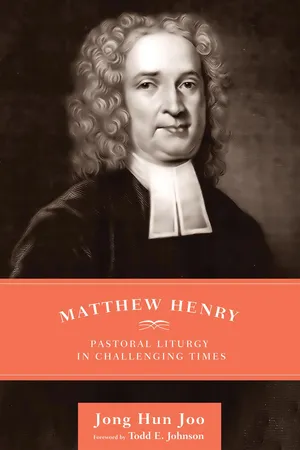
Jong Hun Joo offers a model of how both solid biblical understanding and effective practice of worship can be realized in churches today by exploring the theology and practice of Matthew Henry (1662-1714). Matthew Henry is one of the most famous biblical commentators in the English-speaking world. However, Henry was also a pastor who was liturgical in negotiating the political and religious landmines of his day. This all but overlooked aspect of Henry's biography and writings is both a window into his life and times and an insightful view into the pastoral dimensions of Christian rituals and practices in the home and church. Joo discerns how Henry understood and practiced English Presbyterian worship as an example of Reformed worship in his context and, further, based on the principles found in Henry's writings and practices, Joo suggests how contemporary churches can appropriately develop and articulate their own worship in their own contexts. In so doing he makes a case for worship renewal.
Information
Topic
Theologie & ReligionSubtopic
Christlicher Dienst1
English Presbyterian Worship in the Restoration and Aftermath
The Liturgical Context of Matthew Henry
When Matthew Henry (1662–1714) began his ministry at Chester in 1687 as a nonconformist Presbyterian divine, the liturgical context of England had been in a state of flux in many ways for twenty-five years. The liturgical changes of this English Restoration era shaped the historical context of Matthew Henry’s developing Presbyterian worship ministry. Henry learned and experienced Presbyterian worship mainly from English nonconforming dissenters within the Restoration era (1660–1689), and he ministered at Chester and Hackney for twenty-seven years during the period of liturgical indulgence that began in 1687, until his death in 1714. During this thirty-year period, Matthew Henry made little change in the structure and method of private and public worship. He practiced and led worship without changes from inward or outward causes in this period of toleration towards the liturgy. His decisions on worship for the congregations both in Chester and Hackney were shaped from learning and experiencing English Presbyterian worship during the persecution of the nonconforming dissenters. Thus, liturgical changes in the Restoration era could be regarded as the main context for Henry’s understanding and implementation of Presbyterian worship.
This chapter does not attempt to analyze the general issues about the English Restoration1 or the historical case of any specific territories in England;2 instead it attempts to examine the transition of English Presbyterian worship in the Restoration era as Henry’s liturgical context. At that time, the policy of the king and decision of parliament directly determined the manner of worship since every religious policy was sanctioned by the state. Thus, in order to understand changes in worship of that period, it is necessary to comprehend liturgy within the political and religious context. Recent research has given historians new perspectives on various aspects of the Restoration era.3 With help from historical research, this chapter will focus on how English Presbyterian worship was changed by the restoration of the monarchy. What was the vision of English Reformed Presbyterian ministers at the beginning of this period? What were the main changes—and the causes of these changes—in English Presbyterian worship under the condition of persecution? How did English Presbyterians respond to political freedom and what were Matthew Henry’s choices regarding the liturgy in a context of toleration? By answering these questions, this chapter will illustrate the way English Presbyterians upheld the Reformed principle of worship during the Restoration era and will explore the liturgical context in which Matthew Henry began his ministry.
The Vision of English Reformed Presbyterian Worship
In 1660, two years before Henry’s birth, the nation experienced the restoration of the English monarchy. For the Puritan nonconformists the Restoration meant a period of continuous religious persecution and strife. The persecution for the nonconformists, the Presbyterians, Independents, Baptists, and Quakers, did not begin outside of any context; they were “all dissenters from the church as established by law.”4 The persecution of them was the result of repeated decisions of Charles II and the Parliament and the nonconformists’ rejections of the religious politics of the state. In order to understand how and why the English Presbyterians refused to follow the religious politics of the king and parliament and were thus persecuted, it is first necessary to examine their exact situation when the Restoration began. We need to explain the English Presbyterians’ vision of worship and how they attempted to realize this vision within Restoration in England. The English Presbyterians’ vision of worship at the beginning of the Restoration era can be seen best in the work of Richard Baxter (1615–1691). Richard Baxter’s “Savoy Liturgy” or “Reformed Liturgy” (1661) shows the elements of the English Presbyterian vision when the Restoration began, although it was not implemented in the Presbyterian congregations in history. This section will investigate three points in Baxter’s liturgy: why Baxter tried to write and use a new book of worship; what it included in the form and content of worship; and to what extent it can be seen as Reformed worship.
Political and Religious Attempts to Unify the Anglican and Presbyterian Form of Worship
When the restoration of the monarchy began in 1660, Charles II “issued a declaration [Declaration of Breda] promising ‘a liberty to tender consciences . . . that no man shall be disquieted, or call in question, for differences of opinion in matters of religion which do not disturb the peace of the kingdom.’”5 Regardless of the motives,6 this declaration of Charles II shows his desire for religious toleration. John Spurr assessed Charles’s policy on toleration by saying that “[he] intended to bind the bleeding wounds of his English kingdom, to abolish all notes of discord, separation, and difference of parties, by pardoning past crimes, extending liberty in religion to those of a tender conscience, and referring all disputed property titles to parliament.”7 Bard Thompson, liturgical historian, also pointed out t...
Table of contents
- Title Page
- Foreword
- Acknowledgments
- Introduction
- Chapter 1: English Presbyterian Worship in the Restoration and Aftermath
- Chapter 2: The Life and Thought of Matthew Henry
- Chapter 3: Matthew Henry on Christian Worship
- Chapter 4: Matthew Henry’s Theology of the Sacraments
- Chapter 5: Reformed Tradition in Henry’s Presbyterian Public Worship Service
- Chapter 6: Conclusion
- Bibliography
Trusted by 375,005 students
Access to over 1.5 million titles for a fair monthly price.
Study more efficiently using our study tools.
Frequently asked questions
Yes, you can cancel anytime from the Subscription tab in your account settings on the Perlego website. Your subscription will stay active until the end of your current billing period. Learn how to cancel your subscription
No, books cannot be downloaded as external files, such as PDFs, for use outside of Perlego. However, you can download books within the Perlego app for offline reading on mobile or tablet. Learn how to download books offline
Perlego offers two plans: Essential and Complete
- Essential is ideal for learners and professionals who enjoy exploring a wide range of subjects. Access the Essential Library with 800,000+ trusted titles and best-sellers across business, personal growth, and the humanities. Includes unlimited reading time and Standard Read Aloud voice.
- Complete: Perfect for advanced learners and researchers needing full, unrestricted access. Unlock 1.5M+ books across hundreds of subjects, including academic and specialized titles. The Complete Plan also includes advanced features like Premium Read Aloud and Research Assistant.
We are an online textbook subscription service, where you can get access to an entire online library for less than the price of a single book per month. With over 1.5 million books across 990+ topics, we’ve got you covered! Learn about our mission
Look out for the read-aloud symbol on your next book to see if you can listen to it. The read-aloud tool reads text aloud for you, highlighting the text as it is being read. You can pause it, speed it up and slow it down. Learn more about Read Aloud
Yes! You can use the Perlego app on both iOS and Android devices to read anytime, anywhere — even offline. Perfect for commutes or when you’re on the go.
Please note we cannot support devices running on iOS 13 and Android 7 or earlier. Learn more about using the app
Please note we cannot support devices running on iOS 13 and Android 7 or earlier. Learn more about using the app
Yes, you can access Matthew Henry by Jong Hun Joo in PDF and/or ePUB format, as well as other popular books in Theologie & Religion & Christlicher Dienst. We have over 1.5 million books available in our catalogue for you to explore.