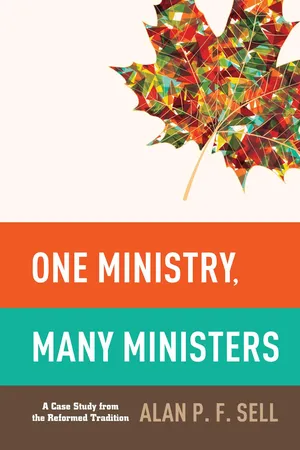
- 158 pages
- English
- ePUB (mobile friendly)
- Available on iOS & Android
eBook - ePub
About this book
The heart of this book is the claim that the one church catholic comprises all who, on the ground of Christ's saving work, are called and gathered by God the Holy Spirit into a fellowship whose only Head is Christ himself; and that all thus called are granted the high privilege of sharing in a variety of ways in the one ministry of Christ. This is the vision of the Reformed churches past and present. Alan Sell argues that far from being a parochial enquiry, the nature of the ministry and the work and education of all the ministers are issues as relevant to the life and practice of particular local churches as they are to ecumenical discussions between the several Christian world communions.
Information
Topic
Teologia e religioneSubtopic
Chiesa cristiana1
Introduction
Like William Jay of Argyle Congregational Church, Bath, I was a boy preacher: we both delivered our first public sermon at the age of sixteen. Unlike William Jay, I did not subsequently remain in one pastorate for sixty-two years. On the contrary, I left regular pastoral charge forty-five years ago. In the eyes of some this may suffice to disqualify me for writing on the ministry, for in many respects church life has undergone a sea-change since 1968. In fact, however, I, who regard myself as a creature of the villages who envisaged a life-time in rural pastorates, have had the quite unexpected privilege of ministering in a variety of ways in many parts of the world. I have had opportunities of teaching students, some of them destined for ministry, in both church and secular institutions at home and abroad. I have learned much from discussing the nature and content of ministerial education with those responsible for providing it in five continents, and I have participated in numerous ecumenical discussions of ministry and other neuralgic topics.
In what follows I set out from the conviction that the primary ministry is that of the risen and ascended Christ, the one Lord of the church, and that he deigns to exercise it not only through those who are called to be ministers of the gospel, but through all the saints. For they, no less than the ministers, are called to use the gifts they have received in witness and service within and beyond the church. In attempting to make this case, I shall draw upon my experience as appropriate, but, much more importantly, I shall seek to recall my readers to the biblically-rooted heritage of reflection on the ministry to which we of The United Reformed Church are heirs. We shall find that over the past 450 years it has been consistently held by our predecessor traditions and ourselves that ministers of the gospel are to lead the church’s worship, to preach the gospel and give pastoral care, and to educate the saints in the faith so that they may the more effectively perform their several ministries. We shall also find that as regards the preparation of our ministers of the gospel, it has never been the case that “one size fits all.” People have come into the ministry by a variety of routes, and they have been educated through courses which have been diverse in location, content, and academic level. But all of our ministers have stood, or stand, in the noble succession of those who have proclaimed the apostles’ gospel through the Christian ages, and many of them have much to teach us. Accordingly, as well as pondering our present situation, we shall “Remember the days of old” (Deut 32: 7). We shall do this not in the interests of nostalgia, or of escaping from current challenges, but because we recognise that we are not the first to have undertaken, or reflected upon, ministry. But let our remembering be of the Hebrew sort.
According to the ancient narrative, when Moses’ successor, Joshua, had successfully led the wandering Hebrews over the river Jordan into the promised land of Canaan, he ordered one man from each of the twelve tribes of Israel to gather one stone, and for these to be erected as a memorial. Then Joshua said, “In days to come, when your children ask what these stones mean, you will tell them how the waters of the Jordan were cut off before the Ark of the Covenant of the Lord. . . . These stones will always be a reminder to the Israelites” (Josh 4: 6–7). In other words, uninscribed mounds of stone require interpretation, and as the years pass by memory is required, and the memory must be handed on from generation to generation. Why? Not simply so that as a matter of interest later generations shall know what happened in the past, but so that they will give thanks to the God who did great things, reconsecrate themselves to his service, mend their ways, and go forward in obedience and faith. Hebrew remembering is a matter of recalling the past into the present so that it revitalizes us for the future. It is to recall the past in such a way that we do not stagnate, but go forward strengthened by it. Is not this exactly what we do as often as we gather at the Lord’s table? Through words and actions we recall who Jesus is and what he has done for us in the victory of the Cross, and we go forward thankfully, strengthened and rejoicing in his continuing presence, eager to proclaim and live by the good news of his love. Our remembering can only be done, and our reinvigorated witness can only be made, in the context in which we have been set.
With these preliminary thoughts in mind, we turn now to consider the nature and work of ministry, and the education of the ministers.
2
The Nature of Ministry
The Ministry of Christ and of all the saints
When we read or hear about “the ministry,” I suppose that our thoughts tend to fly to those whom we call “the minister.” Or we may think, like Paul, of the diversities of ministries that are to be found in the church. We need to remember that all of the forms of ministry with which we are familiar need to be seen in the light of the fact that there is really one ministry only in the church, namely, that of the risen Christ himself. Nobody put it more crisply than T. W. Manson: “There is only one ‘essential ministry’ in the Church, the perpetual ministry of the Risen and Ever-Present Lord Himself.”1 A document of the Presbyterian Church of Canada helpfully fills out this statement:
There is only one ministry of redemption for the world, that of Jesus Christ. He is the living Word of God, the source and steward of all power and authority for ministry. All ministries of the Church proceed from and are sustained by the ministry of the Lord Jesus Christ. When patterned on the example of Christ, the diverse ministries of the Church will be grounded in the creative and redemptive purposes of God, exercised through the presence of Christ, and sustained by the power of the Holy Spirit.2
To this T. F. Torrance adds the important truth that to follow the example of Christ is to participate “in the obedience of Christ.”3
Although the church is called to model Christ’s ministry in its own life, and to be about Christ’s business in the world, I think that we seriously overstate our position as the people of God if we say, as some do, that the church is a prolongation, continuation, or extension of the incarnation of Christ. Such language unduly exalts the church and unintentionally diminishes the significance of the incarnation. P. T. Forsyth’s curt rebuttal of the notion may stand: “that which owes itself to a rebirth cannot be the prolongation of the ever sinless.”4 The church comprises believers, saints, who have made a Spirit-enabled response to the call of God’s grace in the gospel. But, as the slightest glance at some of the New Testament epistles would confirm—indeed, significant tracts of the epistles would not have been written had the saints been behaving themselves—the saints remain sinners on the path of sanctification. By grace we become Christians, not Christs—even little ones; and this applies both to the individual Christian and to the church at large.
The wonder is that despite his treasure being in an earthen vessel, Christ’s continuing ministry is performed through the laos (laity), the people of God, and every member is called to offer such gifts as have been received in service to, and through, the whole company: “There is a ministry to be fulfilled by the whole Church, through all its individual members and through its corporate life.”5 Some forms of ministry are general in nature: we are all called to witness for Christ, to uphold one another in prayer, and to bear one another’s burdens. Other ministries are more specific: they are particular callings addressed by God to those relevantly gifted. The New Testament records a number of these, including apostles, prophets, evangelists, pastors, and teachers (Eph 4:11–12); and let us not forget the callings of such as Ephraim Tellwright. He was a Methodist local preacher, but “It was in the finance of salvation that he rose supreme—the interminable alteration of debt-raising and new liability which provides a lasting excitement for Nonconformists. . . . The minister by his leading might bring sinners to the penitent form, but it was Ephraim Tellwright who reduced the cost per head of souls saved, and so widened the frontiers of the Kingdom of Heaven.”6 The purpose of the particular ministries within the church is to enable all the saints to fulfil their vocations as servants and witnesses for Christ, not only within the church, but out in the world.
What great service has been rendered by the faithful testimony of the saints! Referring to the early Christian centuries, T. W. Manson observed that
The great preachers came after Constantine the Great; and before that Christianity had already done its work and made its way right through the Empire from end to end. When we try to picture how it was done we seem to see domestic servants teaching Christ in and through their domestic service, workers doing it through their work, small shopkeepers through their trade, and so on, rather than eloquent propagandists swaying mass meetings of interested enquirers. It is still true that the best propaganda for genuine Christianity is genuine Christians.7
It is sobering for ministers of the gospel to ponder the fact that some impressive advances of the Christian mission occurred when they were nowhere to be seen. During the English Civil War, for example, a number of ministers fled for safety from Wales to London, among them Walter Cradock of Llanvaches. In a sermon he wrote,
I have observed, and seen, in the Mountains of Wales . . . the Gospel is run over the Mountaines between Brecknockshire and Monmouthshire, as the fire in the thatch; and who should doe this? They have no Ministers: but some of the wisest say, there are about 800 godly people, and they goe from one to another. They have no Ministers, it is true; if they had, they would honour them and blesse God for them: and shall we raile at such, and say they are Tubpreachers, and they were never at the University? Let us fall downe, and honour God. . . . They were filled with good newes, and they tell it to others.8
The ministry, under Christ, of the whole people of God is sometimes referred to as the priesthood of all believers. This p...
Table of contents
- Title Page
- Preface
- Chapter 1: Introduction
- Chapter 2: The Nature of Ministry
- Chapter 3: The Work of the Ministry
- Chapter 4: The Work of the Ministry
- Chapter 5: The Education of the Ministers
- Appendix 1: The Trinitarian Blessing
- Appendix 2: The Councils of The United Reformed Church
- Appendix 3: A Charge to the Minister and the Church
- Bibliography
Trusted by 375,005 students
Access to over 1.5 million titles for a fair monthly price.
Study more efficiently using our study tools.
Frequently asked questions
Yes, you can cancel anytime from the Subscription tab in your account settings on the Perlego website. Your subscription will stay active until the end of your current billing period. Learn how to cancel your subscription
No, books cannot be downloaded as external files, such as PDFs, for use outside of Perlego. However, you can download books within the Perlego app for offline reading on mobile or tablet. Learn how to download books offline
Perlego offers two plans: Essential and Complete
- Essential is ideal for learners and professionals who enjoy exploring a wide range of subjects. Access the Essential Library with 800,000+ trusted titles and best-sellers across business, personal growth, and the humanities. Includes unlimited reading time and Standard Read Aloud voice.
- Complete: Perfect for advanced learners and researchers needing full, unrestricted access. Unlock 1.5M+ books across hundreds of subjects, including academic and specialized titles. The Complete Plan also includes advanced features like Premium Read Aloud and Research Assistant.
We are an online textbook subscription service, where you can get access to an entire online library for less than the price of a single book per month. With over 1.5 million books across 990+ topics, we’ve got you covered! Learn about our mission
Look out for the read-aloud symbol on your next book to see if you can listen to it. The read-aloud tool reads text aloud for you, highlighting the text as it is being read. You can pause it, speed it up and slow it down. Learn more about Read Aloud
Yes! You can use the Perlego app on both iOS and Android devices to read anytime, anywhere — even offline. Perfect for commutes or when you’re on the go.
Please note we cannot support devices running on iOS 13 and Android 7 or earlier. Learn more about using the app
Please note we cannot support devices running on iOS 13 and Android 7 or earlier. Learn more about using the app
Yes, you can access One Ministry, Many Ministers by Alan P.F. Sell in PDF and/or ePUB format, as well as other popular books in Teologia e religione & Chiesa cristiana. We have over 1.5 million books available in our catalogue for you to explore.