- 220 pages
- English
- ePUB (mobile friendly)
- Available on iOS & Android
eBook - ePub
About this book
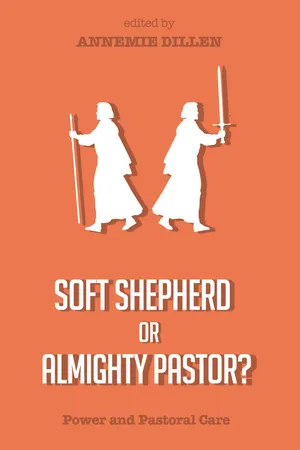
In Soft Shepherd or Almighty Pastor? contributors seek to go beyond the taboo on "power" within pastoral contexts. They not only discuss fundamental theological and philosophical questions about power but also develop ways to prevent power abuse in pastoral context. Power is considered as omnipresent and is analyzed in its positive and negative aspects. Not only the classical associations of "power over" or "domination" are discussed in relation to ecclesial and pastoral situations, but also forms of power linked to "service" and "care." A sacrificial spirituality might also be dangerous.
Soft Shepherd or Almighty Pastor? gathers ten contributions, all of which reflect on the complexity of power issues, also in relation to sexual abuse. The authors argue that dealing adequately with power requires renewed forms of theological thinking, especially about ministry.
Information
Topic
Theology & ReligionSubtopic
Christian Ministrypart 1
Fundamental Philosophical and Theological Reflections on Power and Pastoral Care
1
A Web of Power
Toward a Greater Awareness of the Complexity of Power
Power is a complex phenomenon. The different ways and contexts in which power is used, indicate this clearly. In general practical theological literature and in practical theological literature relating to power, power relations, or power abuse, power is often endowed with different meanings and a (clear) definition of power is often lacking.
It is not easy to give a clear general definition of power that is applicable in every context, and perhaps this is not necessary. Nevertheless, such a definition is important in order to gain insight into the phenomenon of power and to reveal power in all its complexity. A clear description of power can create a greater awareness of the power present in every relationship and may increase the possibility of power being dealt with in an appropriate way.
The purpose of this chapter is to reveal the complexity of power on the basis of the insights of the German sociologist Max Weber (1864–1920) and of the French philosopher Michel Foucault (1926–1984) on power. These insights will be completed with the insights of some practical theologians on power.
Everyone Has Power
Everyone has power or at least everyone has a certain access to or—as Weber argues1—everyone has the opportunity for power. Foucault,2 and some other practical theologians,3 describes this with the term “circular power.” According to Foucault, power may not be seen as something that only can be made use of by certain people. He states that power is a dynamic phenomenon that is always in motion and that is available to all, but does not structurally belong to a subject.
Everyone has a certain access to power, but how much power a person possesses, and to what extent he or she can exercise this power depends on several factors. First, it depends on the situation.4 A professor has for example a certain power over his or her students in an auditorium. But outside of this auditorium, one of the professor’s students can also have power over the professor, for example if the student happens to be the professor’s gym teacher at the sports club. The meeting place determines in this example how much access a person has to power. Another possible example, in which the situation clearly plays a role, is the example of a teacher who has at one moment much power over the class because the students find the topic very interesting, but who has less power at another moment because the students are not interested in the topic and therefore refuse to cooperate.
Secondly, social identity plays a role in how much access a person has to power.5 Characteristics such as gender, age, ethnic origin, social status, class, and sexual inclination determine the access to power. The social identity determines which “position” a person has in society and is thus closely linked with positional power.6 For example, a thirty year old Western man has more chance of finding a job in Belgium than a fifty year old Western man, or than a African peer of the same age. A person’s position (of power) in society is connected to a large extent with the social identity of the person, which determines the access to certain means of power and the possibility of exercising power.7 Since every person has a social identity, and this social identity determines a person’s position of power, it may be said that, although in theory, social identity not should lead to hierarchical power, it does in fact involve thinking in terms of hierarchical power. Because of their social identity, some people are considered to be “superior” and therefore as “more powerful” than other persons.
By stating that every person has, in principle, the possibility of exercising power, this also means that no one person is completely powerless. Even if one is in a situation in which he or she has a sense of powerlessness, there is still the possibility of using power when one has a certain access to it. The constant access to power ensures that in every situation—even where the situation seems hopeless—the possibility of resistance exists. For example, if an employer announces a collective redundancy, employees can resist by striking. By means of a strike, a certain pressure on and certain power over the employer can be exerted, in the hope that the redundancy will be avoided. Since every person has access to power, a glimmer of hope always exists. There is always the hope that the situation can be improved and that the balance of power can change. The present situation does not need to remain as it is. Furthermore, the fact that no one is completely powerless offers the possibility of, and opportunity for empowerment. The idea that one has always a certain power may empower a person and may give the person the strength to use this always available power.
The circular thinking relating to power makes mutuality possible in a relationship. A mutual relationship is often considered as a “perfect” relationship, one without any abuse of power. In this respect, mutuality is often seen as the solution for preventing power abuse in a relationship.8 But even in a mutual relationship, power abuse can occur and usually does so in a subtle way. Mutuality should then rather be seen as an ideal that should be pursued in every relationship. The existence of mutuality in a relationship creates space for “give and take” and demands that the other person is considered as a subject with a certain power. Mutuality in a relationship does not imply that the relationship has to be symmetrical or that the power in the relationship has to be symmetrical. In an asymmetrical relationship, and in a relationship with an imbalance of power, mutuality is also possible. Mutuality may not be seen as equality in the relationship, but must rather be thought of in terms of equivalence.9 It is important to recognize that each person in the relationship is fundamentally equal. But being fundamentally equal does ...
Table of contents
- Title Page
- Preface
- Introduction: Power, Church, and Pastoral Care: Beyond the Taboo
- Part 1: Fundamental Philosophical and Theological Reflections on Power and Pastoral Care
- Chapter 1: A Web of Power
- Chapter 2: Power and Compassion in Pastoral Work
- Chapter 3: Beyond the Almighty Pastor
- Part 2: Power and Interculturality
- Chapter 4: Self-Affirming Prejudice and the Abuse of Pastoral Power
- Chapter 5: “When I Am Weak, Then I Am Strong”
- Part 3: Power and Sexual Abuse
- Chapter 6: Intimacy in Pastoral Care
- Chapter 7: A Wolf in Sheep’s Clothing
- Part 4: Challenges for Theology and Pastoral Praxis
- Chapter 8: Empowerment in Pastoral Care for Persons with a Psychiatric Disorder
- Chapter 9: The Meaning of Informed Consent in Pastoral Counseling
- Contributors
Trusted by 375,005 students
Access to over 1.5 million titles for a fair monthly price.
Study more efficiently using our study tools.
Frequently asked questions
Yes, you can cancel anytime from the Subscription tab in your account settings on the Perlego website. Your subscription will stay active until the end of your current billing period. Learn how to cancel your subscription
No, books cannot be downloaded as external files, such as PDFs, for use outside of Perlego. However, you can download books within the Perlego app for offline reading on mobile or tablet. Learn how to download books offline
Perlego offers two plans: Essential and Complete
- Essential is ideal for learners and professionals who enjoy exploring a wide range of subjects. Access the Essential Library with 800,000+ trusted titles and best-sellers across business, personal growth, and the humanities. Includes unlimited reading time and Standard Read Aloud voice.
- Complete: Perfect for advanced learners and researchers needing full, unrestricted access. Unlock 1.5M+ books across hundreds of subjects, including academic and specialized titles. The Complete Plan also includes advanced features like Premium Read Aloud and Research Assistant.
We are an online textbook subscription service, where you can get access to an entire online library for less than the price of a single book per month. With over 1.5 million books across 990+ topics, we’ve got you covered! Learn about our mission
Look out for the read-aloud symbol on your next book to see if you can listen to it. The read-aloud tool reads text aloud for you, highlighting the text as it is being read. You can pause it, speed it up and slow it down. Learn more about Read Aloud
Yes! You can use the Perlego app on both iOS and Android devices to read anytime, anywhere — even offline. Perfect for commutes or when you’re on the go.
Please note we cannot support devices running on iOS 13 and Android 7 or earlier. Learn more about using the app
Please note we cannot support devices running on iOS 13 and Android 7 or earlier. Learn more about using the app
Yes, you can access Soft Shepherd or Almighty Pastor? by Annemie Dillen, Dillen in PDF and/or ePUB format, as well as other popular books in Theology & Religion & Christian Ministry. We have over 1.5 million books available in our catalogue for you to explore.