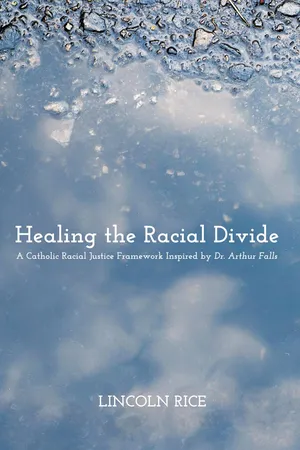
eBook - ePub
Healing the Racial Divide
A Catholic Racial Justice Framework Inspired by Dr. Arthur Falls
- 216 pages
- English
- ePUB (mobile friendly)
- Available on iOS & Android
eBook - ePub
Healing the Racial Divide
A Catholic Racial Justice Framework Inspired by Dr. Arthur Falls
About this book
Healing the Racial Divide retrieves the insights of Dr. Arthur Falls (1901-2000) for composing a renewed theology of Catholic racial justice. Falls was a black Catholic medical doctor who dedicated his life to healing rifts created by white supremacy and racism. He integrated theology, the social sciences, and personal experience to compose a salve that was capable of not only integrating neighborhoods but also eradicating the segregation that existed in Chicago hospitals. Falls was able to reframe the basic truths of the Christian faith in a way that unleashed their prophetic power. He referred to those Catholics who promoted segregation in Chicago as believers in the "mythical body of Christ," as opposed to the mystical body of Christ. The "mythical body of Christ" is a heretical doctrine that excludes African Americans and promotes the delusion that white people are the normative measure of the Catholic faith.
Information
Topic
Theology & ReligionSubtopic
Christian Theology1: Black Experience and Empowerment in Catholic Thought
This chapter will examine more deeply the current state of Catholic racial justice—particularly as it pertains to the role of black agency and the use of black sources in Catholic racial justice. “Black agency” refers to the role that African Americans are deemed to possess in working toward racial justice in society, and “the use of black sources” refers to the extent that the intellectual, cultural, and ecclesial experiences of African Americans are incorporated into a theological framework of racial justice. The first section of this chapter will survey authors who offer a more limited view of African American sources and black agency. The latter section will consider authors who make greater use of and give greater legitimacy to black agency and experience. The first section will begin with an examination of the life and writings of John LaFarge, who, in addition to being a contemporary of Falls, was the most prominent American exponent of Catholic racial justice during the first half of the twentieth century, and whose impact is still discernible in the documents of American bishops. This section will then appraise documents from the United States Conference of Catholic Bishops, the Vatican’s Pontifical Council for Justice and Peace, and the statements of individual American bishops. The second section will examine James Cone, Shawn Copeland, Bryan Massingale, and Jon Nilson.
Limited Use of Black Agency and Experience
John LaFarge
John LaFarge, S.J. (1880–1963), a contemporary of Falls, was the most famous Catholic champion of racial justice during the first half of the twentieth century. He rose to prominence in the interracial relations movement when he became involved with the Federated Colored Catholics (FCC). The FCC was founded in 1924 by Dr. Thomas Wyatt Turner (1877–1978), a biologist, to further the cause of African American Catholics in the Catholic Church, as well as to promote self-worth and to provide leadership opportunities.1 The independence of this group from clerical leadership and its methods of self-determination to solve the oppression of blacks made LaFarge uncomfortable. As historian David Southern observes, “LaFarge simply disliked protest with an African American accent.”2 He believed that the FCC should have clerical leadership and focus primarily on employing moral suasion and appealing to white sympathy to bring about racial justice.3 In 1932, after garnering enough support from black Catholics within the FCC, LaFarge and fellow Jesuit William Markoe orchestrated a constitutional revision of the FCC, which resulted in a change of aims and leadership for the organization.4 As Southern notes, after LaFarge took over the movement, “instead of raising a cadre of black leaders, the Catholic interracial movement actually helped create a vacuum of black leadership in the church.”5
In his 1937 book, Interracial Justice, LaFarge advocated for the integration of public and Catholic schooling in the United States, well before the 1954 Brown v. Board of Education of Topeka court case, which ruled that separate but equal was unconstitutional. Interracial Justice pointed to a twofold approach for Catholic action in the attainment of interracial justice: (1) “the combating of race prejudice,” and (2) “the establishment of social justice.”6 LaFarge defined racial justice as an “equality of opportunity” for all groups or individuals, regardless of race.7 LaFarge’s understanding of racism did not address how to create an equality of opportunity when great economic disparity already exists between blacks and whites.8 Southern notes that the interracial movement had a history of applying pressure on the northern Church to integrate Catholic schools, hospitals, and seminaries, but that LaFarge was “more successful at improving the church’s image than in changing the church’s behavior.”9
LaFarge had greatly refined and simplified his theology of racial justice by 1956, when he published The Catholic Viewpoint on Race Relations. This work, which was published near the end of his life, proposed that growing economic security for blacks depended on the social attitudes of whites toward African Americans. For LaFarge, there was little that blacks could do to improve or contribute to the betterment of their own situation. LaFarge cited African Americans from time to time, but not as inspiration for his thought; instead, their writings served as proof-texts for his own preconceived notions. In a subtle jab at the policies of the FCC before he and Markoe took over the organization, he stated that “the more repeatedly the demands [for justice] were uttered, the less attention and interest did they create.”10 He considered the black empowerment presence in the FCC to be a form of separatism that made its members’ calls for integration hypocritical. He believed that after being properly educated, whites would destroy the idol of racism they were worshipping. An emphasis on white agency and clerical leadership was necessary because “although the Negro is the victim of discrimination, he does not necessarily know the answer or the cure.”11 Such a sentiment left scant room for appreciating either African American sources or black agency. Essentially, LaFarge’s thought did not extend beyond the theology found in the papal encyclicals on labor, such as Rerum novarum. The papal social encyclical tradition does not advocate that the oppressed should confront their oppressors, but rather promotes the use of moral suasion to convince those in power to act properly.12
U.S. Bishops’ Statements
Discrimination and the Christian Conscience
In 1958, the U.S. bishops issued their first major post-World War II document on racism—Discrimination and the Christian Conscience. In the wake of Brown v. Board of Education of Topeka (1954), twenty-one documents decrying segregation had been published by various Protestant denominations before the issuance of the U.S. bishops’ document. This document, authored by Fr. John Cronin, S.S. (1908–1994), was published only after the death of a prominent opponent bishop, Cardinal Edward Mooney, who had anticipated that the document would...
Table of contents
- Title Page
- Acknowledgments
- Abbreviations
- Introduction
- Chapter 1: Black Experience and Empowerment in Catholic Thought
- Chapter 2: The Life of Dr. Arthur G. Falls
- Chapter 3: The Thought and Writings of Dr. Arthur G. Falls
- Chapter 4: A New Understanding of Catholic Racial Justice—Inspired by Falls
- Chapter 5: Virtues for the Oppressed
- Afterword
- Bibliography
Trusted by 375,005 students
Access to over 1.5 million titles for a fair monthly price.
Study more efficiently using our study tools.
Frequently asked questions
Yes, you can cancel anytime from the Subscription tab in your account settings on the Perlego website. Your subscription will stay active until the end of your current billing period. Learn how to cancel your subscription
No, books cannot be downloaded as external files, such as PDFs, for use outside of Perlego. However, you can download books within the Perlego app for offline reading on mobile or tablet. Learn how to download books offline
Perlego offers two plans: Essential and Complete
- Essential is ideal for learners and professionals who enjoy exploring a wide range of subjects. Access the Essential Library with 800,000+ trusted titles and best-sellers across business, personal growth, and the humanities. Includes unlimited reading time and Standard Read Aloud voice.
- Complete: Perfect for advanced learners and researchers needing full, unrestricted access. Unlock 1.5M+ books across hundreds of subjects, including academic and specialized titles. The Complete Plan also includes advanced features like Premium Read Aloud and Research Assistant.
We are an online textbook subscription service, where you can get access to an entire online library for less than the price of a single book per month. With over 1.5 million books across 990+ topics, we’ve got you covered! Learn about our mission
Look out for the read-aloud symbol on your next book to see if you can listen to it. The read-aloud tool reads text aloud for you, highlighting the text as it is being read. You can pause it, speed it up and slow it down. Learn more about Read Aloud
Yes! You can use the Perlego app on both iOS and Android devices to read anytime, anywhere — even offline. Perfect for commutes or when you’re on the go.
Please note we cannot support devices running on iOS 13 and Android 7 or earlier. Learn more about using the app
Please note we cannot support devices running on iOS 13 and Android 7 or earlier. Learn more about using the app
Yes, you can access Healing the Racial Divide by Lincoln Rice in PDF and/or ePUB format, as well as other popular books in Theology & Religion & Christian Theology. We have over 1.5 million books available in our catalogue for you to explore.