eBook - ePub
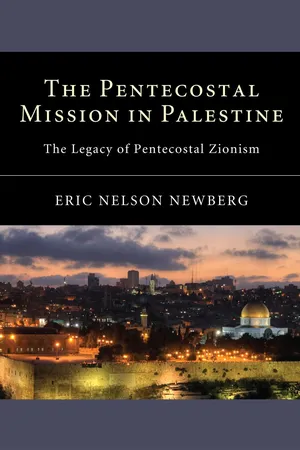
The Pentecostal Mission in Palestine
The Legacy of Pentecostal Zionism
- 272 pages
- English
- ePUB (mobile friendly)
- Available on iOS & Android
eBook - ePub
About this book
The Pentecostal mission in Palestine is a virtually unknown episode in the history of Pentecostalism. Its story begins in 1906 at the Azusa Street Revival, from which missionaries were sent to Palestine. In its first thirty years, the Pentecostal mission in Palestine gained a foothold in Jerusalem and expanded its reach into Jordan, Syria, and Iran. It was severely tested and lost traction during the tumultuous period of the Arab Revolts, World War II, and the Partition Crisis. With the catastrophic war of 1948, the Pentecostal missionaries fled as their Arab clients were swept away in the Palestinian Diaspora. After 1948, a valiant attempt was made to revive the mission, but only with relative success. Although the Pentecostal missionaries failed in their objective of converting Jews and Muslims, they were eyewitnesses of the formative events of the Arab-Israeli conflict. Newberg argues that the Pentecostal missionaries functioned as brokers of Pentecostal Zionism. He offers a postcolonial assessment of the Pentecostal missionaries, crediting them for advocating philosemitism, yet bringing them up short for disregarding the civil rights of Palestinian Arabs, espousing Islamophobia, and contributing to the forces working against peace in the Holy Land.
Information
Topic
Theology & ReligionSubtopic
Christian Theology1
Introduction
The expansion of Pentecostalism between 1906 and today constitutes one of the most significant developments in recent religious history. Pentecostalism has grown from an anomalous coterie of religious and social discontents to a massive global renewal movement, estimated at about 27 percent of all Christians.1 The Pentecostal mission in Palestine is a virtually unknown episode in the history of Pentecostalism. The story of this mission starts out modestly, as did Pentecostalism, on the wrong side of the tracks in Los Angeles in an abandoned building requisitioned for the Azusa Street Revival (1906–10). Palestine was the destination of three of the first five missionaries sent out from the Azusa Street Revival. The purpose of this study is to construct a historical narrative of the Pentecostal mission in Palestine. The scene of the narrative swiftly shifts from Los Angeles to Jerusalem. From 1908 on, Jerusalem served as the home base of the Pentecostal mission in Palestine and its satellite outposts in Syria, Transjordan, and Persia. Much of the story of the Pentecostal mission in Palestine is taken up with events in the Middle East, yet the vantage point from which the missionaries viewed the realities on the ground in Palestine was that of North American Pentecostalism.
Definition of the Problem
The problem addressed in this book was defined in the author’s mind when the reports of the Pentecostal missionaries in Palestine in American and British Pentecostal periodicals came to his attention. A careful reading of these reports, published from 1906 on, reveals a distinctly pro-Zionist sympathy, hereafter referred to as “Pentecostal Zionism.” The primary problem addressed below can be stated in a question: What were the historical and theological connections between the Pentecostal mission in Palestine and the diffusion of Pentecostal Zionism? This book will attempt to ferret out these connections and their repercussions. The author will argue that the history of the Pentecostal mission in Palestine represents a window through which the historical and theological development of Pentecostal Zionism and its checkered legacy can be closely observed.
The crimson thread that connects the Pentecostal mission in Palestine with the development of Pentecostal Zionism is the network of diffusion provided by the Pentecostal periodicals. The reports of the missionaries in Palestine were published in the periodicals, providing the wider Pentecostal constituency with on the scene observations of and commentary on events in Palestine. These reports were embedded with an ideological perspective known as Christian Zionism,2 the driving force of which is a preferential option for a Jewish national home in Palestine. A case can be made that the pro-Zionist stance of the Pentecostal missionaries shaped Pentecostal attitudes toward the Arab-Zionist conflict in Israel/Palestine. The evidence upon which this case rests consists of two layers of discourse. The first layer is the reports of the missionaries. The second is the numerous articles in Pentecostal periodicals dealing with current events in Palestine and the Zionist movement. By connecting the dots, one finds inter-textual strands of ideas that make up Pentecostal Zionism. As this book traces the connections between the Pentecostal missionaries in Palestine and Pentecostal Zionism, painstaking proof will be extracted from the Pentecostal periodicals to argue for the contribution of the missionaries in Palestine to the diffusion of Pentecostal Zionism and its legacy.
Scope of the Historical Narrative
The story of the Pentecostal mission in Palestine begins in 1906 at the Azusa Street Revival in Los Angeles. Some of the very first missionaries sent out from Azusa Street went to Palestine. In its first ten years the Pentecostal mission in Palestine gained a foothold in Jerusalem, due primarily to the efforts of three major pioneering missionaries, Lucy Leatherman, Charles Leonard, and Anna Elizabeth Brown. In the interwar period the Pentecostal missionaries established a mission station in Jerusalem and expanded their territory into Transjordan, Syria, and Persia. The mission was severely tested and lost traction during the Arab Revolt of 1936–39, World War II, and the Partition Crisis of 1947. With the War of 1948 the Pentecostal missionaries fled from the field of battle and their predominately Arab clients were swept away in the Palestinian Diaspora. After 1948 a valiant attempt was made to sustain the Assemblies of God mission in Jerusalem but it eventually lost its vitality and met its demise in the 1970s. In contrast, the Church of God (Cleveland, Tenn.) established an active mission with stations in Bethlehem, the Mount of Olives, and the village of Aboud. Led by the indomitable Margaret Gaines from 1964 to 1999, the Church of God succeeded in developing an indigenous leadership that continues to sustain a vital Pentecostal presence in the West Bank.3 Recent attempts have been made to put new Pentecostal missionary ventures in Israel on an indigenous footing.
Thesis and Argument
The thesis of this book is that the Pentecostal missionaries in Palestine functioned as brokers of Pentecostal Zionism. A broker is one who arranges transactions, a dealer in secondhand goods. The missionaries were ideally situated to play the role of brokers because as eye-witnesses they observed and reported on the unfolding of events on the ground in Palestine. Although the Pentecostal missionaries failed to achieve their primary objective of converting Jews and Muslims, and resorted to proselytizing Arab Christians, they can be credited with advocating philosemitism (love for the Jewish people) and promoting the restoration of a Jewish national home in Palestine. However, in jumping on the Christian Zionist bandwagon, they disregarded the civil rights of the Arabs, provoked cultural antipathy toward Muslims, and left a legacy that continues to militate against peace in Israel/Palestine today.
It is hardly coincidental that today Pentecostals are numbered among the major players in the pro-Israel movement. This is a development to which the Pentecostal missionaries in Palestine made a marked contribution. A notable figure in this regard is Peter Derek Vaughan Prince (1915–2003), who married one of the Pentecostal missionaries in Palestine, Lydia Christensen (1890–1975). Prince went on to become a prominent leader of both the global charismatic movement as well as the pro-Israel movement. He played a significant role in transmitting the legacy of Pentecostal Zionism among charismatic Christians. As stated above in the Preface, the pro-Israel stance of contemporary Pentecostals and charismatics has been substantiated by the Pew Charitable Trust survey, “Spirit and Power.” The Pew survey found that sympathy toward Israel among Pentecostals and charismatics is common even in countries with no direct political stake in the conflict in the Middle East, indicating that the motivating factor is probably religious rather than nationalistic. It is significant that the countries shown by the Pew study to have a stronger sympathy with Israel among Pentecostals and charismatics—Brazil, Kenya, Nigeria, India, and South Korea—were represented in the parade described in the Preface.4
The legacy of the Pentecostal mission in Palestine is related to the role that the missionaries played as the brokers of Pentecostal Zionism. Pentecostal Zionism had positive and negative repercussions. On the positive side, Pentecostal Zionism fostered philosemitism. On the downside, Pentecostal Zionism was imbued with cultural prejudices against Arab Christians and Muslims, which subverted the contextualization of the Pentecostal mission in Palestine. Unfortunately, the Pentecostal missionaries in Palestine failed to develop an effective missionary strategy in Palestine. Worse yet, as Pentecostals afforded theological legitimacy to the Zionist project, they turned a blind eye to the injustices suffered by the indigenous Arab population in Palestine.
Methodology Explained
The methodology of this book can be described as a postcolonial assessment. It is shaped by Allan Anderson’s penetrating critique of Pentecostal missions and Edward Said’s seminal study of Orientalism. Each of these influences has made an imprint on the methodology of this book.
Allan Anderson’s Postcolonial Critique
Allan Anderson (1949–) is Professor of Global Pentecostal studies and Director of the Graduate Institute for Theology and Religions at the University of Birmingham in England. Anderson worked as a pastor in Southern Africa in classical Pentecostal, charismatic Baptist, and independent charismatic churches. He earned a doctorate at the University of South Africa with a dissertation on “African Pentecostalism in So...
Table of contents
- Title Page
- Foreword
- Preface
- Acknowledgments
- Chapter 1: Introduction
- Chapter 2: Palestine Missionary Band from Azusa
- Chapter 3: Azusa-Jerusalem Connection
- Chapter 4: Planting the Pentecostal Flag, 1908–1918
- Chapter 5: Expanding the Territory, 1919–1935
- Chapter 6: Holding the Fort, 1936–1945
- Chapter 7: Retreat and Regrouping, 1946–2007
- Chapter 8: Pentecostal Zionism
- Chapter 9: Assessment of the Legacy of Pentecostal Zionism
- Chapter 10: Conclusion
- Bibliography
Trusted by 375,005 students
Access to over 1.5 million titles for a fair monthly price.
Study more efficiently using our study tools.
Frequently asked questions
Yes, you can cancel anytime from the Subscription tab in your account settings on the Perlego website. Your subscription will stay active until the end of your current billing period. Learn how to cancel your subscription
No, books cannot be downloaded as external files, such as PDFs, for use outside of Perlego. However, you can download books within the Perlego app for offline reading on mobile or tablet. Learn how to download books offline
Perlego offers two plans: Essential and Complete
- Essential is ideal for learners and professionals who enjoy exploring a wide range of subjects. Access the Essential Library with 800,000+ trusted titles and best-sellers across business, personal growth, and the humanities. Includes unlimited reading time and Standard Read Aloud voice.
- Complete: Perfect for advanced learners and researchers needing full, unrestricted access. Unlock 1.5M+ books across hundreds of subjects, including academic and specialized titles. The Complete Plan also includes advanced features like Premium Read Aloud and Research Assistant.
We are an online textbook subscription service, where you can get access to an entire online library for less than the price of a single book per month. With over 1.5 million books across 990+ topics, we’ve got you covered! Learn about our mission
Look out for the read-aloud symbol on your next book to see if you can listen to it. The read-aloud tool reads text aloud for you, highlighting the text as it is being read. You can pause it, speed it up and slow it down. Learn more about Read Aloud
Yes! You can use the Perlego app on both iOS and Android devices to read anytime, anywhere — even offline. Perfect for commutes or when you’re on the go.
Please note we cannot support devices running on iOS 13 and Android 7 or earlier. Learn more about using the app
Please note we cannot support devices running on iOS 13 and Android 7 or earlier. Learn more about using the app
Yes, you can access The Pentecostal Mission in Palestine by Eric Nelson Newberg in PDF and/or ePUB format, as well as other popular books in Theology & Religion & Christian Theology. We have over 1.5 million books available in our catalogue for you to explore.