- 284 pages
- English
- ePUB (mobile friendly)
- Available on iOS & Android
eBook - ePub
About this book
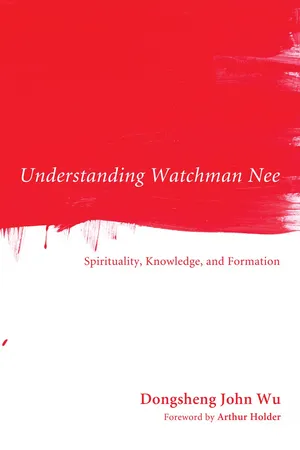
This book situates Nee's view within the rich heritage of the Protestant, Catholic, and Eastern Orthodox spiritual traditions, and thus renders Nee's thought more intelligible to Christians of both evangelical and more liberal persuasions. In this book Dongsheng John Wu examines Watchman Nee's thought on the spiritual life, focusing on the relationship between spiritual formation and spiritual knowledge. Different ways of acquiring spiritual understanding are explored, including the respective roles of divine illumination, intellectual studies, and life circumstances. Understanding Watchman Nee begins by synthesizing strategic aspects of Nee's teachings as well as formative events and sources in the development of Nee's own spirituality and theology. It then utilizes the critical work of contemporary theologian Mark McIntosh to bring Nee's voice into dialogue with some important figures in the history of Christian spirituality. Such interactions reveal that Nee's crucial theological convictions exhibit strong parallels with related themes found in the church's spiritual or mystical treasures.
Information
Topic
Theologie & ReligionSubtopic
Christliche KirchePart One
Background
1
Turbulence and Emergence
The Context and Life of Watchman Nee
Nee’s Historical Context
Watchman Nee (1903–1972) lived through an age of great upheavals. His life span journeyed across four of the five “revolutionary civil wars” (except the Taiping Uprising of 1851–1868) in the last two centuries of China’s history. These four wars or revolutions were: (1) the Republic Revolution of 1911, (2) the Northern Expedition of 1926–1927, (3) the Nationalist-Communist civil war of 1945–1949, and (4) Mao’s Cultural Revolution of 1966–1976.1 Furthermore, Nee also lived through other major political and social events such as the May Fourth Movement of 1919 and the anti-Christian movement of the 1920s, as well as the eight-year Sino-Japanese war in 1937–1945. Nee’s life in the first half of twentieth-century China also witnessed different Protestant mission developments, and the burgeoning indigenous church movement in which Nee himself played a notable part.
Christianity in China and China in Its Modern Age
Christian mission efforts in China before the mid-nineteenth century were sporadic. It is uncertain as to when Christianity first entered China.2 One tradition maintains that the missionary work in China goes back to St. Thomas the apostle, but Kenneth Scott Latourette notes that no historical evidence exists to corroborate with any suggestions that Christianity was in the empire before the Tang dynasty (618–907).3 There is reliable information that in 635, Nestorian missionaries from Mesopotamia and Central Asia came to China, but their major propagation lasted only to 845, and it is doubtful that they left “any permanent influence on Chinese life and thought.”4
Then in 1294 the first Roman Catholic missionary reached the then Mongol-ruled China, beginning the Franciscan mission work, which survived in the Yuan dynasty till the middle of the fourteenth century.5 The third attempt to evangelize the Middle Kingdom began with the Jesuit Francis Xavier who was nonetheless forbidden to enter mainland China and died near Macau in 1552. Xavier was followed by other Jesuit priests, among them the Italian Matteo Ricci, who was finally allowed to set foot on Chinese soil in 1582. With much labor and prudence, Ricci introduced Western scientific learning to China and found a warm reception among Chinese officials. Subsequently other able Jesuit scientists and philosophers came in and had great influence on the Chinese court. However, the issue of Chinese ancestor worship brought about what is known as the “Rites Controversy,” which developed into an intense conflict of authority between the Pope and the Chinese emperor. Eventually, in 1724 an imperial edict was issued to expel from China all Catholic missionaries (except for a few who attached to the Bureau of Astronomy in Beijing), and Chinese believers were commanded to renounce their faith. The number of Catholics in China, in 1800, was estimated to be between two hundred thousand and two hundred fifty thousand.6 The influence of the Russian Orthodox Church’s missionaries in China, according to Latourette, was so small that it can be neglected, although it is notable that their scholarship contributed to the interpretation of China to the Russian people.7
Protestant mission in China began in the nineteenth century, fueled by the Evangelical Revival in Great Britain and the Great Awakening in America. In 1807 the first Protestant missionary, Robert Morrison (1782–1834) of the London Missionary Society, arrived in China. By 1840, there were more than twenty Protestant missionaries in China, but the Chinese who had been baptized were fewer than one hundred. This was a foundation-laying period that produced a sizable Christian literature in Chinese. For instance, Morrison, with the assistance of William Milne, completed a translation of the entire Bible in 1819, and later produced the first Chinese-English dictionary. Another form of literary work was by way of introducing China to the West, including information on the life, conditions, and mission works in China. During this early period, two other important fields of Protestant activity were medicine and education.8
Beginning with the two Opium Wars around the mid-1800s, China’s door—after many years of self-imposed closure—was forced to open to Western powers that were attracted by the lure of trade in this Oriental “sleeping beauty.” Yet along with profit-oriented traders and privilege-minded diplomats and soldiers, also came the missionaries who were “at least ostensibly, to serve the interests of the Chinese.”9 Britain waged the first Opium War against China in 1839, for China’s refusal to allow the import of opium. This war ended in 1842 with China’s defeat and the signing of the Treaty of Nanjing, through which China ceded Hong Kong to Britain, and opened five seaports for foreign trade: Shanghai, Ningbo, Fuzhou, Xiamen, and Guangzhou. Within these open ports, foreigners were given express permission to erect churches. This new treaty and other edicts issued in following years facilitated considerably both Catholic and Protestant mission operations. Many British and American missionaries, including Hudson Taylor (who founded the China Inland Mission) from England, came to China and began to establish their work there.10 A few years later in 1858, China lost again in the second Opium War (against Britain and France)—this time signing the Treaty of Tianjin, which further enhanced Europe’s trade position and granted foreigners rights to travel throughout the land. Consequently China was flooded with “more ship loads of opium,” despite protests among British as well as Chinese citizens.11 The Sino-French Treaty of Tianjin revolutionized the position of all Christian missions in China. The treaty formally rescinded all previous official announcements against Christianity, guaranteeing the freedom for Catholic priests to propagate their religion anywhere in China as well as the right for the Chinese people to practice Christianity. Because of the most-favored-nation clauses, Protestant...
Table of contents
- Title Page
- Foreword
- Acknowledgments
- Note on Names and Terms
- Introduction
- Part 1: Background
- Chapter 1: Turbulence and Emergence
- Chapter 2: Influence and Adaptation
- Part 2: Analysis and Interpretation
- Chapter 3: Revelation and Illumination
- Chapter 4: Knowledge and Spirituality
- Chapter 5: Discernment and Formation
- Conclusion
- Bibliography
- Glossary
Trusted by 375,005 students
Access to over 1.5 million titles for a fair monthly price.
Study more efficiently using our study tools.
Frequently asked questions
Yes, you can cancel anytime from the Subscription tab in your account settings on the Perlego website. Your subscription will stay active until the end of your current billing period. Learn how to cancel your subscription
No, books cannot be downloaded as external files, such as PDFs, for use outside of Perlego. However, you can download books within the Perlego app for offline reading on mobile or tablet. Learn how to download books offline
Perlego offers two plans: Essential and Complete
- Essential is ideal for learners and professionals who enjoy exploring a wide range of subjects. Access the Essential Library with 800,000+ trusted titles and best-sellers across business, personal growth, and the humanities. Includes unlimited reading time and Standard Read Aloud voice.
- Complete: Perfect for advanced learners and researchers needing full, unrestricted access. Unlock 1.5M+ books across hundreds of subjects, including academic and specialized titles. The Complete Plan also includes advanced features like Premium Read Aloud and Research Assistant.
We are an online textbook subscription service, where you can get access to an entire online library for less than the price of a single book per month. With over 1.5 million books across 990+ topics, we’ve got you covered! Learn about our mission
Look out for the read-aloud symbol on your next book to see if you can listen to it. The read-aloud tool reads text aloud for you, highlighting the text as it is being read. You can pause it, speed it up and slow it down. Learn more about Read Aloud
Yes! You can use the Perlego app on both iOS and Android devices to read anytime, anywhere — even offline. Perfect for commutes or when you’re on the go.
Please note we cannot support devices running on iOS 13 and Android 7 or earlier. Learn more about using the app
Please note we cannot support devices running on iOS 13 and Android 7 or earlier. Learn more about using the app
Yes, you can access Understanding Watchman Nee by Dongsheng John Wu in PDF and/or ePUB format, as well as other popular books in Theologie & Religion & Christliche Kirche. We have over 1.5 million books available in our catalogue for you to explore.