eBook - ePub
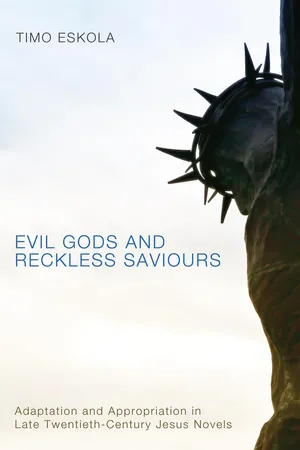
Evil Gods and Reckless Saviours
Adaptation and Appropriation in Late Twentieth-Century Jesus Novels
- 348 pages
- English
- ePUB (mobile friendly)
- Available on iOS & Android
eBook - ePub
Evil Gods and Reckless Saviours
Adaptation and Appropriation in Late Twentieth-Century Jesus Novels
About this book
Late twentieth-century Jesus novels carve out a completely new picture of Jesus. Those written by Norman Mailer, Jose Saramago, Michele Roberts, Marianne Fredriksson, and Ki Longfellow, among others, provide inversive revisions of the canonical Gospels. Their adaptations often turn into a critique of the whole of Christian history.
The contrast novels investigated in this study end up with appropriations that are based on prototypical rewriting. They aim at the rehabilitation of Judas, and some of them make Mary Magdalene the key figure of Christianity. Saramago describes God as a bloodthirsty tyrant, and Mailer makes God battle the devil in a "Manichaen" sense as with an equal.
The main result of this intertextual analysis is that these authors have adopted Nietzschean ideas in their writing. An attack on the so-called biblical slave morality and violent concept of God deprives Jesus of his Jewish messianic identity, makes Old Testament law a contradiction of life, calls sacrificial soteriology a violent paradigm supporting oppression, and presents God as a cruel monster.
As a result, Jewish faith appears in a negative light. Apparently, Western culture still harbours anti-Judaic attitudes, albeit hidden beneath sentiments of equality and tolerance. Timo Eskola skillfully shows that despite the evident post-Holocaust consciousness present in the novels, they actually adopt an arrogant and ironic refutation of Jewish beliefs and Old Testament faith.
Information
Topic
Theologie & ReligionSubtopic
Christliche Kirche1
Source Texts and Subtexts in Contemporary Jesus-Novels
The New Testament is a challenging source text. Any adaptation is obliged to define its position in relation to a text that has affected the whole course of Western history, the emergence of the civilised society, our concept of justice, and our view of humane morality. As the late twentieth-century Jesus-novels propose new gospels, they take on the immense task of contributing to a tradition that in many ways has moulded the author herself or himself. Furthermore, as the revisions appear to question the values represented by the canonical texts, there immediately arises questions both about the motivation and the purpose of adaptations and rewritings. In this chapter a general introduction to the novels’ use of source texts will be given. The focus is mainly on the author’s use of historical texts, not on their creation of completely new ideas.
1. Adaptation and Appropriation
There are three kinds of source texts in the investigated novels, and in each case the treatment of the intertextual relationship has its distinctive features. First group of source texts comprises ancient writings. The New and Old Testaments are naturally the most important of these, but the novels also treat the Dead Sea Scrolls and Gnostic writings, as well as a number of apocryphal gospels. The second source text, a text in a pantextual sense, is Christian history, particularly in the manner each author understands and interprets it. Saramago in particular applies this kind of pantextual approach by putting Christian history in a critical dialogue with Gospel stories and their theological ideas. In several novels from Roberts to Longfellow feminist ideology is made a dialogue partner with the canonical tradition. The third source text, according to the hypothesis of the present work, is Nietzschean ideology, as discussed above in the final section of the Introduction. This text is not simply a group of Nietzsche’s books but an ideology in a more general sense, the spirit of his Anti-Christ that opposes the so-called biblical slave morality.
Since Jesus-novels’ intertextual relationships involve extant manuscripts and texts, it is necessary to return to the methodology of adaptation. The act of rewriting is usually a multidimensional process of adaptation and appropriation where, as Julie Sanders says, an adaptation “signals a relationship with an informing source text or original.”1 Writing on Jesus who lives in ancient Israel, or calling a novel a gospel, strongly signals such an approach. Most Western people—at least those with a Christian background—reading these new novels automatically locate them in a particular tradition. Meanings in these novels are constructed in a relationship with the Bible, not autonomically inside the text itself.
Adaptation and appropriation are dependent on the literary canon for the provision of a shared body of storylines, themes, characters, and ideas upon which their creative variations can be made. The spectator or reader must be able to participate in the play of similarity and difference perceived between the original, source, or inspiration to appreciate fully the reshaping or rewriting undertaken by the adaptive text.2
Adaptive Jesus-novels trust that readers can recognise any variation and inversion the new story proposes. This creates a situation that Linda Hutcheon describes as follows: “If we know that prior text, we always feel its presence shadowing the one we are experiencing directly.”3 Jesus-novels share most details with their canonical source. The story is similar, the characters are the same, and most events have been taken from the New Testament narrative. Several direct or slightly altered quotations emphasise the relationship. This is a good point of departure for an adaptation.
It is not too easy to define adaptation as such, though. Sanders has noted that already the terminology used in methodological discussion reveals that adaptations can possess different aims.
As well as throwing up potent theoretical intertexts of their own, adaptation studies mobilize a wide vocabulary of active terms: version, variation, interpretation, continuation, transformation, imitation, pastiche, parody, forgery, travesty, transposition, revaluation, revision, rewriting, echo. As this list of terms suggests, adaptations and appropriations can possess starkly different, even opposing aims and intentions.4
Adaptation, in a general sense, means acknowledged transposition and rewriting. Its mode, however, changes from case to case. Adaptation can be mere echo of the source text or it can produce a revaluation or a forgery. Since adaptation is a form of intertextuality, it can be seen as part of a reception process. Therefore, it is not merely a matter of transposing but also a “creative and interpretive act of appropriation.”5
The investigated Jesus-novels, as noted already in the Introduction, are not content with copying the original text. Neither do they attempt to explain the New Testament or interpret the “true” meaning of Jesus’ original teaching. Instead, they belong to those novels that create a “manifestly different interpretation.” Jesus-novels conduct imitation and transformation. Some of the contemporary works aim at hostile revision and appropriation. Appropriation, as Sanders says, is a “more decisive journey away from the informing source into a wholly new cultural product and domain.”6 These approaches are situated on a continuum where authors move from slight adaptation to deconstructive appropriation, and ultimately to the direct challenge of biblical views even though they keep the characters and some of the events that occur in the source text. This is why the analysis must focus on the novels’ own themes.7
Adaptation can even aim at intentional confusion. It may well be the whole purpose of the adaptation in many cases, and this is very true for inversive Jesus-novels.8 Audiences, however, are dependent on sources: “When giving meaning and value to an adaptation as an adaptation, audiences operate in a context that includes their knowledge and their own interpretation of the adapted work.” They must not be left in confusion since the final effect of a rewriting depends on reader’s ability to recognise the source text. Therefore, adaptations, by their very existence, “remind us there is no such thing as an autonomous text or an original genius that can transcend history, either public or private.”9 This is why adaptation and appropriation are the perfect means for producing a transformation, whatever the reason for it.
In the analysis of Jesus-novels, both adaptation and appropriation are important factors. The novels are adaptive since they constantly use the Bible, as well as some apocryphal gospels, the Dead Sea Scrolls, and Gnostic writings. Their rewriting is not traditional, however, since reinterpretation and revaluation of Christian concepts are signs of appropriation. In Jesus-novels the whole process of narration is based on a play between the well-known source text and the novel itself. These novels refer to a source text, the New Testament, even though the relation between them is complex. The novel’s story stays inevitably in a reciprocal relationship with canonical Gospels.
Ideologies also affect adaptation. Sanders reminds us that “adaptations and appropriations are impacted upon by movements in, and readings produced by, the theoretical and intellectual arena as much as by their so-called sources.”10 The pantextual approach in intertextuality has always claimed that both individual expressions and larger revisions turn out to be cultural phenomena. Allen, when describing Barthes’s view on intertextuality, notes that a pantextual approach has to do “with the entire cultural code.”11 According to Barthes a novel is a woven fabric with countless cultural threads. Phelan calls the source for this kind of influence a cultural narrative, whose author is “a larger collective entity, perhaps a whole society or at least some significant subgroup of society.” These cultural narratives “typically become formulas that underlie specific narratives whose authors we can identify, and these narratives can vary across a spectrum from totally conforming to the formula to totally inverting it.”12 The aim of the present investigation is to ask whether Nietzschean ideology could be interpreted as such a cultural narrative, influencing the adaptive work of contemporary Jesus-novels. My investigation will also prove that the interpretation of recent Jesus-novels remains incomplete unless their critique of religion is given proper notice.
These ideas are closely related to a more general discussion in the field of intertextuality. Many theorists have attempted to find a path between a pantextual approach and a more simple intertextuality that treats particular texts. Laurent Jenny, in his mediating view, emphasises that even though no text is comprehensible without intertextuality, intertextuality is also related to source criticism. Extant sources are the basis on which the work of transformation and assimilation can be done. One essential methodological change has taken place here, though. The intertextual approach can no longer be identified with source criticism. For Jenny, it is the hypertext, or the ...
Table of contents
- Title Page
- Preface
- Introduction
- Chapter 1: Source Texts and Subtexts in Contemporary Jesus-Novels
- Chapter 2: Turning God-Incarnate into a Faustian Frivol
- Chapter 3: Contesting the Moral Values of the Gospels
- Chapter 4: Challenging the Biblical Role of Women
- Chapter 5: Dissolving Sacrificial Religion
- Chapter 6: Attacking Biblical Theism
- Chapter 7: Reinjecting Mystery into Religion
- Chapter 8: Iconoclastic Intertextualism
- Conclusion: Nietzschean Themes in Contrast-Novels
- Bibliography
Trusted by 375,005 students
Access to over 1.5 million titles for a fair monthly price.
Study more efficiently using our study tools.
Frequently asked questions
Yes, you can cancel anytime from the Subscription tab in your account settings on the Perlego website. Your subscription will stay active until the end of your current billing period. Learn how to cancel your subscription
No, books cannot be downloaded as external files, such as PDFs, for use outside of Perlego. However, you can download books within the Perlego app for offline reading on mobile or tablet. Learn how to download books offline
Perlego offers two plans: Essential and Complete
- Essential is ideal for learners and professionals who enjoy exploring a wide range of subjects. Access the Essential Library with 800,000+ trusted titles and best-sellers across business, personal growth, and the humanities. Includes unlimited reading time and Standard Read Aloud voice.
- Complete: Perfect for advanced learners and researchers needing full, unrestricted access. Unlock 1.5M+ books across hundreds of subjects, including academic and specialized titles. The Complete Plan also includes advanced features like Premium Read Aloud and Research Assistant.
We are an online textbook subscription service, where you can get access to an entire online library for less than the price of a single book per month. With over 1.5 million books across 990+ topics, we’ve got you covered! Learn about our mission
Look out for the read-aloud symbol on your next book to see if you can listen to it. The read-aloud tool reads text aloud for you, highlighting the text as it is being read. You can pause it, speed it up and slow it down. Learn more about Read Aloud
Yes! You can use the Perlego app on both iOS and Android devices to read anytime, anywhere — even offline. Perfect for commutes or when you’re on the go.
Please note we cannot support devices running on iOS 13 and Android 7 or earlier. Learn more about using the app
Please note we cannot support devices running on iOS 13 and Android 7 or earlier. Learn more about using the app
Yes, you can access Evil Gods and Reckless Saviours by Timo Eskola in PDF and/or ePUB format, as well as other popular books in Theologie & Religion & Christliche Kirche. We have over 1.5 million books available in our catalogue for you to explore.