- 210 pages
- English
- ePUB (mobile friendly)
- Available on iOS & Android
eBook - ePub
About this book
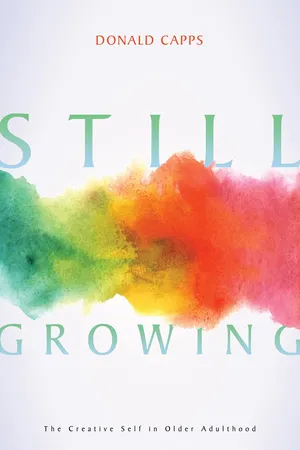
The later-adult years are commonly viewed as a period in which one struggles to maintain a vestige of the physical, mental, and emotional vitality of one's earlier years. In Still Growing, however, Donald Capps contends that older adulthood is actually a period of growth and development, and that a central feature of this growth and development is the remarkable creativity of older adults.
This creativity is the consequence of the wisdom gained through years of experience but is also due to a newly developed capacity to adapt to unprecedented challenges integral to the aging process.
Part 1 illustrates the challenges of transitioning to older adulthood from the author's own experiences. Part 2 draws on material from Erik H. Erikson, Sigmund Freud, and Paul W. Pruyser to account for longevity, adaptability, and creativity in older adults. Finally, part 3 focuses on the work of both William James and Walt Disney to fashion a model of creative aging.
Information
Subtopic
Religionpart 1
The Transition to Older Adulthood
1
Fired Up and Loaded for Bear
.....
Fire up: to animate or inspire; to excite, stimulate; to become excited or aroused
Loaded for bear: ready and eager to deal with something that is going to be difficult
.....
For the purposes of this book, I will assume that older adulthood begins at age seventy. There are those who would argue that it begins earlier—say, at age sixty-five—but many sixty-five-year-olds do not view themselves as older adults. They accept the fact that they are transitioning into older adulthood, but they do not think that they are there yet. There are also those who are in their early seventies who do not believe that they are older adults, but I tend to believe that persuading others that they are right about this is no simple task. So I assume that for all practical purposes anyone who is seventy or older is, in fact, an older adult.
The question of how one feels about being an older adult is, of course, a whole other issue. As noted in the introduction, I found the idea of older adulthood rather discouraging. Not very many persons are elated about the fact that they have entered older adulthood, and those who are tend to have special reasons for being so, such as the fact that they did not believe that they would live to seventy, or that they have finally gained release from onerous and unfulfilling occupations. On the other hand, there are not many persons who have really strong negative feelings about becoming an older adult. Despondency or anger about the fact that one is entering older adulthood is usually thought to be a rather excessive response to a situation that everyone will face in their lives if they live to seventy. To be sure, one may have strong negative emotions because of certain circumstances that accompany entering older adulthood, such as retirement, relocation, economic challenges, physical disabilities, and so forth. But the simple fact that one has entered older adulthood does not ordinarily produce strong emotions either way. Probably the more prevalent attitude that this fact elicits is that of resignation, which the dictionary defines as “patient submission; passive acceptance; acquiescence.”1 As many older adults have been heard to say, “Well, it had to come, sooner or later,” to which other older adults have responded, “I would have preferred later than sooner.” To be sure, many older adults say that they are “looking forward” to their “golden years,” and, no doubt, there are those who genuinely feel this way. But more often than not, their flat tone of voice when they say this seems to betray their real feelings of resignation, their passive acceptance and acquiescence, the feeling that one may as well make the best of it.
This chapter is about my own struggles with the anticipation and, subsequently, the reality of entering older adulthood. I do not present it as a model for others to follow, and I am also aware of the fact that one part of me views what I will be saying here as so much whistling in the dark. But there is another part of me that feels quite strongly about what I will be suggesting here, and as the thoughts presented here were originally expressed when I turned seventy, I can attest to the fact that I have not had any reason to think they were misguided or wrongheaded. On the contrary, I think there is a lot to be said for them. Moreover, I tend to trust the insights I have gained into myself that have come as a result of my having reflected on a poem that has, for some inexplicable reason, engaged my interest at one or another period or stage of my life. In the following discussion of the poem, I will make clear its relevance to my transition to older adulthood in the concluding paragraphs of the chapter.
Smokey the Bear and Becoming an Older Adult
The poem is Billy Collins’s “Flames.”2 It was published in 1988. At the time I first read it, the possibility that it may have any personal relevance was the farthest thing from my mind. Here is the poem:
Flames
Smokey the Bear heads
into the autumn woods
with a red can of gasoline
and a box of wooden matches.
His ranger’s hat is cocked
at a disturbing angle.
His brown fur gleams
under the high sun
as his paws, the size
of catchers’ mitts,
crackle into the distance.
He is sick of dispensing
warnings to the careless,
the half-wit camper,
the dumbbell hiker.
He is going to show them
how a professional does it.
When I first read the poem, my heart went out to Smokey. After all, he had been devoting his life to forest-fire prevention, a most worthy cause. I could also understand how he might crack one day out of frustration and set a fire himself. After all, there is a great deal of precedence for this very reversal in the annals of human history: where someone who has been devoted to a worthy cause for many years throws in the towel and joins the opposition. But I found this reversal in the case of Smokey the Bear difficult to fathom, so I turned to Sigmund Freud for an explanation.
Possible Reasons for Smokey’s Behavior
Readers may wonder why I turned to Freud for an explanation for Smokey’s strange behavior, but I remembered that Freud had written about how one can suppress some negative or destructive motivations and keep them hidden—even from oneself—and then suddenly give vent to them. Was this what Smokey the Bear was doing? Freud, I recalled, termed this phenomenon a reaction-formation and described how it works in his book Inhibitions, Symptoms, and Anxiety.3 He presented this scenario: Suppose a person has an inner conflict due to ambivalent feelings toward another person. He or she has a well-grounded love for this person but a no less justifiable hatred toward this person. Freud suggested that a typical outcome of such conflicts is that one of the two conflicting feelings (usually the affectionate one) becomes greatly intensified while the other feeling completely vanishes. However, the exaggerated degree and compulsive character of the chosen feeling betray the fact that this is not the only feeling present, but that it is, in fact, constantly on the alert to keep the opposing feeling under repression.
But what if the repression fails for one reason or another and the conflicting feeling reappears? Typically, it emerges with great force—with force greater than if the feeling had been allowed to express itself more naturally in the meantime.4 Conceivably, then, Smokey the Bear’s dedication to forest-fire prevention was an exaggeration of one side of an ambivalence involving two strongly conflicting feelings: the desire to prevent forest fires and the desire to set forest fires. His given name of Smokey may have stimulated a greater fascination with forest fires than is typical of young male bears.
Another possibility, however, is that there was something deeply symbolic for Smokey about fire. In Civilization and Its Discontents Freud suggests that the first acts of civilization were the use of tools, the construction of buildings, and the control over fire. He adds, “Among these, the control over fire stands out as a quite extraordinary and unexampled achievement.”5 Why extraordinary? Because the stimulus behind the other acts of civilization is rather easy to guess: they have enabled humans to perfect their own organs, whether motor or sensory, or to remove the limits of their functioning. Gaining control over fire is something entirely different. Freud suggests that it may be that whenever they came into contact with fire, they had the habit of satisfying an infantile desire to put the fire out by urinating on it. This, Freud believes, is a sexual act, even in young boys, because they are using their ability to urinate for pleasure, and not the mere need to eliminate urine from their bodies. I can recall when we, as young boys, referred to urinating as “putting the fire out.” Freud thinks, though, that the first person who renounced this infantile desire and spared the fire was able to put the fire to his own practical use. Thus, “by damping down the fire of his own sexual excitation, he had tamed the natural force of fire.”6 Thus, instinctual renunciation led to a great cultural conquest.
Freud expands on this point in his later article “The Acquisition of Power over Fire.”7 Here, he reaffirms his idea that the acquisition of the use of fire required the renunciation of the pleasure of putting the fire out by urinating on it, and he supports this idea by focusing on the Greek myth of Prometheus. Prometheus’s acquisition of fire is represented as a crime—an act of robbery or theft—and an outrage, and his punishment was to be chained...
Table of contents
- Title Page
- Tables
- Acknowledgments
- Introduction
- Part 1: The Transition to Older Adulthood
- Chapter 1: Fired Up and Loaded for Bear
- Chapter 2: A Faithful Reunion
- Part 2: Growth and Development in Older Adulthood
- Chapter 3: The Three Stages of Older Adulthood
- Chapter 4: The Aging Process as Forward Movement
- Chapter 5: The Creativity of Older Adults
- Part 3: The Artistry of Aging
- Chapter 6: Relaxed Bodies, Emancipated Minds, and Dominant Calm
- Chapter 7: Happy Spirits and Grumpy Souls
- Epilogue: Aging Horses and Wounded Healers
- Permissions
- Bibliography
Trusted by 375,005 students
Access to over 1.5 million titles for a fair monthly price.
Study more efficiently using our study tools.
Frequently asked questions
Yes, you can cancel anytime from the Subscription tab in your account settings on the Perlego website. Your subscription will stay active until the end of your current billing period. Learn how to cancel your subscription
No, books cannot be downloaded as external files, such as PDFs, for use outside of Perlego. However, you can download books within the Perlego app for offline reading on mobile or tablet. Learn how to download books offline
Perlego offers two plans: Essential and Complete
- Essential is ideal for learners and professionals who enjoy exploring a wide range of subjects. Access the Essential Library with 800,000+ trusted titles and best-sellers across business, personal growth, and the humanities. Includes unlimited reading time and Standard Read Aloud voice.
- Complete: Perfect for advanced learners and researchers needing full, unrestricted access. Unlock 1.5M+ books across hundreds of subjects, including academic and specialized titles. The Complete Plan also includes advanced features like Premium Read Aloud and Research Assistant.
We are an online textbook subscription service, where you can get access to an entire online library for less than the price of a single book per month. With over 1.5 million books across 990+ topics, we’ve got you covered! Learn about our mission
Look out for the read-aloud symbol on your next book to see if you can listen to it. The read-aloud tool reads text aloud for you, highlighting the text as it is being read. You can pause it, speed it up and slow it down. Learn more about Read Aloud
Yes! You can use the Perlego app on both iOS and Android devices to read anytime, anywhere — even offline. Perfect for commutes or when you’re on the go.
Please note we cannot support devices running on iOS 13 and Android 7 or earlier. Learn more about using the app
Please note we cannot support devices running on iOS 13 and Android 7 or earlier. Learn more about using the app
Yes, you can access Still Growing by Donald Capps in PDF and/or ePUB format, as well as other popular books in Théologie et religion & Religion. We have over 1.5 million books available in our catalogue for you to explore.