- 104 pages
- English
- ePUB (mobile friendly)
- Available on iOS & Android
eBook - ePub
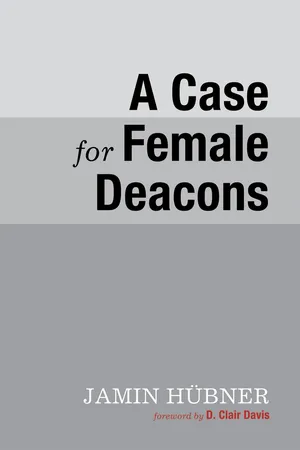
A Case for Female Deacons
About this book
The subject of "women in ministry" has attracted considerable attention in the past half-century of Western Christianity. While much of the debate has centered around ordination and female pastors, few works have focused specifically on female deacons. A Case for Female Deacons challenges reformed and evangelical Christians to accept the legitimacy of female deacons without getting distracted by the more controversial debate about female pastors. The heart of the book contains a thorough exegesis of key passages and a fascinating look at what the church believed about deacons in centuries past. As a graduate thesis, readers will find a cohesive, logical argument supported by a wealth of scholarly research. As a contemporary work in theology, many complementarians and traditionalists will be challenged to revise their position. The end result is a compelling biblical, theological, and historical case for female deacons.
Information
Subtopic
Église chrétienne1
The Argument
Is the church office1 of deacon restricted to one sex? Since this study is aimed at those who hold the Christian Scriptures in high regard, we will first look at the biblical material and then look at how Christians throughout history have thought about female deacons. Each chapter of this book will correspond to a portion of the argument outlined below.2
The Argument
(Primary Premise) The ban on women elders propounded by complementarians does not apply to women deacons; New Testament teaching suggests that teaching and exercising authority over men is neither a required ability nor necessary task undertaken by a deacon (whether “functional” or “official”3).
1. (Primary Conclusion) Therefore, the office of deacon is not gender specific and qualified women4 are encouraged to occupy it.
2. (Confirming Argument A) The New Testament authors show awareness of women deacons in Rom 16:1.
3. (Confirming Argument B) The Apostle Paul provides the qualifications of women deacons in 1 Tim 3:11.
4. (Confirming Argument C) Female deacons (“deaconesses”) are not foreign to the historical church. Rather, female deacons have been conceptually approved by Christian leaders and have actually existed in many churches throughout history.
5. (Final Conclusion) Therefore, the truthfulness of conclusion (2) is reaffirmed by the testimony of the Scriptures (namely, Rom 16:1–2, 1 Tim 3:11) and of the church.
You may have noticed that the structure of this argument is not like those that are often given in today’s contemporary debates. Instead of assuming the burden of proof is on the one who believes in female deacons—and therefore puts all the weight on Scripture’s explicit mentioning of female deacons (or something similar), I assume instead (in the spirit of the New Testament, I hope) that the role and function of church members are determined primarily by the gifts specifically given to them by God (Acts 11:29; Rom 12:3–8; 1 Cor 12:7–31; Eph 4:1–14; cf. Heb 2:2–4). If there are no real prohibitions or sound theological reasons against the idea of female deacons, and if the Spirit gives gifts to women that correspond to the task of being a deacon, then there seems to be every reason to affirm the legitimacy of female deacons. I do not believe that God gives spiritual gifts to people only to prohibit them from using those gifts—especially in the context of the church!
Thus, what follows from that point are “confirming arguments”—positive reasons to believe that women often ought to be deacons. These are the more popularly disputed controversies that surround the subject, such as the role of Phoebe in Rom 16:1–2 and the meaning of “women” in 1 Tim 3:11. Readers can determine for themselves how much weight ought to be given to each of these three cases.
As I said in the previous chapter, no argument is perfect. But hopefully it will become clear that, from an evangelical or reformed perspective that gives priority to biblical teaching, one cannot prohibit women from the office of deacon simply on the basis of their gender. One must look at a person’s heart and soul—not their chromosomes—to see if they are fit to be deacons of God’s church.
1. Craig Blomberg defines office as “a settled or consistent function, role, or position” in Beck, Two Views, 152. Typically, an “office” also involves interpersonal accountability in the church and explicit qualifications in the New Testament. Belleville critiques Blomberg’s definition on page 197 of the same aforementioned volume, calling it “anachronistic” precisely because the concept of “offices” was in development in the NT period. Thus, there were no “settled” or “consistent” church positions in NT times. Cf. Craig Keener: “We should avoid distinguishing between offices and gifts too arbitrarily, especially when someone receives a title as in Exod 15:20; Judg. 4:4; 2 Kgs 22:14; Isa 8:3; Luke 2:36) and our term for ‘office’ does not exist in Scripture (Eph 4:8, 11 calls ministers ‘gifts’; ‘prophets’ in 1 Cor. 14:29, 32 seems to refer to any who prophesy),” 207. We will address this matter more thoroughly in chapter 4 when discussing Phoebe in Romans 16.
2. Note that 1 and 2 of the argument is in the same chapter.
3. This popular (though often unhelpful) distinction will be addressed in chapter 4 when discussing Romans 16:1.
4. See Confirming Argument B for the qualifications of women deacons.
2
Primary Premise and Conclusion
The ban on women elders propounded by complementarians does not apply to women deacons; New Testament teaching suggests that teaching and exercising authority over men is neither a required ability nor necessary task undertaken by a deacon (whether “functional” or “official”).
One of our major assumptions going into this work is that the New Testament generally teaches that church government is to be structured with elders (pastors) shepherding the church5 and deacons (“servants”) assisting the church.6 This section of our study will brie...
Table of contents
- Title Page
- Foreword
- Abbreviations
- Introduction
- Chapter 1: The Argument
- Chapter 2: Primary Premise and Conclusion
- Chapter 3: Confirming Argument A: Romans 16:1–2
- Chapter 4: Confirming Argument B: 1 Timothy 3:11
- Chapter 5: Confirming Argument C: Historical Theology
- Conclusion
- Bibliography
Trusted by 375,005 students
Access to over 1.5 million titles for a fair monthly price.
Study more efficiently using our study tools.
Frequently asked questions
Yes, you can cancel anytime from the Subscription tab in your account settings on the Perlego website. Your subscription will stay active until the end of your current billing period. Learn how to cancel your subscription
No, books cannot be downloaded as external files, such as PDFs, for use outside of Perlego. However, you can download books within the Perlego app for offline reading on mobile or tablet. Learn how to download books offline
Perlego offers two plans: Essential and Complete
- Essential is ideal for learners and professionals who enjoy exploring a wide range of subjects. Access the Essential Library with 800,000+ trusted titles and best-sellers across business, personal growth, and the humanities. Includes unlimited reading time and Standard Read Aloud voice.
- Complete: Perfect for advanced learners and researchers needing full, unrestricted access. Unlock 1.5M+ books across hundreds of subjects, including academic and specialized titles. The Complete Plan also includes advanced features like Premium Read Aloud and Research Assistant.
We are an online textbook subscription service, where you can get access to an entire online library for less than the price of a single book per month. With over 1.5 million books across 990+ topics, we’ve got you covered! Learn about our mission
Look out for the read-aloud symbol on your next book to see if you can listen to it. The read-aloud tool reads text aloud for you, highlighting the text as it is being read. You can pause it, speed it up and slow it down. Learn more about Read Aloud
Yes! You can use the Perlego app on both iOS and Android devices to read anytime, anywhere — even offline. Perfect for commutes or when you’re on the go.
Please note we cannot support devices running on iOS 13 and Android 7 or earlier. Learn more about using the app
Please note we cannot support devices running on iOS 13 and Android 7 or earlier. Learn more about using the app
Yes, you can access A Case for Female Deacons by Jamin Hübner in PDF and/or ePUB format, as well as other popular books in Théologie et religion & Église chrétienne. We have over 1.5 million books available in our catalogue for you to explore.