eBook - ePub
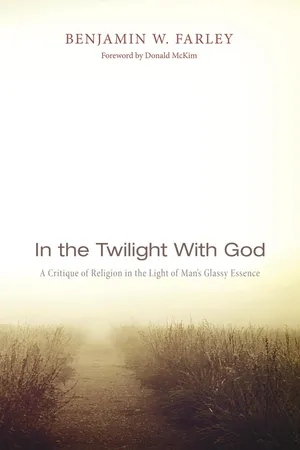
In the Twilight with God
A Critique of Religion in the Light of Man’s Glassy Essence
- 138 pages
- English
- ePUB (mobile friendly)
- Available on iOS & Android
eBook - ePub
In the Twilight with God
A Critique of Religion in the Light of Man’s Glassy Essence
About this book
Granted that God may exist, how may God be defined in our time? Addressing this issue Benjamin Farley explores a variety of belief systems, Western and Eastern, religious and skeptical.
Taking an approach that is both critical of religion as well as sympathetic, Farley refuses to shy away from hard questions or to dismiss constructive answers that speak to the human condition. He distinguishes human "intellectual ascent" towards God from humankind's "innate and inner sense" to know and relate to the living God, demonstrating the efforts and rewards of both approaches in Christianity, as well as in Hinduism, Buddhism, Taoism, and Zen.
Alongside these more obviously "religious" approaches, Farley reviews the methodologies and findings of today's greatest scientific minds, including skeptics such as Hawking, Dawkins, and Wilson, as well as their skeptical forerunners of the past. He argues that belief in God can no more ignore the scientific truth about the universe than science can dismiss the spiritual yearnings and hunger of humanity for purpose, meaning, and its inescapable sense of the presence of God.
Information
Topic
Teologia e religioneSubtopic
Religioni comparateChapter 1
The Inescapable Question
The question is infinitely more than “does God exist?” or even, “does it matter that God exists?” Either question is multi-faceted and incorporates a sequel of related questions within itself. Why? Because words like “God” and “exists” are functions of the definitions we assign them. To assume that either implies an independent existence beyond language is part of the problem we cannot escape. Indeed, complicating and inseparable from the preceding statement is the age-old distinction between objectivity and subjectivity. How do we ever get out of our subjectivity to know anything objective? We shall examine this in chapter 4. Still, the dilemma persists. Does God exist objectively, independent of a human self, or is God purely a function of our subjective encounter with the self as we relate to the world?
Does that mean that we can never attain a definitive answer to either question? Most contemporaries would maintain that no one knows the truth about God in any scientific sense; only faith can make that leap. This side of faith, ambivalence will always prevail. Nonetheless, there are sound philosophical and religious considerations that have sustained mankind in their leaps of faith. We shall seek to examine these as the critique unfolds.
By this I do not mean to sound that I know something that nobody else knows. God hasn’t singled me out or endowed me with a privileged position. Across the centuries, however, religious persons have experienced a Self within the self of their self-consciousness that engages them in dialogue, if not an encounter with a deeper Self whose presence is totally unmediated. One thinks of biblical Abraham and the ease with which YHWH converses with him and he with YHWH, or the sudden appearance of Krishna in the chariot with the young Arjuna who is on his way to battle in that epic story of the Bhagavad Gita. For years, Western theologians have addressed this phenomenon under the heading of “transcendence,” even identifying the self’s awareness of that Other as the self’s “encounter” with God. In today’s culture, however, such encounters with any mystical Self, especially defined as God, are politely, if not openly, rejected. On the contrary, it is argued that any Self within the self is nothing more than the mind’s capacity to address itself, or one’s inner self simply speaking to the self. Even more likely, it is a “meme,” a gene, in accordance with Richard Dawkins’ theory, by means of which mankind has been able to cope with life and survive over the eons of evolution. In fact, during the nineteenth century, the philosopher Ludwig Feuerbach argued that mankind’s “innate” sense of God was little more than an objectification of one’s inner-self, purified and projected onto the screen of infinity as God. Today’s world is simply more comfortable with assessing any awareness of “divine presence” as an aspect of one’s biological self, influenced by cultural preference, rather than an awareness of an Eternal Order that stands outside the self.
Taking issue with all this, however, is the late existentialist Jewish philosopher Martin Buber. With passion he argued that God is not a condition that exists merely within human beings, or a transcendent principle whose existence is dependent upon the mind of man. Rather, God is truly independent and exists over against man, yet constantly in dialogue with man. More must be said of this later, but suffice it to state that the majority of present-day empirical-minded people find themselves more under the influence of skeptics of religion than believers in the reality of God as one who exists outside human subjectivity.
Had one been born in the East, it is likely that one’s sense of the mystical self would be identified with the Buddha essence, or, at least in Hinduism, with one of Vishnu’s descents, or as that Name not even the Taoists dare name. The phenomenon of “transcendence” has been known for centuries. Yet, for all the wisdom attached to the major religions and their prophets, priests, and mystics, we still do not know with certainty the truth about God, or for that matter the truth about ourselves vis-à-vis the phenomenon of transcendence.
Both Plato and Descartes longed for certainty. So also did St. Augustine. All three labored to discover the absolute grounds on which one might establish a foundation for what can be known about anything. For Plato, it was the realm of eternal ideas, or universals which the mind grasps, that became his foundation for knowing what is good, true, and real; for Descartes, it was the self-evident truths that his doubting mind could not deny that became “indubitable” for him; for Augustine, it was the illuminating power of faith that enabled him to understand the created universe, thus allowing his restive heart to find rest in God.
Each in his way established a level of certainty to which he could entrust his life. But their world of transcendent certitude is no longer believable for many today. This is especially the case in the light of contemporary science’s knowledge of the universe and of human evolution. In the mind of skeptical science, belief in God is more of a detriment than a blessing, more of a step back into ignorance than an advancement toward enlightenment. Thus, religious persons are compelled to explore anew the truth about themselves and God. No one can ever possess with innocence Plato, Augustine, or Descartes’ certitude again, but one can examine the phenomenon of the sense of the presence of God, along with mankind’s philosophical and religious arguments for God, insofar as any of the above can be objectively studied and critiqued. Moreover, it is a task that can be relished, as much as Sisyphus relished his, who from morning to evening rolled the stone of his existence up the dark hill of destiny, even though his stone rolled back down in the smudge of a purple dusk. In the same way that Samson placed his hands against the pillars of the Philistines’ temple to bring down its stones about their pagan heads, so too contemporary humankind can apply the synapses of reason against today’s pillars of objection to recover what can be postulated about God.
What are some of the pillars that must come down? A partial list might include the following:
Exclusivity. As difficult as this may be for established religions, especially Protestantism, Catholicism, and the Reformed Tradition, or facets of Judaism, Islam, and Buddhism, few, if any, global-minded persons today would maintain that their religion alone enjoys an inviolable, privileged position among the competing views of God. Such confidence may have served cultural purposes and political aspirations up through the late nineteenth century, but the self-advancement of one religion over others can neither be proven to be true nor fruitful for international dialogue. A militant Christianity, zealot Zionist movement, or resurgent Islam may enjoy support among respective constituents, but they fail to address the global sighs for peace and wellbeing that demand redress in our time. To bind God to a single religion, as if God’s voice cannot be heard in the universal hunger and hope, insight and comfort of other faiths, or their theological views, eviscerates any unconditional goodness that the subject could hope to offer. All deserve to be explored as windows onto the Eternal, until their darker shadows obscure the view.
The assumption that one’s religion actually speaks unequivocally for God is a second pillar that requires Samson’s nudge. In truth, no one can claim that his or her religion speaks solely for God while others do not. At best, each represents a culture’s collected thoughts, or inherited traditions, or personal convictions of divine encounters, echoing one’s deep and abiding personal longings. The Ineffable, of its very necessity, would have to transcend anything mankind has thought about the divine or attributed to God. Thus, Isaiah could imagine God descrying: “For your ways are not my ways, nor your thoughts my thoughts” (Isa 55:8). His bold assertion still stands as one of mankind’s greatest insights. No one today can claim to speak unequivocally for God. Such “speaking” testifies primarily to the speaker’s heritage, background, or cultural milieu. At best, one can strive to appreciate the religious experiences of others, or, whenever possible, demonstrate respect for the varied hierophanies that manifest the Holy.
Revelation. Revelation has often been defined as that moment of moments in the light of which all other moments become intelligible. H. Richard Niebuhr advanced this view with powerful persuasion. Yet, as convincing as this insight sounds, each religion savors its own revelatory moment or moments, challenging any hope of discovering a universal moment or hierophany that illuminates all humankind’s other moments. That means that “revelations” are also bound by time and culture, language and the historical exigencies of locale and era. To argue that one’s “revelation” is superior to another’s is a facet of cultural-centricity, which requires an authentic and humble willingness to test the Spirit of grace and insight it has to offer.
Related to revelation is each religion’s dogma concerning authoritative sources. These consist of sacred writings, viewed as divinely inspired and often considered inerrant and infallible in order to establish a religion’s unassailable veracity. Whether it is the Holy Bible, the Quran, the Bhagavad Gita, the Dhammapada, or Tao Te Ching, each collection claims to be a depository of sacred wisdom, if not the actual words of God or its founder, thus making that religion’s scriptures inviolable. Rather than each being the sole source of God’s will or of God’s self-revelation, each requires investigation and scrutiny of its own. None can be taken on face value without passing the bar of what we know to be true, just, and in sync with the universe.
Literalism also constitutes a formidable obstacle. The belief that God created the universe in six days, or that Moses literally parted the waters of the Red Sea, or that dead bodies and/or deceased souls can be resurrected to an eternal life, or that we are reincarnations of preexisting souls, or that multiple Buddha-lands await the Buddha’s faithful followers, or that each Dalai Lama is an actual reincarnation of his predecessor’s spirit, or that the Shiite Mahdi or Christian Messiah may return at some future time, clashes with contemporary humankind’s knowledge about anything we cherish as true. It stands in stark opposition to the Enlightenment and what we know about the universe, its age, origin, natural laws, and evolving geo-physical concurrences. Literalism has done much to thwart the truth about the universe in which we live. In some instances it has led to a plethora of fundamentalist beliefs that do more to divide the world than foster common hope. At other times it has promoted an intellectual and spiritual darkness that belies the very truth it portends to herald. Christianity, Islam, Judaism, along with barbaric Hindu groups, share equal blame for fostering fundamentalist groups that insist that God supports their radical views, thereby justifying their acts of violence, abuse, and terrorism. Such views have created fanatical dreams of creating fascist theocracies opposed to every idea of freedom and liberty that the last four centuries of social contract democracies have sought to establish.
Superstition. Even Jesus opposed superstition, denying the belief that parental sin was the causal factor of a young man’s blindness (John 9:3). As an exorcist and Palestinian sage, he labored within the framework of his culture’s medical and therapeutic limits to heal people. He discouraged the “healed” from making unsubstantiated claims, encouraging them rather to submit to the religious practices of the time, or just remain silent. He was not after fame for himself. It was thrust upon him by the discouraged, downcast, and disenfranchised populace of the time. Only later was their movement championed by a more educated and disenchanted generation of leaders whose unhappiness with the politico-religious policies of the Roman Empire compelled them to look elsewhere. The latter represent that long line of dedicated bishops and priests who transformed the Jesus Movement into a powerful Western religion by the time of Charlemagne.
Miracles. The philosopher David Hume argued that miracles are the weakest line of evidence on which to build truth. Reason, experience, and observation coalesced for him to provide mankind’s surest “ultimate standard.” He defined a miracle as “a violation of the laws of nature,” which experience cannot verify.1 Nor has any sufficient number of “unquestioned [men] of good sense, education and learning” by their observations and witness ever secured confidence in favor of miracles. He offered as a maxim the principle that “objects of which we have no experience resemble those of which we have.” Only the uninformed, awed by “surprise and wonder,” are led astray to embrace the miraculous.
This isn’t to say that sacred writings aren’t filled with “wonder and surprise,” or even saga, legend, poetry, and mystical visions. Certainly, Paul Tillich’s definition of “miracle” supersedes Hume’s altogether and is far more profound (see chapter 3). Thanks to Tillich, stories of wonder and surprise fall under appropriate categories of interpretation and need not be viewed as literal observable experiences, or as Hume’s “violations of the laws of nature.” Granted that God exists, astute and penetrating minds would still constitute God’s greatest gift to humanity. In that regard, gullibility is not a virtue, nor has it ever been. True, Martin Luther castigated “reason,” referring to it as a “cunning, rascally power” and frequently denounced its followers. But his critique was aimed principally against the schoolmen of the mid-to-late medieval period, and “those who follow the light of reason and go no farther than they consider right, godly, and good.” The latter he deemed no better than “horses and asses.”2 His harsh words, however, were intended to bolster faith in God and God’s salvation rather than in human pride and self-righteousness. To that extent, the limits of reason in its ascent to God are well taken.
Exclusivity, privileged position, revelation, authoritative sources, literalism, superstition, and a fascination with miracles constitute unfortunate barriers that do more to cloud an understanding of God than to illuminate the subject.
If the truth about God, or God himself, is knowable, one would think it would have to address the following criteria:
Unity or Divine Oneness. One cannot imagine that God would be subject to, or limited by, different perspectives. Zen, Taoism, and the Theravada School of Buddhism view the divine as impersonal, if not non-existent at all. Their focus is on a way of life that conf...
Table of contents
- Title Page
- Foreword
- Introduction
- Chapter 1: The Inescapable Question
- Chapter 2: That Than Which None Greater Can be Conceived
- Chapter 3: The Ground of Being
- Chapter 4: Language, Truth, and Metaphor
- Chapter 5: A Critique of the Philosophical Arguments for the Existence of God
- Chapter 6: Science and the Universe
- Chapter 7: The Voice of Being Speaks Many Languages
- Chapter 8: Beyond Good and Evil
- Chapter 9: The Ballast of Skepticism
- Chapter 10: The Dynamics of Doubt and Its Anodyne Faith
- Chapter 11: Redemption and Redeemers
- Chapter 12: The Light that Enlightens Everyone
- Chapter 13: The Hiddenness of God
- Chapter 14: Magna Est Veritas: A Postscript
- Appendix A: Athens and Jerusalem
- Appendix B: Karl Barth’s Rejection of the Analogia Entis
- Selected Bibliography
Trusted by 375,005 students
Access to over 1.5 million titles for a fair monthly price.
Study more efficiently using our study tools.
Frequently asked questions
Yes, you can cancel anytime from the Subscription tab in your account settings on the Perlego website. Your subscription will stay active until the end of your current billing period. Learn how to cancel your subscription
No, books cannot be downloaded as external files, such as PDFs, for use outside of Perlego. However, you can download books within the Perlego app for offline reading on mobile or tablet. Learn how to download books offline
Perlego offers two plans: Essential and Complete
- Essential is ideal for learners and professionals who enjoy exploring a wide range of subjects. Access the Essential Library with 800,000+ trusted titles and best-sellers across business, personal growth, and the humanities. Includes unlimited reading time and Standard Read Aloud voice.
- Complete: Perfect for advanced learners and researchers needing full, unrestricted access. Unlock 1.5M+ books across hundreds of subjects, including academic and specialized titles. The Complete Plan also includes advanced features like Premium Read Aloud and Research Assistant.
We are an online textbook subscription service, where you can get access to an entire online library for less than the price of a single book per month. With over 1.5 million books across 990+ topics, we’ve got you covered! Learn about our mission
Look out for the read-aloud symbol on your next book to see if you can listen to it. The read-aloud tool reads text aloud for you, highlighting the text as it is being read. You can pause it, speed it up and slow it down. Learn more about Read Aloud
Yes! You can use the Perlego app on both iOS and Android devices to read anytime, anywhere — even offline. Perfect for commutes or when you’re on the go.
Please note we cannot support devices running on iOS 13 and Android 7 or earlier. Learn more about using the app
Please note we cannot support devices running on iOS 13 and Android 7 or earlier. Learn more about using the app
Yes, you can access In the Twilight with God by Benjamin W. Farley in PDF and/or ePUB format, as well as other popular books in Teologia e religione & Religioni comparate. We have over 1.5 million books available in our catalogue for you to explore.