eBook - ePub
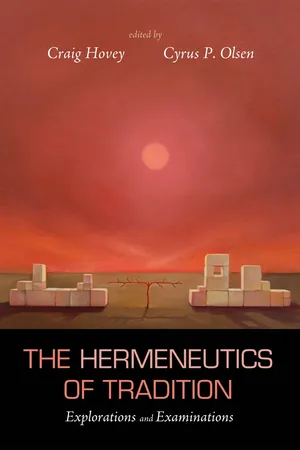
The Hermeneutics of Tradition
Explorations and Examinations
- 272 pages
- English
- ePUB (mobile friendly)
- Available on iOS & Android
eBook - ePub
About this book
The Hermeneutics of Tradition presents the latest scholarship on tradition as a concept and reality in the development of Christian cultures. One aim is to show that traditions are upheld, communicated, and developed within a recognizable set of interpretive guidelines (or rules) and that analysis of these sets both requires and reveals a "hermeneutics of tradition." The work of the authors included here presents the precarious integrity of traditions and the often tenuous hold upon those traditions exercised by the hermeneutics that drive dynamics of preservation and change. As scholars and religious worshippers continue ancient traditions of receiving strangers with generous hospitality, the coherence of tradition serves conversations about where our true differences lie.
Information
Topic
Theology & ReligionSubtopic
Christian TheologyPart One
❖
Tradition: Evangelical, Catholic, and Orthodox
1
Up the Mountain with the Fathers
Evangelical Ressourcement of Early Christian Doctrine1
The last several decades have witnessed a fascinating development among evangelicals. More and more, evangelical theologians are developing an interest in the theology of the Church Fathers. Suspicious of the ways in which previous generations of evangelicals approached Christian doctrine—too often, so it is thought, as an abstract and lifeless cataloguing of propositional statements of truth derived from syllogistic argumentation—contemporary evangelicals are turning to premodern modes of doing theology; and they look to the Church Fathers, in particular.2 This retrieval or ressourcement of the Fathers is, for all sorts of reasons, a wonderful thing, and this essay is intended as a small contribution to this burgeoning enterprise.
At the outset, however, I want to insert two caveats. First, a ressourcement of the Church Fathers that turns to the early Church in order to recover a putatively ideal era along with a pristine and pure theology is bound to end in failure. As one begins to read the Fathers, it soon becomes evident that some of the most revered theologians were perhaps rather acrimonious characters. It also becomes clear that some of the issues that occupied the Fathers tremendously are no longer in the center of attention today, so that to rehash the very same issues may render us, to some extent at least, irrelevant. Simply to go back to the early Church would mean to jettison later developments that we actually value a great deal and that we do not want to go back on. This is not to gainsay that a ressourcement of the Fathers can be a wonderful thing. But proper ressourcement is never simply a jump from where we are today into the second-century thought world of St. Irenaeus or the fifth-century theology of St. Augustine. A worthwhile retrieval of the Church Fathers both recognizes the limitations of individual theologians in the early Church and it acknowledges significant development between the age of the Fathers and our own twenty-first century. So, we have to say “no” to a naïve idealization of the Church Fathers.3
Second, while I do understand the negative reaction that many contemporary evangelicals have to what we often call “modern” approaches to theology, I am convinced it would be a mistake simply to play off the Church Fathers’ more intuitive, more biblical, more symbolic approach against what we may sense is the far too rational, systematic, and propositional theology of the modern period. Such a broad sketch does have its value. Modernity has indeed encouraged us to do theology in a sometimes strictly rational fashion, which causes serious problems. But we need to keep in mind two things:
(1) The Church Fathers were not averse to deep and careful thought. Whether we analyze Irenaeus’s opposition to the Gnostics in the second century, read Gregory of Nyssa’s reflections on the nature of human language, or engage St. Augustine’s anti-Pelagian writings, in each case, we cannot but be impressed, perhaps even daunted, by the intellectual rigour, the depth of analysis, and the vehemence with which theological statements of truth are proposed and defended. The nearly unanimous conviction of the Fathers is that human reason constitutes the very image of God, which makes it the most highly prized aspect of the human person. In short, the Church Fathers do not excuse intellectual laziness.
(2) The Church Fathers never confused mystery with skepticism. In today’s postmodern climate, contemporary evangelicals tend to react against the certainties of the past that fuelled mutual misunderstanding, fed intellectual pride, and kept denominations apart. We have become impatient with the intellectual boundaries and edifices previous generations erected, and the postmodern climate of our culture has made us skeptical of our epistemic ability to arrive at truth.4 As a result, we sometimes turn to premodern theological approaches because we mistakenly believe they are more congenial to our postmodern skepticism than the propositionalism of our immediate evangelical forebears. It is true that the Church Fathers would have objected to the rationalist propositionalism of modernity. But we should not confuse their high regard for mystery with a lapse into skepticism. The mystery that the Fathers explored is something fundamentally different from the skepticism that today eats away at the foundations of Western culture.5
With those caveats in mind, let me turn to the topic of Christian doctrine in the early Church. In what follows, I will explore five aspects: (1) the purpose of doctrine; (2) the basis of doctrine; (3) the context of doctrine; (4) the development of doctrine; and (5) the limits of doctrine—all of this with reference to the early Church.
The Purpose of Doctrine
With regard to the first aspect, the purpose of doctrine, perhaps I can best illustrate the point I am trying to make by means of the Beatitudes in Matthew 5. Here Jesus pronounces as “blessed” or “happy” eight categories of people. These eight categories ultimately devolve into one. The poor in spirit, those who mourn, the meek, those who hunger and thirst for righteousness, the merciful, the pure in heart, the peacemakers, and those who are persecuted are all one and the same group. As our Lord addresses the crowds, and in particular his disciples (Matt 5:1), he addresses us all, and he holds out the prospect of happiness to everyone.6
The textual details that stood out for the Church Fathers as they read the Scriptures were at times rather different from the things we tend to notice. Take the word “mountain” (oros) in verse 1: “Now when he saw the crowds, he went up on a mountainside [oros] and sat down.” The mindset of the Fathers was such that for them this word oros leapt off the page, as it were. The cause of this is what they regarded as the purpose of theology. Let’s listen in on the fourth-century Cappadocian spiritual master, St. Gregory of Nyssa (c. 335–c. 394). In the first of his sermons on the Beatitudes, he immediately honed in on Matthew’s “mountain”—a “spiritual mountain of sublime contemplation.”7 “This mountain,” said Gregory,
leaves behind all shadows cast by the rising hills of wickedness; on the contrary, it is lit up on all sides by the rays of the true light, and from its summit all things that remain invisible to those imprisoned in the cave may be seen in the pure air of truth. Now the Word of God Himself, who calls blessed those who have ascended with Him, specifies the nature and number of the things that are contemplated from this height.8
For Gregory, the Beatitudes served to unshackle us from our imprisonment in the Platonic cave (the world of the passions), and they placed us in the presence of Jesus (“the Word of God Himself” as Gregory would rather put ...
Table of contents
- Title Page
- Contributors
- Acknowledgments
- Introduction
- Part One: Tradition: Evangelical, Catholic, and Orthodox
- Chapter 1: Up the Mountain with the Fathers
- Chapter 2: Communion and Catholicity
- Chapter 3: The Hermeneutics of Schism and the Question of “Sister Churches”
- Part Two: Tradition: Ancient, Late-Medieval, and Modern Analyses
- Chapter 4: The Holiness of the Church in North African Theology
- Chapter 5: Martin Luther’s Hermeneutics of Christ’s Deified Flesh
- Chapter 6: Alasdair MacIntyre’s Hermeneutics of Tradition
- Part Three: Tradition: Liturgy and Lament
- Chapter 7: Tradition, Truth, and Time
- Chapter 8: Joseph Ratzinger and the Hermeneutic of Continuity
- Chapter 9: The Wound of Tradition
Trusted by 375,005 students
Access to over 1.5 million titles for a fair monthly price.
Study more efficiently using our study tools.
Frequently asked questions
Yes, you can cancel anytime from the Subscription tab in your account settings on the Perlego website. Your subscription will stay active until the end of your current billing period. Learn how to cancel your subscription
No, books cannot be downloaded as external files, such as PDFs, for use outside of Perlego. However, you can download books within the Perlego app for offline reading on mobile or tablet. Learn how to download books offline
Perlego offers two plans: Essential and Complete
- Essential is ideal for learners and professionals who enjoy exploring a wide range of subjects. Access the Essential Library with 800,000+ trusted titles and best-sellers across business, personal growth, and the humanities. Includes unlimited reading time and Standard Read Aloud voice.
- Complete: Perfect for advanced learners and researchers needing full, unrestricted access. Unlock 1.5M+ books across hundreds of subjects, including academic and specialized titles. The Complete Plan also includes advanced features like Premium Read Aloud and Research Assistant.
We are an online textbook subscription service, where you can get access to an entire online library for less than the price of a single book per month. With over 1.5 million books across 990+ topics, we’ve got you covered! Learn about our mission
Look out for the read-aloud symbol on your next book to see if you can listen to it. The read-aloud tool reads text aloud for you, highlighting the text as it is being read. You can pause it, speed it up and slow it down. Learn more about Read Aloud
Yes! You can use the Perlego app on both iOS and Android devices to read anytime, anywhere — even offline. Perfect for commutes or when you’re on the go.
Please note we cannot support devices running on iOS 13 and Android 7 or earlier. Learn more about using the app
Please note we cannot support devices running on iOS 13 and Android 7 or earlier. Learn more about using the app
Yes, you can access The Hermeneutics of Tradition by Craig Hovey,Cyrus P. Olsen, Hovey, Olsen in PDF and/or ePUB format, as well as other popular books in Theology & Religion & Christian Theology. We have over 1.5 million books available in our catalogue for you to explore.