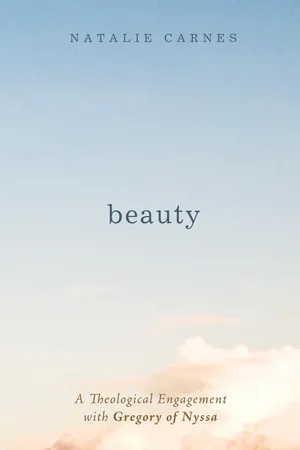
- 282 pages
- English
- ePUB (mobile friendly)
- Available on iOS & Android
eBook - ePub
About this book
Beauty engages fourth-century bishop Gregory of Nyssa to address beauty's place in theology and the broader world. With the recent resurgence of attention to beauty among theologians, questions still remain about what exactly beauty is, how it is perceived, and whether we should celebrate its return. If beauty fell out of favor because it was seen to distract from the weightier concerns of poverty and suffering--because it can even be a tool of oppression--why should we laud it now? Gregory's writings offer surprisingly rich and relevant reflections that can move contemporary conversations beyond current impasses and critiques of beauty. Drawing Gregory into conversation with such disparate voices as novelist J. M. Coetzee and art theorist Kaja Silverman, Beauty displays the importance of beauty to theology and theology to beauty in a discussion that bridges ancient and modern, practical and theoretical, secular and religious.
Information
Topic
Theology & ReligionSubtopic
Christian Theology1
On Gregory of Nyssa and Beauty
genealogical threads
Before a performance, the stage must be set. And to set the stage for this theological performance is to introduce its two main characters, first Gregory of Nyssa and then beauty, by telling a story about each character. Story one begins in the twilight of antiquity, as light grays around rhetorically gifted and beauty-loving bishop Gregory of Nyssa (c. 335–394). The second story opens as the starry medieval night breaks into the dawn of modernity. The new day glares on beauty, whose grandeur fades in the bright Enlightenment.1 It fades as beauty suffers transformations that by late modernity have feminized beauty, marginalized her, and left her vilified as market promiscuous. She is exiled from her once-central location in theological thought and scholarly work.
This chapter recounts the stories of these characters to stage a performance in which Gregory wanders through the set of modernity, asking after, seeking, and finding beauty, to rehabilitate her as and for theology. The rehabilitation, however, cannot just be beauty’s; the theological terms on which beauty’s exile were approved must themselves recover. For to reclaim the theological significance of beauty is to suggest both that a full and flourishing conception of beauty requires theological description and also that a full and flourishing theology does not marginalize beauty as a peripheral concern. So if one description of the performance might be tiresomely gendered—an active male character restoring a passive, feminized one—another account yields a fresher take: A feminized character redeems a rather male-dominated discipline. For, if beauty has become a woman for moderns, she names God for Gregory, and as a name for God, she rightly disciplines, guides, and proliferates theological work.
The present chapter prepares for this performance of double-restoration of beauty and theology by evoking the disparate worlds of the main characters. I begin with Gregory of Nyssa and reflect on his life by tracing themes especially significant for the constructive chapters: family and friendship, rhetoric, training, and death. I conclude the story of Gregory with a brief turn to the history of reception that yielded the narratives we tell and texts we have of Gregory today. From there I move on to beauty and attend to several voices accounting for how beauty came to be discussed (and not discussed) in the modern world. Of particular interest in these accounts are changes in its status and presence in North Atlantic academic conversation—changes that are not unrelated to the social and intellectual history of modernity. I end the chapter by noting recent theological performances on beauty—work I consider to be itself quite beautiful, and which gives me a loose model for how I will proceed. Gregory, then, need not pioneer beauty’s reclamation, but only join a growing chorus of theologians sounding the centrality of beauty to theology.2
Story One: Gregory of Annisa, Caesarea, and Nyssa
Gregory lived in one of the most contentious centuries in Christian history. The church was evolving from persecuted to persecutor, and the ones whom it persecuted were its own. Gregory’s story is woven into these power struggles of church and empire. He was himself one of the persecuted: Under the influence of the Eunomians,3 Emperor Valens permitted his exile. Yet he was also one of the powerful: His brother Basil was bishop of the important see of Caesarea, and he himself was also a bishop, though of a less important see, as was his good friend Gregory of Nazianzus. Together these three, known collectively as the “Cappadocian Fathers,” set about Trinitizing the church. So the story goes.4
It is easy to extract these three men and name their importance as the Cappadocian Fathers because they wrote treatises, debated doctrines, convened synods, and attended councils. The further one goes into Nyssen’s writings, though, the more one sees the loss such extraction entails. On the one hand, extracting them as the Cappadocian Fathers is a loss because it overly conflates the three men and glosses over differences, particularly in theological style and commitment. 5 On the other hand, titling them as the Cappadocian Fathers overemphasizes their agency and significance at the expense of others’, especially that of their family members. In this second respect, the title inflates the aloneness, the uniqueness, the unrepeatability of their achievements. Yet Gregory was certainly not alone. Born into a wealthy, locally important family in Pontus, Gregory might deserve the distinction of belonging to one of the most significant Christian families in history. His friend witnesses to the family’s significance for the church. Upon the death of Gregory’s mother, Emmelia, Gregory of Nazianzus wrote epigrams about her. In one, he “marveled” at “the wealth of her mighty womb.”6 In another, he exclaimed,
Emmelia is dead! Who would have thought it, she who gave to life the light of so many and such children, both sons and daughters married and unmarried? She alone among mortals had both good children and many children. Three of her sons were illustrious priests, and one daughter the companion of a priest, and the rest were like an army of saints.7
“The rest” brought Emmelia’s total to nine children.8 They included Macrina and Naucratius, who would influence the development of Christian monasticism. Naucratius suffered an early death, but Macrina (c. 327–80) was a formidable influence on her family up through old age. As the eldest child, Macrina helped her mother raise her siblings, which meant that she loved them tenderly and rebuked them sternly. In his book about her, the Life of Macrina (De Vita Macrinae), Gregory testifies to her use of both parental modes.
Macrina is the hidden heroine of our story. It is gallingly familiar that a woman should perform the role of silent heroine enabling the rehabilitation a male hero performs. But how can we draw her out of hiding? Gregory of Nazianzus, too, wonders over Macrina’s hiddenness. As he does with Emmelia, Nazianzen brings his poetry to bear on Macrina after her death. He writes, “The dust holds the illustrious virgin Macrina, if you have heard something of her, the first born of the great Emmelia. But who kept herself from the eyes of all men, is now on the tongues of all and has a greater glory than any.”9 The qualification “if you have heard something of her” belies the ending declaration of her surpassing glory and makes plain the impossibility that she is “on the tongues of all.” We must understand Gregory of Nazianzus as describing Macrina’s glory in the eschatological present, which means that there is a strong “not yet” to the way humanity may perceive the glory of the one who “kept herself from the eyes of all men.” Not until every tongue has confessed the Lordship of Christ will they also celebrate the glory of Macrina.
Until then, Macrina, who occupied no position of power, who bequeathed to us no texts, meets us modern readers through her brother’s texts. For Gregory of Nazianzus was not the only Cappadocian to take note of Macrina’s hidden glory. Apparently troubled by her lack of renown, Gregory of Nyssa explains in the beginning of the Life of Macrina that if Macrina’s life were to remain “veiled in silence,” it would be a loss.10 He conceives of his writing, then, as a kind of unveiling, and he takes pains to assure the reader that the Macrina she meets in his text is, indeed, Macrina the Younger of Annisa. All the stories in his text come from personal experience,11 and he insists he delivers them in an unstudied and unstylized manner.12
One needn’t doubt Gregory’s truthfulness to know the difficulty of discerning the historical Macrina. It is difficult to discern Macrina’s presence, for access to Macrina is always mediated by Gregory’s compositions; she’s a character in and of his memories, agendas, and debates. Nevertheless, Macrina, even as Gregory’s character, exceeds Gregory’s writerly purposes. At times she glimmers forth, reminding us that Gregory’s rehabilitative quest is a form of fidelity to her—she who showed him the beautiful Bridegroom into whose arms she finally disappeared. But we are never sure which appearance and disappearance reveals Macrina, daughter of Emmelia and founder of the monastic life at Annisa. Many have tried to pin this Macrina down,13 yet the lady always vanishes.14 ...
Table of contents
- Title Page
- Acknowledgments
- Introduction
- Chapter 1: On Gregory of Nyssa and Beauty
- Chapter 2: Beautiful Bodies, Beautiful Words
- Chapter 3: Rotting Bodies, Bleeding Words
- Chapter 4: Bodies Luminous and Wounded
- Epilogue
- Bibliography
Trusted by 375,005 students
Access to over 1.5 million titles for a fair monthly price.
Study more efficiently using our study tools.
Frequently asked questions
Yes, you can cancel anytime from the Subscription tab in your account settings on the Perlego website. Your subscription will stay active until the end of your current billing period. Learn how to cancel your subscription
No, books cannot be downloaded as external files, such as PDFs, for use outside of Perlego. However, you can download books within the Perlego app for offline reading on mobile or tablet. Learn how to download books offline
Perlego offers two plans: Essential and Complete
- Essential is ideal for learners and professionals who enjoy exploring a wide range of subjects. Access the Essential Library with 800,000+ trusted titles and best-sellers across business, personal growth, and the humanities. Includes unlimited reading time and Standard Read Aloud voice.
- Complete: Perfect for advanced learners and researchers needing full, unrestricted access. Unlock 1.5M+ books across hundreds of subjects, including academic and specialized titles. The Complete Plan also includes advanced features like Premium Read Aloud and Research Assistant.
We are an online textbook subscription service, where you can get access to an entire online library for less than the price of a single book per month. With over 1.5 million books across 990+ topics, we’ve got you covered! Learn about our mission
Look out for the read-aloud symbol on your next book to see if you can listen to it. The read-aloud tool reads text aloud for you, highlighting the text as it is being read. You can pause it, speed it up and slow it down. Learn more about Read Aloud
Yes! You can use the Perlego app on both iOS and Android devices to read anytime, anywhere — even offline. Perfect for commutes or when you’re on the go.
Please note we cannot support devices running on iOS 13 and Android 7 or earlier. Learn more about using the app
Please note we cannot support devices running on iOS 13 and Android 7 or earlier. Learn more about using the app
Yes, you can access Beauty by Natalie Carnes in PDF and/or ePUB format, as well as other popular books in Theology & Religion & Christian Theology. We have over 1.5 million books available in our catalogue for you to explore.