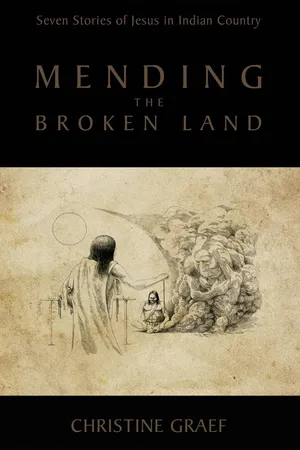
- 150 pages
- English
- ePUB (mobile friendly)
- Available on iOS & Android
eBook - ePub
About this book
After five centuries of oppressions committed in the name of Jesus, many hearts have hardened toward the name of Christ on the part of many of those native or original to the lands we now call America and Canada. The imposition of residential schools, removal policies, and forced adoptions left many angry about white man's religion, confused about a savior who would promote such violent ripping apart of families, deceitful taking away of lands, and forced assimilation away from natural heritages.
Acknowledgment has been made and apologies given. In Canada large amounts of compensation are being paid out to survivors and their communities. But what does Scripture say about culture and what can original treaties teach us about healing from our shared history?
In an era when America and Canada are being called to return to God, Mending the Broken Land provides a meeting ground in an ecotone of cultures as diverse as nature's meadows. Drawing on the example of the governance of a first people of the northeast, the Haudenosaunee Confederacy, it witnesses a new generation in a process of healing aligning with the teachings of Christ.
Information
Topic
Theology & ReligionSubtopic
Christian Theology1
Aiionwatha
The Lord is near to the brokenhearted and saves the crushed in spirit.
Psalm 34:18
On a late summer afternoon the car radio brought the voice of a pastor talking about how God calls individuals from among all nations, lands, and languages to be his people. The sun was low in the western sky, slanting rays through the trees that forest upstate New York. Deer rested in the cool shade. The trio of crow siblings born in a nest high in one of the pines glided like shadows between the trees and announced to all who could hear that they’d found a food source somewhere. A chipmunk hopped onto an ancient rock left long ago by the glaciers forming the St. Lawrence River. Out in the water a turtle peered above the surface and let the current carry him.
The pastor went on speaking. He said he thought cultural tradition should be abolished so it would not separate people. The airwaves carried his words across New York state and southern Canada, where a wealth of rivers quench the land, flowing into lakes and out to tributaries that gather into the Great Lakes, the world’s largest interconnected freshwater bodies. Emptying into the St. Lawrence River, the water moves northeast to the edge of the continent and mixes with the salty ocean water. The flow of these waters has sustained the ways of unity, good mind, and health of the original people of the region, the Haudenosaune Confederacy, for the past millennia.
This time of year, Haudenosaunee people on their six reserves were bundling up medicinal plants with knowledge passed through the generations. There would be people tending the gardens, families swimming in the river, fishermen bringing in the day’s catch, faithkeepers talking about the coming Green Corn Ceremony to give thanks for another year bringing a harvest. Environmental workers would be assessing the water and land that suffered a hundred Superfund cleanups in just a couple of centuries since the new arrivals from Europe.
An eagle spread his wings high on a thermal circling above the Mohawk’s Akwesasne community, where the St. Lawrence surges through their reserve. His presence, recently restored, served as a reminder of the origins of their governance, the Great Law of Peace, his meaning more ancient than the systems of churches and governments across the region. The eagle perched at the top of the white pine tree that is the symbol of the Haudenosaunee’s governance, showing how our God looks out over the land seeing yesterday, today, and tomorrow.
Then the pastor said he would like to see people of all colors sitting there in his congregation. But he had just said abolishing people’s cultural separations is a good idea, unaware that what he was saying was that all other traditions should be abolished except his own cultural norm. His words, to a Native listener, lacked inclusion of the history that brought him to stand where he was speaking, or he would have known how a European doctrine had sent a decree across the world to bring all Native peoples into submission, take over their lands, erase their ancient knowledge, and take dominion over their children.
The doctrine, along with papal bulls and royal charters decreed in the fifteenth century, held that lands belonged to no one if they didn’t belong to Christians, a claim that transferred land to political successors and continues to undercut Indian law today. A movement to repeal the policy began among the Haudenosaunee nations with a 2005 letter from an Onondaga faithkeeper, Oren Lyons, to the Vatican, gaining momentum in April 2010, when nearly two thousand representatives from indigenous people around the world gathered at the UN in New York City as the doctrine was presented for its legacy in their communities.
The Haudenosaunee white roots of peace spreading out in all directions were followed by the country’s founders, the pastor’s people, and even his own family, all of who found shelter under the branches of the pine here on this land. It was under this law that Europeans escaped from the unbearable religious disputes in their homelands to find freedom to serve God each in their own way.
What happened next made the North American continent the site of the greatest genocide in the history of mankind. There were 16 million Indians here at the landfall of Columbus. In 1900, in under two hundred years, there were 250,000. Whole cities, thousands of cities of Indians, whole tribes were exterminated using the systems of the church to implement removal and assimilation policies. The bonds of a once strong, healthy people and their sense of belonging to communities, clans, and extended families were broken. Hundreds of thousands of children were torn from their families: many disappeared without a trace; many died.
“By their fruits you shall know them.” (Matt 7:20)
The Confederacy survived. They were once a divided people before a Law of Peace brought them into the unity of the Haudenosaunee, dwelling together in a way Jesus had taught. This constitutional form of government directed them to reach out to other nations with the precepts of the Law. The result would be a major influence in North America, affecting politics, economics, law, culture, and history.
The differing gifts among the people, knowledge of medicinal plants to support health, knowledge of the water, of the fish, of sewing, gardening, language of prayer, burial ceremonies, and stories handed down through the generations, are as diverse as a meadow of wildflowers and grasses that sustain the bees, the butterflies, and all the birds and animals that depend on them. With each plant or animal carrying the responsibility of its gift, the meadow thrives and grows in one accord for creation to continue, a harmony of scents, colors, and strengths.
“And God saw everything that he had made, and behold, it was very good.” (Gen 1:31)
Long ago, more than two thousand years ago, in a land across the ocean, God gave life to the Christ (the Anointed One), birthed through the lineage of the Hebrew people. In his own language his name is Yeshua, derived from Yehoshua, meaning salvation. He came to be known as Jesus. The new religion his life fulfilled told how God’s Spirit sends teachers to every generation, recognized in the way God’s compassion and wisdom are promoted.
“Knowing this first of all, that no prophecy of Scripture comes from someone’s own interpretation. For no prophecy was ever produced by the will of man, but men spoke from God as they were carried along by the Holy Spirit.” (2 Pet 1:20–21)
A thousand years later on the North American continent, God sent a teacher to the people in the northeast, the man who is called Skennenrahawi (Peacemaker). He was born on Wyandot Indian lands in the Bay of Quinte on the north shore of Lake Ontario. The Wyandot are a part of the Iroquoian peoples and were known as the great Huron Nation, a French word meaning “wild boar” because of the men’s Mohawk hairstyles.
Guided by a vision, Peacemaker stepped into his canoe and pushed off into the water that carried him across Lake Ontario into what later became New York state. He paddled into a land forested with conifers and tall hardwood trees, where rivers nourish many systems, interconnecting with tributaries across the entire land. Peacemaker followed the waters in and out of lakes that linked the people to each other, carrying messages and news about battles, spreading trade, and sharing concerns of the land. The rich soils nurtured gardens, fragrant wildflowers, bushes offering an abundance of berries, and other plentiful bounty.
At night he watched the moon wane and wax brightly above, reassuring in the dark hours as Earth returned to the light of morning. In the book of Genesis the storyteller tells about the balances in creation: “And God made two great lights; the greater light to rule the day, and the lesser light to rule the night: he made the stars also. And God set them in the firmament of heaven to give light upon the earth, and to rule over the day and over the night, and to divide the light from the darkness: and God saw that it was good.”
As he entered the land Peacemaker understood that to the people here, the moon is creation’s oldest grandmother, first of the female cycles that continue life, a radiance rising from the eastern sky, following the sun across the sky, assuring the capacity of new lives to regenerate in humans and in plants and animals as well. She orbits in the sky, bringing moisture to the soil and informing the people of times to come together for the ceremonies that give thanks for the continuing cycles of life.
In times long old the people of the Haudenosaunee made a covenant with each other, creation, and Creator, represented in the Four Ceremonies: Ostowa’ko:wa (the Great Feather Dance); Kane:hon (the Drum Dance); Aton:wah (the Men’s Chant); and Kayentowa:nen (the Peach Stone and Bowl Game). But the ceremonies for giving thanks had been forgotten. Peacemaker stepped from his canoe and found the people torn by war and murder that covered the region with fear and heavy hearts.
Songs were now about the dark times of war. Revenge killings and murders went on for generations. Elders among the people prayed to the Creator of Life for a solution. They listened as messengers came and prophesied change that would come. One of the men who would speak with the leaders about ways to end the fighting would be Aiionwatha. Aiionwatha is often called Hiawatha. Loosely translated, his name means He Who Combs.
Together Peacemaker and Hiawatha went down the Mohawk River to the Kanienkehaka people, who lived in villages along the river. The Algonquin called them the Mohawk because they were enemies at that time. Their own name for themselves is Kanienkehaka—People of the Place of Flint.
The Mohawk told Peacemaker, “If we let down our guard our enemies will destroy us.” Peacemaker agreed to be tested so they would know that he was truly sent by the Creator. Then the Mohawk people accepted Peacemaker’s vision of governance. They became the Confederacy’s eastern doorkeepers, where they dwell next to morning.
After a long time (legend says five years) traveling the rivers and walking the paths to talk among all the people, Peacemaker and his words about good mind and unity brought thousands out of their dissension into an agreement to live as one family lives inside a longhouse. Their name became Haudenosaunee, derived from a new architecture, meaning The People Who Built a Longhouse.
The unity formed the powerful six-nation league, sometimes called the Iroquois Confederacy, that spanned 39,000 square miles, from the St. Lawrence River and Lake Ontario to the north, Lake Champlain and the Hudson River to the east, the Niagara River and Lake Erie to the west, and the Susquehanna and Delaware Rivers to the south. Linked from east to west, the tribes of the Iroquois Confederacy are the Mohawk, Oneida, Onondaga, Cayuga, Seneca, and later, in the 1700s, the Tuscarora.
Their oral history tells of the League being formalized on a day in late summer around noon. Corn was knee-high when the Seneca, who were divided about Peacemaker’s message, agreed to be the western doorkeepers. Grandmother Moon moved in front of the sun, convincing the people the powers that guided life wanted them and their children to have this way to live. Modern archaeology would later find stone effigies of the Tree of Peace dated to around 900 AD. Astronomy records a total eclipse of the sun over the Seneca’s main village of Ganondagen at 12:48 p.m., August 18, 909, suggesting a possible date.
The Confederacy had to transform Tadodaho, the land’s most menacing man. Tadodaho lived in Onondaga country, present-day Syracuse. He was a tyrant, described as having writhing snakes growing out of his head, twisted thoughts coming from the mind. Feared by everyone, Tadodaho thrived on the disunity of the people. But God’s Spirit sending a vision speaks, “Have I not commanded you? Be strong and courageous. Do not be frightened, and do not be dismayed, for the Lord your God is with you wherever you go” (Josh 1:9). This is because prophets are seldom invited. And Tadodaho was transformed.
Elders gathered in the longhouse to discuss this new governance but strangers broke in, threatening and knocking them down, and the elders fled. Hiawatha returned home from the meeting to find that one of his three daughters had been murdered. At the next meeting another attack of violence scattered the elders. Hiawatha found another daughter had been murdered. Winter came and as spring thawed the frozen rivers and cleared the paths, another meeting was planned. Hiawatha’s only remaining daughter, now pregnant with child, was killed when she was knocked to the ground.
These losses broke Hiawatha’s mind and he wandered away from the people. Peacemaker heard about his sorrow and went out to comfort him.
Together they went to see Tadodaho, the most violent among the people.
This defines faith, the action of upholding what our God is doing. When it’s the flow of a river, the people respect the direction because it is God who established the flow for all the land. When the trees struggle, there is effort to help them to fulfill their work for creation as God designed. Th...
Table of contents
- Title Page
- Illustrations
- Foreword
- Introduction
- Chapter 1: Aiionwatha
- Chapter 2: Edge of the Woods
- Chapter 3: Hiawatha Belt
- Chapter 4: Two-Row Wampum
- Chapter 5: Women
- Chapter 6: One Bowl One Spoon
- Chapter 7: Dark and Light Creations
- Further Reading
Trusted by 375,005 students
Access to over 1.5 million titles for a fair monthly price.
Study more efficiently using our study tools.
Frequently asked questions
Yes, you can cancel anytime from the Subscription tab in your account settings on the Perlego website. Your subscription will stay active until the end of your current billing period. Learn how to cancel your subscription
No, books cannot be downloaded as external files, such as PDFs, for use outside of Perlego. However, you can download books within the Perlego app for offline reading on mobile or tablet. Learn how to download books offline
Perlego offers two plans: Essential and Complete
- Essential is ideal for learners and professionals who enjoy exploring a wide range of subjects. Access the Essential Library with 800,000+ trusted titles and best-sellers across business, personal growth, and the humanities. Includes unlimited reading time and Standard Read Aloud voice.
- Complete: Perfect for advanced learners and researchers needing full, unrestricted access. Unlock 1.5M+ books across hundreds of subjects, including academic and specialized titles. The Complete Plan also includes advanced features like Premium Read Aloud and Research Assistant.
We are an online textbook subscription service, where you can get access to an entire online library for less than the price of a single book per month. With over 1.5 million books across 990+ topics, we’ve got you covered! Learn about our mission
Look out for the read-aloud symbol on your next book to see if you can listen to it. The read-aloud tool reads text aloud for you, highlighting the text as it is being read. You can pause it, speed it up and slow it down. Learn more about Read Aloud
Yes! You can use the Perlego app on both iOS and Android devices to read anytime, anywhere — even offline. Perfect for commutes or when you’re on the go.
Please note we cannot support devices running on iOS 13 and Android 7 or earlier. Learn more about using the app
Please note we cannot support devices running on iOS 13 and Android 7 or earlier. Learn more about using the app
Yes, you can access Mending the Broken Land by Christine Graef in PDF and/or ePUB format, as well as other popular books in Theology & Religion & Christian Theology. We have over 1.5 million books available in our catalogue for you to explore.