eBook - ePub
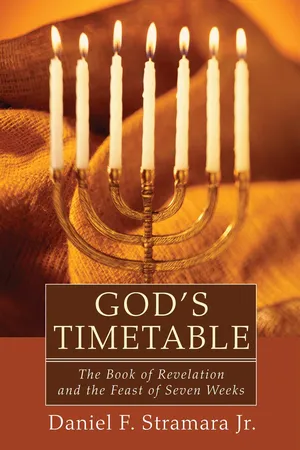
God's Timetable
The Book of Revelation and the Feast of Seven Weeks
- 202 pages
- English
- ePUB (mobile friendly)
- Available on iOS & Android
eBook - ePub
About this book
Sets of seven. 666. The Whore of Babylon and the Seven-headed Beast. How would first-century readers have heard these things? One can get at an answer by asking, How does the Book of Revelation compare with contemporaneous Jewish apocalypses? God's Timetable unlocks the hitherto unseen Jewish background to the Apocalypse based on the seven weeks leading up to Pentecost, the Harvest Feast. The meaning of Revelation suddenly becomes clearer. Stramara situates the Book of Revelation in its original context as a prophetic work regarding the end of the world, the final harvest, and Jesus as the fulfillment of expectations.
Information
1
Introduction
Trying to divine the inspiration behind the Book of Revelation is like using a dowsing rod to discover a major artesian well: perhaps several aquifers can be detected, but the underlying source escapes the dowser. Each commentator applies sound (and perhaps at times not so sound) criteria to tap into what is buried in the text—a text which claims to be a revelation of what was hidden. Many streams of thought have been explored and have produced various results in trying to slake the thirst of the avid reader and interpreter. It was quite fortuitously that I stumbled upon what I now consider to be the main wellspring of the currents of thought running throughout the Book of Revelation. I am convinced that the thematic source of the contents and structure of the Book of Revelation is the Feast of Pentecost, the Feast of [Seven] Weeks that celebrates the harvest as well as God’s revelatory action.1 The “divining rod” I employed was that of analyzing extra-biblical apocalyptic literature written before the Book of Revelation, primarily the Book of Jubilees, and then reading the Book of Revelation as a liturgical text embedded in Jewish midrashic (expository) thought.
To sound the depths of my hypothesis, in this treatise I will 1) set forth the major importance of the Feast of Weeks in the Book of Jubilees and its theology at Qumran, as well as in literature contemporaneous to that of the Book of Revelation; 2) discuss the liturgical meaning of Pentecost as understood before and soon after the first century CE; 3) unpack the Jewish liturgical readings for the Feast of Weeks; 4) reveal these liturgical texts in the Book of Revelation and then exegete the passages accordingly; 5) review the Book of Revelation in the historical context of Jerusalem and the Jewish War 66–70 CE ; 6) explore some possible gematria and Hebrew plays on words in the text; and 7) recapitulate my thesis and draw conclusions to see if it “holds water.”
Anyone casually acquainted with the Book of Revelation realizes that it is filled with seven sets of various items: seals, trumpets, angels, bowls, plagues, et cetera. Several scholars have tried to structure the book accordingly.2 The text is likewise replete with images of the temple, altar, priests, incense, hymns, Ark of the Covenant, and offerings.3 Demonstrably a liturgical understanding is integral to the work. But was there a liturgical feast that gave rise to the conception of the apocalypse itself? Håkan Ulfgard as well as Barbara Snyder have argued that the Feast of Tabernacles helps to unlock the meaning.4 This issue will be reviewed below, but I believe the Feast of Weeks, a liturgical celebration of the harvest in seven sets of seven and the commemoration of the giving of the Torah, most aptly resonates with the thematic presentation throughout the whole work. I believe Pentecost is the well, the “Well of the Oath,” feeding the various streams of thought. 5
The number of books, articles, and sermons ever composed on the Book of Revelation must number as the stars of heaven. So why produce yet another book? The main reason is to test my hypothesis; to see what you the reader and scholars say about my re-evaluation of the Book of Revelation. Though other authors have explored somewhat similar avenues, I have come up with a fairly novel approach. Based on my research, I contend that the main section of the Book of Revelation (now part of the New Testament canon) was originally a Jewish apocalypse, at least in its oral stage—though I do not rule out an original written version.6 Many Jewish works were lost to the mainline Jewish tradition but preserved by Christians. For example, the works of Philo and Josephus were both unknown to Jewish scholars until the sixteenth century.7 In fact, what Christians call 4 Ezra (also known as 2 Esdras) was originally a Jewish apocalypse taken over by Christians. For all present-day Christians, 4 Ezra is part of the Apocrypha (or Pseudiepigrapha depending upon your classification). Nevertheless, copies of this book ended up in some medieval Latin Bibles as well as in Syriac, Ethiopic, and Armenian Bibles. Thus the hypothesis that what we now call the Revelation of St. John was an earlier Jewish work taken over by a Christian editor (who added chapters 1–3 and tacked on an epilogue) is not totally implausible.
But whatever one’s views are regarding the authorship of the Book of Revelation, this treatise argues that the original author, that is to say authoritative source behind the revelation, was deeply influenced by Jewish theology and the liturgical readings for the Feast of Weeks. This Feast is also known in Hebrew as Shavu’ot, as the Harvest Feast or the Feast of First-Fruits, and in Greek as Pentecost.
From the outset, it is imperative to define what I mean by the terms “Jew” and “Christian,” and the concomitant adjectives. In the religious sphere, I am defining a Jew as someone of any ethnic background who espouses monotheism and a belief that God’s covenantal love is revealed through the books and teachings of the Torah (Law) and the Prophets. Such believers adhere to various degrees of Torah observance and utilize a variety of practices. I am defining a Christian as someone of any ethnic background who espouses monotheism and a belief that this One God sent Jesus of Nazareth as Messiah (Anointed One = Christ in Greek) to inaugurate the Messianic Age by his resurrection from the dead. Such believers adhere to various degrees of Torah observance, utilize a variety of practices, and believe in various levels of Jesus’ divine status. Thus one can be a Torah observant Jew (whether ethnically a Jew or not) and have faith in Jesus as the Christ.8
Before moving into my argument in earnest, I provide here an overview of how I shall develop it. Chapter 2 introduces the reader to apocalyptic thought in general, and then explores Jewish apocalyptic literature. This helps us to contextualize the writing of the Book of Revelation. I especially analyze the Book of Jubilees, which was widely used at Qumran by the Dead Sea Community and which re-envisions Israel’s history around the Feast of Weeks.
Chapter 2 also investigates the Jewish understanding of the Feast of Weeks before the second century of the Common Era. Besides as an offering of first fruits to God, this Feast was also a celebration of God’s giving the life-giving Law to Moses and of God’s act of self-revelation itself. Many Jewish apocalypses were built off of this motif.
Chapter 3 reviews the practice of having assigned readings for every Sabbath in the synagogue. I then uncover the actual readings used during the Jewish liturgy for the Feast of Weeks. These readings pre-date the various synagogue lectionaries and go back to before the first century BCE.
Chapter 4 presents an exegesis of the Book of Revelation in light of the Jewish liturgical readings for the Feast of Shavu’ot. This is the heart of the book. Building on the lectionary readings uncovered in chapter 3, this chapter demonstrates that the author of Revelation purposefully utilized the readings from the Law, the Prophets, and Writings specific to that feast day. Additionally, the theological and liturgical themes of the Harvest Feast appear throughout the corpus of the Book of Revelation. In short, the Book of Revelation is a Jewish apocalyptic midrash. That is to say, it is a commentary on the Feast of Weeks that is interpreted as God’s timetable: a set of seven weeks. This midrash, an exegetical commentary, is thoroughly steeped in Jewish theology and expects the End of Time to be close at hand. The earlier Book of Jubilees had already shown that all of Israel’s major events in history happened on the Feast of Weeks. The conclusion of history on that Feast makes perfect sense. With this insight, chapter 4 offers solutions to many hidden riddles found in the Book of Revelation.
Chapter 5 situates the Book of Revelation in the historical context of Jewish history, particularly those events that had previously taken place on Pentecost. Pentecost was a politically charged festival. The major event in Israel’s history during the first century CE was the Jewish War, which lasted three and a half years from 66–70 (regarding Jerusalem). The Book of Revelation is then reread through this lens.
Chapter 6 unlocks the hidden meaning of numbers and names. Everyone is familiar with the mark of the Beast: 666, which is also the name of a man. This is explored in depth in regard to the Feast of Weeks. In the ancient world, both Hebrews and Greeks did not have separate symbols for numbers. They used the letters of their alphabet to designate what we call ciphers (1, 2, 3 etc.). Consequently, letters carried a numerical value and could be added up. In chapter 6, numerous Hebrew plays on words and hidden numerological mysteries are revealed. This chapter, building upon chapter 4, demonstrates that the Book of Revelation, although presently preserved in Greek, had a thoroughly Jewish mind behind it that made various plays on words and crafted numerological symbols in Hebrew and Aramaic.
Chapter 7 draws conclusions from all the evidence assembled. The reader and scholarly world is invited to evaluate whether I have objectively tested my hypothesis and produced valid results. The book itself is an “intellectual exercise.” It is the fruit of “enjoying thinking for the sake of thinking.” Like any scientist, I came up with a hypothesis and then tested it. I began this book, originally as an “intellectual exercise,” an “academic curiosity,” just to see where it would lead me. Is this thought plausible? Does this avenue of investigation lead anywhere? Much to my amazement, I found evidence convincing me that understanding the Jewish theology behind the Feast of Weeks unlocks the meaning of the Book of Revelation as never before.
But as with any scientific hypothesis, it needs to be tested by others and reduplicated. I ask the scholarly community, as well as the general public, to scrutinize my theory, and to see if my insights make sense. Obviously I am persuaded that they do or I would not have attempted to publish them. But I am also persuaded that “no prophecy of scripture is a matter of one’s own interpretation” (2 Pet 1:20). The JB and NEB translations bring out even more so how interpretation is never a matter for an individual alone.
To aid the reader, I have supplied several appendices. Appendix A provides all the liturgical readings for the Jewish Feast of Shavu’ot used before the second century CE. Appendix B charts out the ancient empires and their major rulers. Appendix C ...
Table of contents
- Title Page
- Foreword
- Preface
- Acknowledgments
- Abbreviations
- Chapter 1: Introduction
- Chapter 2: Jewish Apocalyptic Literature
- Chapter 3: The Liturgical Meanings of the Feast of Weeks and the Lectionary
- Chapter 4: Revelation as an Apocalyptic Pentecost Commentary
- Chapter 5: The Historical, Religious, and Political Contexts
- Chapter 6: Gematria and Some Underlying Hebrew Plays on Words
- Chapter 7: Recapitulation: Re-envisioning Revelation
- Appendix A: Jewish Liturgical Readings for the Feast of Weeks
- Appendix B: The Ancient Empires and Their Major Rulers
- Appendix C: The Hasmonean and Herodian Dynasties in Israel
- Appendix D: Chronology of the Jewish War (66–70)
- Appendix E: Chiastic Structure of the Book of Revelation
- Bibliography
Trusted by 375,005 students
Access to over 1.5 million titles for a fair monthly price.
Study more efficiently using our study tools.
Frequently asked questions
Yes, you can cancel anytime from the Subscription tab in your account settings on the Perlego website. Your subscription will stay active until the end of your current billing period. Learn how to cancel your subscription
No, books cannot be downloaded as external files, such as PDFs, for use outside of Perlego. However, you can download books within the Perlego app for offline reading on mobile or tablet. Learn how to download books offline
Perlego offers two plans: Essential and Complete
- Essential is ideal for learners and professionals who enjoy exploring a wide range of subjects. Access the Essential Library with 800,000+ trusted titles and best-sellers across business, personal growth, and the humanities. Includes unlimited reading time and Standard Read Aloud voice.
- Complete: Perfect for advanced learners and researchers needing full, unrestricted access. Unlock 1.5M+ books across hundreds of subjects, including academic and specialized titles. The Complete Plan also includes advanced features like Premium Read Aloud and Research Assistant.
We are an online textbook subscription service, where you can get access to an entire online library for less than the price of a single book per month. With over 1.5 million books across 990+ topics, we’ve got you covered! Learn about our mission
Look out for the read-aloud symbol on your next book to see if you can listen to it. The read-aloud tool reads text aloud for you, highlighting the text as it is being read. You can pause it, speed it up and slow it down. Learn more about Read Aloud
Yes! You can use the Perlego app on both iOS and Android devices to read anytime, anywhere — even offline. Perfect for commutes or when you’re on the go.
Please note we cannot support devices running on iOS 13 and Android 7 or earlier. Learn more about using the app
Please note we cannot support devices running on iOS 13 and Android 7 or earlier. Learn more about using the app
Yes, you can access God's Timetable by Daniel F. Stramara Jr. in PDF and/or ePUB format, as well as other popular books in Theology & Religion & Biblical Criticism & Interpretation. We have over 1.5 million books available in our catalogue for you to explore.