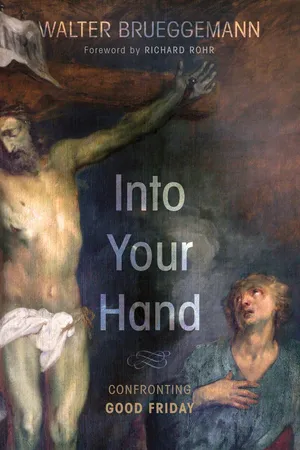
This set of seven sermons follows the traditional church sequence of "The Seven Last Words of the Cross," utterances that the gospel narratives place on the lips of Jesus. These utterances are drawn from the several gospel narratives. In the liturgical life of the church, however, the sequence has a significance and staying power of its own quite apart from the gospel narratives in which the utterances are embedded. These sermons take seriously the faith voiced by Jesus in his context of wretched abuse by the Roman Empire. They attempt, moreover, to connect that reality of faith and abuse in our contemporary world of concentrated, ruthless power. The intent of such sermons on Good Friday is to replicate for us in our context what such an interface of faith and abuse must have been like. These sermons were preached last Good Friday in the preacher's home congregation.
- 64 pages
- English
- ePUB (mobile friendly)
- Available on iOS & Android
eBook - ePub
About this book
Information
Topic
Theology & ReligionSubtopic
Religion1
Father, Forgive Them, for They Know not What They Do
(Luke 23:34; Psalm 103)
Did you know that this famous verse, “Father, forgive them for they know not what they do,” is missing from some of the most important manuscripts of the New Testament? That it is missing in some manuscripts means it is treated with suspicion by some scholars, whether it belongs there and if he really said it . . . plus that it is not reported in any Gospel narrative except Luke.
You could ask a question about what the absence of this verse means in two ways. Assume that Jesus said it: why would the early church leave it out and pretend that he did not say it? Well, maybe they found it too radical. Maybe they figured that there was a limit to forgiveness and if there is, then that red line was surely crossed in the execution of Jesus. If there is something that could not be forgiven, this must be it, well beyond an acceptable limit. In the narrative, those who wanted him dead, those who shouted, “Crucify him” knew that they will carry blood-guilt that is beyond forgiveness. There is good reason that Jesus could not ask forgiveness for that. So it is missing in some reliable manuscripts.
But turn the question around. What if he did not say it for those reasons, but they put it in some manuscripts anyway, even if it does not belong there? I think it is there because the early church could not imagine the narrative without it. So they had him say it, even if he did not. They could not imagine that Jesus did not say it, because the word of forgiveness is his ultimate, most radical word, and it must not be left unspoken, even if he did not say it. So it is there! In Luke’s narrative, moreover, it is the very first thing he says when he arrives at this place of his execution. It is as though he seizes the initiative and wants to frame his execution in a specific way by making this prayer at the outset. Before you do anything of the process of execution, know my attitude toward you. Know that I will not hold a grudge against you. I will forgive you who do the actual killing. I will forgive the authorities who do not even come to Calvary but who have engineered the killing. I will forgive you because it is my most elemental propensity to forgive. It is my signature act, that for which I am best and most faithfully known.
But Jesus himself does not forgive them. Maybe he is too busy, or that it is too big a task for him. He refers the matter to his Father. He says, “Father, forgive them.” He addresses his petition to the creator of heaven and earth, to the Lord of all that is, seen and unseen. He draws the attention of the Father to his particular moment, to these particular offenders, to his particular moment of suffering and death. It is as though this act of forgiveness has cosmic proportion, as forgiveness always does. The extremity of his situation is matched by the extremity and urgency of the prayer. He asks of the father an outrageous act of self-giving, for who among us wants to forgive the killers of our beloved son or daughter? But Jesus knows the heart of the Father who is at bottom a forgiver.
Jesus is nurtured in the ancient Psalm that recites God’s overpowering, relentless resolve to heal the world:
Do not forget all his benefits—
who forgives all your iniquity,
who heals all your diseases,
who redeems your life from the Pit,
who crowns you with steadfast love and mercy,
who satisfies you with good as long as you live. (Psalm 103:2–5)
This is an amazing inventory of what the Father God does: forgive, heal, redeem, crown, satisfy; they are all synonyms. They are all actions that correct the deficiencies of the world, because the Father wills the world to well-being. These are God’s characteristic and recurring actions, and the first one is “forgive”! And then the Psalmist can say in confidence:
He will not always accuse,
nor will he keep his anger forever.
He does not deal with us according to our sins,
nor repay us according to our iniquities . . .
As far as the east is from then west,
so far he removes our transgressions from us.
As a father has compassion for his children
so the LORD has compassion for those who fear him.
He knows how we were made;
he remembers that we are dust. (vv. 9–14)
God does not retain anger. God does not hold grudges. God does not keep score. God’s proper business is compassion. And that compassion is in response to who we are. God knows, from Genesis 2, that we are dust . . . feeble, frail, weak, inadequate. So God compensates, making up for what we will not do ourselves.
Jesus stands in sharp contrast to those who mock him who will kill him. They are busy, task-oriented, prone to violence, cynical, greedy for gain. He is not:
• he has no task to perform, confident of the Father; he doesn’t need to do anything,
• he is an agent of non-violence;
• he is not greedy for anything;
• he has no cynicism.
If we focus on that contrast between Jesus and those around him, there are here two ways in the world, the way of suffering love and the way of anxious violence. The narrative invites us to choose.
The Father does not answer the prayer soon. The answer that leaps to forgiveness is at Easter. God’s forgiveness at Easter makes it the decisive moment in the history of the world. In Easter God has no vengeance, no grudge, no retaliation, only a reach into the hate and death of the world to make all things new. We live in the wake of that sweeping action. So when you hear in the liturgy, “Christ is risen; he is risen indeed,” mark that as an answer to this prayer, as forgiveness. The world is forgiven. The men of hate and violence are forgiven. The greedy, cruel executioners are forgiven. The pattern of death is broken. This is not a Friday moment, but it is a Sunday answer to the Friday prayer.
So here is a take-away for us. The drama of Friday is changed by this remarkable prayer of generosity. The drama of our lives is changed by the self-giving of Jesus and the reach of the Father. The drama of the world is made new by the forgiveness of the Father. We need not carry old grudges or old guilts, because the Father has no interest in them. The world is driving itself to death. But the reach of Jesus has broken that cycle of destruction. It only remains to act it out. Bishop Tutu and his daughter Mpho, in their new book on forgiveness, write:
When I develop a mindset of forgiveness, rather than a mindset grievance, I don’t just forgive a particular act; I become a more forgiving person. With a grievance mindset, I look at the world and see all that is wrong. When I have a forgiveness mindset, I start to see the world not through grievance but through gratitude. In other words, I look at the world and start to see what is right. There is a special kind of magic that happens when I become a more forgiving person—it is quite remarkable. What was once a grave affr...
Table of contents
- Title Page
- Foreword
- Preface
- Chapter 1: Father, Forgive Them, for They Know not What They Do
- Chapter 2: Truly I Tell You, Today You Will Be with Me in Paradise
- Chapter 3: Woman, Here Is Your Son; Here is Your Mother
- Chapter 4: My God, My God, Why Have You Forsaken Me?
- Chapter 5: I Thirst
- Chapter 6: It Is Finished!
- Chapter 7: Father, into Your Hand I Commend My Spirit
- For Further Reading and Reflection
- Recent Works by Walter Brueggemann
Trusted by 375,005 students
Access to over 1.5 million titles for a fair monthly price.
Study more efficiently using our study tools.
Frequently asked questions
Yes, you can cancel anytime from the Subscription tab in your account settings on the Perlego website. Your subscription will stay active until the end of your current billing period. Learn how to cancel your subscription
No, books cannot be downloaded as external files, such as PDFs, for use outside of Perlego. However, you can download books within the Perlego app for offline reading on mobile or tablet. Learn how to download books offline
Perlego offers two plans: Essential and Complete
- Essential is ideal for learners and professionals who enjoy exploring a wide range of subjects. Access the Essential Library with 800,000+ trusted titles and best-sellers across business, personal growth, and the humanities. Includes unlimited reading time and Standard Read Aloud voice.
- Complete: Perfect for advanced learners and researchers needing full, unrestricted access. Unlock 1.5M+ books across hundreds of subjects, including academic and specialized titles. The Complete Plan also includes advanced features like Premium Read Aloud and Research Assistant.
We are an online textbook subscription service, where you can get access to an entire online library for less than the price of a single book per month. With over 1.5 million books across 990+ topics, we’ve got you covered! Learn about our mission
Look out for the read-aloud symbol on your next book to see if you can listen to it. The read-aloud tool reads text aloud for you, highlighting the text as it is being read. You can pause it, speed it up and slow it down. Learn more about Read Aloud
Yes! You can use the Perlego app on both iOS and Android devices to read anytime, anywhere — even offline. Perfect for commutes or when you’re on the go.
Please note we cannot support devices running on iOS 13 and Android 7 or earlier. Learn more about using the app
Please note we cannot support devices running on iOS 13 and Android 7 or earlier. Learn more about using the app
Yes, you can access Into Your Hand by Brueggemann in PDF and/or ePUB format, as well as other popular books in Theology & Religion & Religion. We have over 1.5 million books available in our catalogue for you to explore.