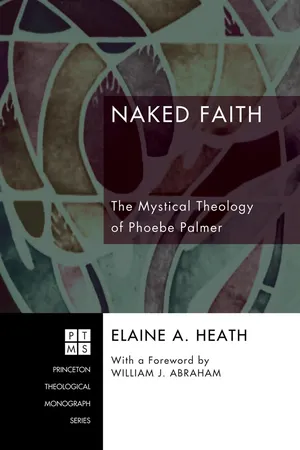
- 136 pages
- English
- ePUB (mobile friendly)
- Available on iOS & Android
eBook - ePub
About this book
Now and then through the history of the church a great light appears, a prophet who calls the church back to its missional vocation. These reformers are lovers of God, mystics whose lives are utterly given to the divine vision. Yet as Jesus noted, a prophet is often without honor among her own people. In the case of Phoebe Palmer (1807-1874), honor was lost posthumously, for within a few decades after her death her name all but disappeared. Palmer's sanctification theology was separated from its apophatic spiritual moorings, even as her memory was lost. Throughout most of the twentieth century her name was virtually unknown among Methodists. To this day the Mother of the Holiness Movement still awaits her place of recognition as a Christian mystic equal to Catherine of Siena, Teresa of Avila, or Therese of Lisieux.
This book locates Palmer's life and thought within the great Christian mystical traditions, identifying her importance within Methodism and the church universal. It also presents a Wesleyan theological framework for understanding and valuing Christian mysticism, while connecting it with the larger mystical traditions in Catholic, Anglican, and Orthodox communions.
While Palmer was a powerful revivalist in her own day, in many ways she could be the patron saint for contemporary Methodists who are drawn to the new monasticism and who long for the renewal of the church. Saint Phoebe is precisely the one who can help Methodists envision new forms of Christian community, mission, and witness in a postmodern world.
Information
Subtopic
Église chrétienne1
Saint Phoebe
Introduction
Now and then through the history of the church a great light appears, a prophet who calls an erring church back to its missional vocation. These reformers are lovers of God, mystics whose lives are utterly given to the divine vision. Yet as Jesus noted, a prophet is often without honor among her own people. In the case of Phoebe Palmer (1807–1874), honor was lost posthumously, for within a few decades after her death her name all but disappeared. Though Palmer’s theology continued to be handed on with varying degrees of fidelity through camp meeting preachers and holiness leaders, the holiness movement splintered into numerous denominations eschewed by mainstream Methodism. As Albert Outler comments, holiness, the “keystone” of Wesleyan doctrine, became “a pebble in the shoe” of Methodists.1 There is also the fact of Palmer’s gender, which undoubtedly helped reduce her to a footnote in the official stories of Methodism. The deepest problem, though, is that Methodism lacked the necessary theological framework with which to honor and interpret its premier mystic, for Methodists have long been averse to mysticism.2
For all these reasons Palmer’s sanctification theology was separated from its apophatic spiritual moorings, even as her memory was lost. Throughout most of the twentieth century her name was virtually unknown among Methodists. To this day the Mother of the holiness movement still awaits her place of recognition as a Christian mystic equal to Catherine of Siena, Teresa of Avila, or Thérèse of Lisieux.
The primary goal of this book is to locate Palmer’s life and thought within the great Christian mystical traditions, reclaiming her importance within and beyond Methodism. Within this task rests a secondary goal, which is to offer a Wesleyan theological framework for understanding and valuing Christian mysticism, while connecting it with the larger mystical traditions in Catholic, Anglican and Orthodox communions.
While Palmer was a powerful revivalist in her own day, until her status as a mystic is fully recognized, she will not have “come into her own.” Palmer, for example, could become the patron saint for contemporary Methodists who are drawn to the new monasticism,3 and who long for the renewal of the church. Palmerian mystical spirituality is exactly what the mainline church needs today to overcome its torpor. Like Wesley, Luther or Zwingli, Palmer was a firebrand who evangelized a sleeping church. Like John of the Cross and other great apophatic mystics, Palmer’s theology emerged from her own experiences of unknowing, darkness and loss.
In this chapter I present a brief overview of Palmer’s life and theological contributions, to contextualize the more detailed examination of her mysticism and theology in subsequent chapters. Chapter two describes Christian mysticism, locating Palmer’s spirituality within the long history of Christian mysticism. Chapter three focuses on Palmer’s apophatic mysticism,4 the aspect of her theology and spirituality that has been the least understood and most controversial. In chapter four a new reading of Palmer’s theology is presented, honoring her mysticism and her authority to speak to a drifting church. Chapter five advances the proposal that Palmer is indeed a mystic for our own day, with several key elements of a Palmerian spirituality that are consistent with the ethos of the new monastic movement. While Palmer was a powerful revivalist in her own day, in many ways she could be the patron saint for contemporary Methodists who are drawn to the new monasticism, and who long for the renewal of the church. Saint Phoebe is precisely the one who can help Methodists envision new forms of Christian community, mission and witness in a postmodern world.
Biography
In order to address the issue of Palmer’s mysticism5 we must begin with her context in nineteenth century America and in the Methodist Church. For comprehensive biographies see Harold Raser’s The Life and Thought of Phoebe Palmer or Charles White’s The Beauty of Holiness: Phoebe Palmer as Theologian, Feminist, Revivalist and Humanitarian. For our purposes the following survey should suffice.6
The Mother of the holiness movement was a native of Manhattan, New York, the fourth of sixteen children born to devout Methodist parents Dorothea Wade and Henry Worrall. Ten of the sixteen children born to Dorothea and Henry would survive to adulthood. As a young teenager Henry Worrall had come under the influence of John Wesley, whose Methodist society meetings made a profound impact on the fourteen year old. Within a short time the Yorkshire native became a Methodist whose faith remained the center of his life for the rest of his life.7 Along with his wife Dorothea, Henry took seriously his responsibilities as a Christian parent. Palmer attributes much of her spiritual vitality to her Christian parents.
Typical of well-to-do, pious households of the time, the Worrall family was managed with sober but loving discipline. Family devotions, each of which was an hour long, were held morning and evening with Father presiding over Bible reading and prayer. The Bible, especially verses that had been memorized, was the favorite topic of conversation around the dinner table. Children were encouraged at an early age to surrender their lives to Christ and be saved.8 Thus it was that from her earliest memory Palmer describes herself as having had an acutely sensitive religious conscience and never having willfully disobeyed her parents.9 With a spirituality somewhat reminiscent of Thérèse of Lisieux, as a young girl Palmer longs for opportunities to offer to Jesus lavish, sacrificial gifts.10 She wishes she could be “like the Jew bringing his costly offering” and feels frustrated that she cannot.11 Ever feeling her spiritual deficiencies, Palmer describes herself at age twenty as lacking in faith, courage and resolve. In a journal entry dated November 24, 1827, Palmer confesses that she “shrinks from crosses,” avoiding the simple religious duty that lies at hand even though in her heart she would like to be a martyr.12 In time these longings would lead Palmer to the most significant turning point in her life: her experience of sanctification based on “naked faith in the naked word of God.”13 It was this experience that eventually launched Palmer into ministry and from which some of her key theological themes emerged.
Virtually nothing is recorded as to the kind of formal education Palmer had as a child, but it is clear that as an adult she was well-versed in the works that were standard for persons who were Methodist class leaders: the Bible, commentaries on the Bible by Adam Clarke and others, the works of John Wesley and other key Methodist writers.14 As we shall see in chapters 2 and 3, the writings of John Fletcher and his wife Mary Bosanquet, as well as those of William Carvasso and Hester Anne Rogers were deeply influential on Palmer. (It could be argued from the number of times Palmer cites Fletcher and from some of her theology, that Fletcher’s work was more influential upon her than Wesley’s.) Each of these authors expresses elements of classical Christian mysticism as being formative in their own spirituality and theology.15 Indeed, John Fletcher was known as “the Methodist Mystic.”16
It is also probable that Palmer read at least some of the 50 volumes of Wesley’s Christian Library, since Methodist class leaders were encouraged to read these works for their own spiritual formation. Here, too, the influence of at least eight mystical tracts and numerous other works by or about mystics were included in the library and may well have left their mark on the Mother of the holiness movement.17
At age 19 Phoebe Worrall married Dr. Walter C. Palmer, a homeopathic physician who received his training at Rutgers University. In a remarkable journal entry dated August 12, 1827, the young woman reflects upon her decision not to date four different suitors who p...
Table of contents
- Title Page
- Foreword
- Acknowledgments
- Chapter 1: Saint Phoebe
- Chapter 2: Mysticism
- Chapter 3: The Via Negativa
- Chapter 4: Altar Theology and the Shorter Way
- Chapter 5: Conclusion
- Bibliography
Trusted by 375,005 students
Access to over 1.5 million titles for a fair monthly price.
Study more efficiently using our study tools.
Frequently asked questions
Yes, you can cancel anytime from the Subscription tab in your account settings on the Perlego website. Your subscription will stay active until the end of your current billing period. Learn how to cancel your subscription
No, books cannot be downloaded as external files, such as PDFs, for use outside of Perlego. However, you can download books within the Perlego app for offline reading on mobile or tablet. Learn how to download books offline
We are an online textbook subscription service, where you can get access to an entire online library for less than the price of a single book per month. With over 1.5 million books across 990+ topics, we’ve got you covered! Learn about our mission
Look out for the read-aloud symbol on your next book to see if you can listen to it. The read-aloud tool reads text aloud for you, highlighting the text as it is being read. You can pause it, speed it up and slow it down. Learn more about Read Aloud
Yes! You can use the Perlego app on both iOS and Android devices to read anytime, anywhere — even offline. Perfect for commutes or when you’re on the go.
Please note we cannot support devices running on iOS 13 and Android 7 or earlier. Learn more about using the app
Please note we cannot support devices running on iOS 13 and Android 7 or earlier. Learn more about using the app
Yes, you can access Naked Faith by Elaine A. Heath in PDF and/or ePUB format, as well as other popular books in Théologie et religion & Église chrétienne. We have over 1.5 million books available in our catalogue for you to explore.