eBook - ePub
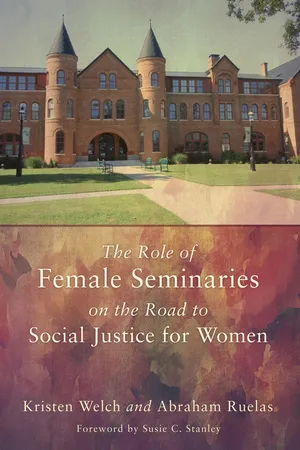
The Role of Female Seminaries on the Road to Social Justice for Women
- 194 pages
- English
- ePUB (mobile friendly)
- Available on iOS & Android
eBook - ePub
The Role of Female Seminaries on the Road to Social Justice for Women
About this book
In the United States, female seminaries and their antecedents, the female academies, were crucial first institutions that played a vital role in liberating women from the "home sphere," a locus that was the primary domain of Euro-American women. The female seminaries founded by Native Americans and African Americans had different founding rationales but also played a key role in empowering women. On the whole, the initial intent of these schools was to prepare women for their proper role in American society as wives and mothers. An unintended effect, however, was to prepare women for the first socially accepted profession for women: teaching. Thus equipped, women played a crucial role in the development of American education at all levels while achieving varying degrees of social justice for themselves and other groups through engagement in the reform movements of their times--including women's suffrage, abolition, temperance, and mental health reform. By recapturing the role religion played in shaping education for women, Welch and Ruelas offer a refreshing take on history that draws on several primary texts and details more than one hundred female seminaries and academies opened in the United States.
Information
Topic
Theology & ReligionSubtopic
World History1
Antecedents of the Female Seminary and the Age of Reform: “I Study Because I Must”
Spanish Roots
The history of obtaining an equal education for American women demonstrates the complexity of our progress towards social justice. For example, before the settlement of Jamestown and Plymouth, the Spanish colonized Florida and much of the Southwest.1 The Historical Dictionary of Women’s Education in the United States marks the education of Hispanic American women from the colonial period up to the Treaty of Guadalupe Hidalgo in 1848 that resulted in the surrender of a great deal of land.2 Education was usually obtained in Catholic mission schools of the sixteenth and seventeenth centuries, with priests serving as teachers. They were designed to convert the “Indians” and to “spread the Catholic faith.” While instruction was for boys and focused largely on trades like “masonry, hide tanning, and wine making,” instruction for girls was domestic. However, Catholic women had the option to go much further with their education if they entered the convent as a nun. But not all Catholic women. Women of mixed or Indian blood were not welcome in the cloister, and women of the lower economic classes were not able to get in since admittance required a large dowry.3
Nuns needed higher “intellectual training” and could devote themselves to reading, reflection, and writing. Their “poems, songs, plays, and theological treatises” were largely confined to the cloister, but Sor Juana Ines de la Cruz, who lived from 1648 to 1695, became popular in the local communities, although according to a short biography of her life, she lived in Mexico and was driven to silence by the church because of a letter published by a jealous priest detailing a critique on the sermon of a Jesuit that she had voiced in a private conversation.4 The critique of de la Cruz was used as evidence that she did not know her place within her patriarchal society and brought her under heavy criticism. The fact that the Catholic church went to great lengths to silence her and to demand that she renounce her life as an intellectual is evidence of her level of influence.
It is instructive to look at her letter in some detail to see how she couched her defense of education for women. In response to the spiteful bishop of Puebla who published her critique of the Jesuit’s sermon in 1690 under the pseudonym Sister Filotea de la Cruz, Sor Juana Ines de la Cruz defended the education of women in “La Respuesta de la poetisa a la muy illustre Sor Filotea de la Cruz,” or “The Poet’s Answer to the Most Illustrious Sister Filotea de la Cruz,” published in 1691. Her letter began with this statement: “I study because I must. I believe for the same reason that the fault is none of mine. Yet withal, I live always so wary of myself that neither in this thing nor in anything else do I trust my own judgment.”5 In this statement, she played a role made famous by Queen Elizabeth (although it is unknown if she was aware of it), by asserting her intelligence while humbly encapsulating it within self-deprecation. She then listed biblical women, just as the English Quaker Margaret Fell Fox did in her famous tract “Women’s Speaking, Proved, Justified and Allowed of by the Scriptures” in 1666 to argue that women should not be silent.6 In order to demonstrate examples of women that held places in society that were out of the norm, she offered Deborah, who was “issuing laws, military as well as political, and governing the people among whom there were so many learned men,” the Queen of Sheba who dared to question King Solomon, prophetesses such as Abigail, and those gifted in persuasion, such as Esther. In her long list of “the Gentiles,” she included “Minerva, daughter of great Jupiter and mistress of all the wisdom in Athens, adored as goddess of the sciences,” Aspasia, “who taught philosophy and rhetoric and was the teacher of the philosopher Pericles,”7 and many others. “For what were they all but learned women, who were considered, celebrated, and indeed venerated as such in Antiquity?” she asked.
She went on to write, “And seeking no more examples far from home, I see my own most holy mother Paula, learned in the Hebrew, Greek, and Latin tongues and most expert in the interpretation of scriptures.” By pointing this out, she was refuting the bishop’s accusation that she was entering a masculine realm when critiquing a sermon. She went on to show how her mother was well educated and well praised, and then pointed to Proba Falconia, “a Roman woman, wrote an elegant book of centos, joining together verses from Virgil, on the mysteries of our Holy Faith.” She went on to point out that Queen Isabella (Spain), the Queen of Sweden, the Duchess of Aveyro, and the Countess of Villaumbrosa were also well educated.8
Like so many before her, de la Cruz took on Paul in the Scriptures and used the interpretations of Dr. Arce to defend her claim that while she accepted the biblical injunction that women should not speak publicly, most certainly could do so privately.9 She wrote: “Clearly, of course, he does not mean by this that all women should do so, but only those whom God may have seen fit to endow with special virtue and prudence, and who are very mature and erudite and possess the necessary talents and requirements.” She went on to argue that not all men should be educated either, particularly those who are evil. “To such men, I repeat, study does harm, because it is like putting a sword in the hands of a madman: though the sword be of the noblest of instruments for defense, in his hands it becomes his own death and that of many others.”
Her defense of women’s education began by turning to St. Jerome and to the Scriptures and can be summed up with a request to allow women to educate their daughters instead of risk their reputations by “familiarity with men.”10 She asks: “For what impropriety can there be if an older women, learned in letters and holy conversation and customs, should have in her charge the education of young maids?” Using several examples, she showed how Scriptures and poetry can’t be interpreted correctly without the historical and cultural knowledge required to contextualize them, and thus how women must be educated beyond just basic skills to fully engage with Scripture.11 She was wise in arguing this since society widely supported allowing women to attain basic literacy in order to read Scripture and to become better Christian wives and mothers. This was a common theme in the New England colonies as well. De la Cruz advocated for private study...
Table of contents
- Title Page
- Foreword
- Preface
- Acknowledgments
- Chapter 1: Antecedents of the Female Seminary and the Age of Reform: “I Study Because I Must”
- Chapter 2: Political and Religious Roots: The “Fourth Branch of Government” and Early Exhorters
- Chapter 3: Religious and Cultural Sources for the Founding of Female Seminaries: From “Butterflies to Eagles”
- Chapter 4: Selected List of Female Academies and Seminaries
- Chapter 5: An Evolving Curriculum
- Chapter 6: The Self-Sustaining Impulse and the Talented Tenth: African American Seminaries
- Chapter 7: The Politics of Assimilation: The Cherokee Female Seminary
- Chapter 8: Educating the Chickasaws, Choctaws, and Other Tribes
- Chapter 9: Women Stepping Out of the Home Sphere and Into the Teaching Profession
- Chapter 10: From Seminaries to Normal Schools: Farmville Female Seminary
- Conclusion: Alumni and Social Reform Movements
- Bibliography
Trusted by 375,005 students
Access to over 1.5 million titles for a fair monthly price.
Study more efficiently using our study tools.
Frequently asked questions
Yes, you can cancel anytime from the Subscription tab in your account settings on the Perlego website. Your subscription will stay active until the end of your current billing period. Learn how to cancel your subscription
No, books cannot be downloaded as external files, such as PDFs, for use outside of Perlego. However, you can download books within the Perlego app for offline reading on mobile or tablet. Learn how to download books offline
Perlego offers two plans: Essential and Complete
- Essential is ideal for learners and professionals who enjoy exploring a wide range of subjects. Access the Essential Library with 800,000+ trusted titles and best-sellers across business, personal growth, and the humanities. Includes unlimited reading time and Standard Read Aloud voice.
- Complete: Perfect for advanced learners and researchers needing full, unrestricted access. Unlock 1.5M+ books across hundreds of subjects, including academic and specialized titles. The Complete Plan also includes advanced features like Premium Read Aloud and Research Assistant.
We are an online textbook subscription service, where you can get access to an entire online library for less than the price of a single book per month. With over 1.5 million books across 990+ topics, we’ve got you covered! Learn about our mission
Look out for the read-aloud symbol on your next book to see if you can listen to it. The read-aloud tool reads text aloud for you, highlighting the text as it is being read. You can pause it, speed it up and slow it down. Learn more about Read Aloud
Yes! You can use the Perlego app on both iOS and Android devices to read anytime, anywhere — even offline. Perfect for commutes or when you’re on the go.
Please note we cannot support devices running on iOS 13 and Android 7 or earlier. Learn more about using the app
Please note we cannot support devices running on iOS 13 and Android 7 or earlier. Learn more about using the app
Yes, you can access The Role of Female Seminaries on the Road to Social Justice for Women by Kristen Welch,Abraham Ruelas in PDF and/or ePUB format, as well as other popular books in Theology & Religion & World History. We have over 1.5 million books available in our catalogue for you to explore.