eBook - ePub
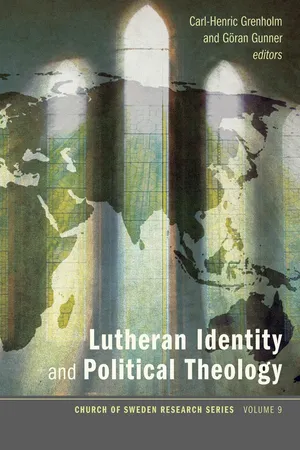
Lutheran Identity and Political Theology
- 254 pages
- English
- ePUB (mobile friendly)
- Available on iOS & Android
eBook - ePub
Lutheran Identity and Political Theology
About this book
Lutheran tradition has in various ways influenced attitudes to work, the economy, the state, education, and health care. One reason that Lutheran theology has been interpreted in various ways is that it is always influenced by surrounding social and cultural contexts.
In a society where the church has lost a great deal of its cultural impact and authority, and where there is a plurality of religious convictions, the question of Lutheran identity has never been more urgent. However, this question is also raised in the Global South where Lutheran churches need to find their identity in a relationship with several other religions. Here this relationship is developed from a minority perspective.
Is it possible to develop a Lutheran political theology that gives adequate contributions to issues concerning social and economic justice? What is the role of women in church and society around the world? Is it possible to interpret Lutheran theology in such a way that it includes liberating perspectives? These are some of the questions and issues discussed in this book.
Information
Topic
Theology & ReligionSubtopic
Christian Church1
Introduction
Lutheran Tradition in Transition
With the Reformation Jubilee in 2017 in mind, there is a need for critical evaluation of the Lutheran tradition, which has been of great importance not just within the churches but also for society and culture in general. Lutheran tradition has in various ways influenced attitudes to work, the economy, the state, education, and health care. How should this tradition be evaluated in the contemporary multicultural and post-Christian society? What can be learned from this tradition today and what should be criticized? What are the characteristics of Lutheran identity five hundred years after the Reformation?
Lutheran tradition has never been uniform. Of course, there are some basic theological positions that are summarized in Confessio Augustana and developed in the writings of Martin Luther and Philip Melanchthon. Some of these are the doctrine of justification by grace alone, the conviction that the Bible is a primary source of the content of theology, and the sharp distinction between law and gospel. However, these positions have been interpreted in different ways in later Lutheran tradition. Some of the positions of the Luther orthodoxy in the seventeenth century were questioned by pietism, in search of an interpretation of faith that made experiences and piety more important than rational considerations. The Luther renaissance in the beginning of the twentieth century was to a high degree influenced by neo-Kantianism, which later on was criticized by neo-orthodoxy.
One reason that Lutheran theology has been interpreted in various ways is that it is always influenced by the surrounding social and cultural context. Questions that need to be dealt with in theological reflection are of different kinds depending on the particular social context in which they are raised. Experiences, perspectives, and concepts are often related to particular cultures, and the result is that theological positions are interpreted in many various ways. From feminist theology and postcolonial theory we can learn that differences is social positions and inequalities related to power structures have a great impact also on the understanding of theological conceptions.
The Lutheran tradition was originally formed in Northern Europe. In Germany, Denmark, Norway, Sweden, Finland, and Iceland Lutheran churches have had a strong position in society, often with a close relationship between state and church. Later on, Lutheran churches became rather strong also in the USA, even if they are not majority churches. Mainstream Lutheran theologies have developed in Northern Europe and the USA, as a response to issues raised in this particular cultural and social context. Therefore Lutheran theology has often been formed by perspectives and experiences within Western culture.
However, migration and missionary activities have led to the formation of many Lutheran churches also in the Global South. These churches are often minority churches, living in societies quite different from Northern Europe and the USA. Many of these Lutheran churches are growing rapidly, and soon their members will be the majority of Lutherans in the world. They are struggling with issues that are different from those that are regarded to be important in Western societies. Since they are minority churches one urgent issue is how they should relate to other religions. Since they are living in societies with great social problems and economic inequalities they need to reflect upon their political role and their possibilities to contribute to the liberation from oppression and poverty.
How should we understand Lutheran identity in this global world? Do minority churches in the global South understand their identity in a different way than majority churches in Northern Europe and the USA? What are the new theological perspectives that are developed within Lutheran churches in Africa, Asia, and Latin America? Is it possible to develop a Lutheran political theology that gives adequate contributions to issues concerning social and economic justice? What is the role of women in church and society around the world? Is it possible to interpret Lutheran theology in such a way that it includes liberating perspectives?
These questions were discussed at an international conference in Uppsala during October 8–10, 2013, on the theme “Remembering the Past—Living the Future. Lutheran Tradition in Transition.” The conference was hosted by the Church of Sweden Research Unit and the Department of Theology at Uppsala University. During the conference almost two hundred participants from all parts of the world discussed issues concerning Lutheran identity and different interpretations of Lutheran theology. Lectures were given and papers presented on eight different themes: (1) Lutheran theology and ethics in a post-Christian society, (2) the Bible in Lutheran tradition, (3) Lutheran identity in a global world, (4) Reformation as a model for interpretation of the present, (5) Lutheran theology and politics, (6) atonement, reconciliation, and forgiveness, (7) Lutheran tradition and tolerance, and (8) Lutheran tradition and gender.
The question of Lutheran identity is raised in two different contexts. It is raised in Western societies that can be characterized as being post-Christian and multicultural. In a society where the church has lost a great deal of its cultural impact and authority, and where there is a plurality of religious convictions, it is urgent to find out what is the Lutheran identity. However, this question is also raised in the Global South where Lutheran churches need to find their identity in a relationship with several other religions. Here this relationship is developed from a minority perspective.
In the Global South the question concerning Lutheran identity is closely related to the question regarding the role of the church in society and politics. Lutheran churches in Africa, Asia, and Latin America are not always living in liberal societies, where the state is said to be secular. Instead they are living in societies where religion usually has a great impact on political issues. How should Lutherans in these societies understand their role in society and the public arena? Is it possible to develop a distinct Lutheran social doctrine that can give interesting contributions to urgent political issues? And how should Lutheran churches in Europe and USA understand their political role in a post-secular society that is often said to be characterized by the return of religion?
Finally the question concerning Lutheran political theology is closely related to the question of Lutheran tradition and gender. The patriarchal principle in Lutheran ethics has meant not only that Lutheran churches often have supported those in political power. It has also meant a defense of male superiority over women. Mainstream theology in Lutheran theology has most often been developed by men, who did not criticize these patriarchal power structures. Therefore it is urgent to develop a Lutheran feminist theology that articulate those liberating perspectives that can be found also in the theology of Martin Luther.
The conference in Uppsala on “Lutheran Tradition in Transition” has resulted in two volumes based upon some of the lectures and papers presented. The volume on Justification in a Post-Christian Society deals with the issues of justification and atonement, Lutheran theology and ethics in a post-Christian society, and Reformation as a model for interpretation of the present. In this volume on Lutheran Identity and Political Theology three main problems are discussed. How should we understand Lutheran identity in the contemporary global world? Are there perspectives in Lutheran theology that can contribute to the liberation of women and a critique of traditional patriarchal power structures? Is it possible to develop a Lutheran political theology that does not support existing authorities?
Lutheran Identity in a Global World
The first theme of this book is Lutheran identity in a global world. The changes in the religious arena in the world today mean serious challenges for Lutheran churches. Traditionally, Lutheran identity has been formed in Northern Europe, where the churches have been in majority and where they often have had a close relation with the state. However, today the Lutheran churches are growing in the Global South. Most of the Lutheran churches are today minority churches in Africa, Asia, and Latin America. Some of them have been established by immigration or as a result of missionary activity, and today they are independent churches working in contexts that are quite different from the societies in Northern Europe and the USA.
What are the new challenges facing Lutheran churches around the world today? What does it mean to be Lutheran in the contemporary global world, and how should we understand Lutheran identity from a minority perspective in the South? Are there in different social and cultural contexts different understandings of what it means to be a Lutheran? In what way do different social contexts imply various conceptions of the main tasks of Lutheran churches? How may multiple identities be both a challenge and a resource for Lutherans globally?
In Chapter Two Vítor Westhelle argues that when the majority of Lutherans in the world will be situated in the South, new theological questions are being formulated that conventional answers can no longer address. Luther’s theology can be a resource to deal with some of these new challenges originating from new contexts, but a prerequisite is a theological approach that is aware of those issues that are important in the Global South. Westhelle introduces some areas in which Luther’s theology might have some relevance in the contexts of Africa, Asia, and Latin America.
One such area is freedom and liberation. According to Westhelle, what Luther said about freedom is rather close to the liberation motif that has characterized theologies shaped in the third world to a large extent. Another area is Luther’s theology of the cross and his understanding of Christ’s real presence, which can be made relevant for a theology in a planetary perspective. Luther’s conception of the three institutional spheres, namely the church, the economy, and politics, can also be interpreted in such a way that they are relevant, not only in modern and secularized Western societies, but also in other societies where Lutheranism is growing today. Here the church can be regarded to be a third sphere that keeps the economy and politics in relation, but still distinctly apart.
The next chapter, which is written by Göran Gunner, describes what are perceived to be substantial problems or important issues at stake within a sample of Lutheran churches around the world. What are regarded to be burning issues by Lutheran churches in different cultural contexts and different kinds of societies? It is quite obvious that there are a variety of opinions concerning what are the most important issues, depending on membership number and social context. Minority churches in Africa, Asia, and Latin America seem to face other challenges than majority churches in traditional European contexts.
One burning issue in many Lutheran churches is the situation of women in society and in the church. Some churches in Africa are growing rapidly and regard it important to increase growth, while some churches in the European context try to find ways to reverse the decrease in membership. Churches in the Global South are struggling to develop a Lutheran identity that is not dependent of Western culture. Several minority churches are dealing with issues concerning their relationship to Muslim majorities, and issues regarding the relationship between church and state are important in various contexts. The most common burning issue raised is related to the role of the church in the surrounding society, but minority churches have different perspectives on this issue than Lutheran churches in Northern Europe.
A different perspective on the role of Lutheran churches in the Global South is given by Ville Päivänsalo in Chapter Four. He explores some ways in which Christian identity has been expressed in the health work documents of the Lutheran churches and faith-based organizations in Tanzania and India. Even if some Lutheran accounts of health and development differ from each other significantly, Päivänsalo argues that a good part of the variation that shapes this work across cultures can be taken as theological richness rather than a problem. A wide array of Lutheran health work documents tell about a complementary unity, which means that even if perspectives vary and many agencies are minimalistic in terms of explicit faith, the statements do not tend to contradict each other.
Päivänsalo shows that both the Tanzanian and the Indian churches tell about the basis of faith of their health work rather extensively, even if the explored documents depict the pragmatic work in a largely non-confessional manner. He identifies both some important theological perspectives on the right to health, and some practical perspectives on Lutheran health work. One of his conclusions is that health work will be an important task for Lutheran churches in the Global South also in the future. Even if, for example, leprosy has almost been beaten and the global struggle against the HIV/AIDS pandemic has shown some signs of success, the health rights of the globally poor are still usually poorly fulfilled. Exploring the core aspects of the Lutheran health work so far can serve further ventures towards comprehensive visions of Lutheran responses to health-related human needs tomorrow.
Michael R. Trice discusses in Chapter Five what a productive Lutheran theology would look like in the contemporary post-Christian world. This is a world where more people believe in God than have a religion that expresses their belief, and where they are disassociated from organized religious life. Trice argues that there are three general characteristics of this post-Christian world. One is that the authority of the Church is a problem, since the Church is regarded to be a choice among an aggregation of choices in a world of pluralism. A second marker is a disconnection between “the story of God and us” and a world that may not find this story relevant. A third marker of a post-Christian world is a struggle for the coherence of an enclosed identity.
From this perspective Michael R. Trice discusses what a portal for Lutheran identity would need to be in a post-Christian world. His proposal is that Lutheran communities should address five questions aligned to the markers of authority, story, and identity. They need to consider how they understand the identity of the individual and the identity of the community of the believers. They need to reflect on the story of being human on this planet today, and they should also try to find out what is the radical question for the world tomorrow. A fourth question concerns our resources for responding to God’s hope fo...
Table of contents
- Title Page
- Contributors
- Abbreviations
- Chapter 1: Introduction
- Part One: Lutheran Identity in a Global World
- Chapter 2: Planet Luther
- Chapter 3: Burning Issues
- Chapter 4: Lutheran Perspectives on the Right to Health in a Global World
- Chapter 5: “There’s an App for That!”
- Part Two: Lutheran Tradition and Gender
- Chapter 6: For the Sake of the Future
- Chapter 7: Liberating Aspects in Lutheran Theology for a Post-Gender Politics
- Chapter 8: Re-Embracing the Body of Jesus Christ
- Chapter 9: Idolatry-Critical Justification and the Foreclosed Gendered Life
- Part Three: Lutheran Theology and Politics
- Chapter 10: Luther, Wittgenstein, and Political Theology
- Chapter 11: The “Communitarian” Critique of Luther’s Ethics
- Chapter 12: Reconfiguring Church-State Relations
- Chapter 13: Transforming Domination Then and Now
- Chapter 14: Eros, Ethics, and Politics
Trusted by 375,005 students
Access to over 1.5 million titles for a fair monthly price.
Study more efficiently using our study tools.
Frequently asked questions
Yes, you can cancel anytime from the Subscription tab in your account settings on the Perlego website. Your subscription will stay active until the end of your current billing period. Learn how to cancel your subscription
No, books cannot be downloaded as external files, such as PDFs, for use outside of Perlego. However, you can download books within the Perlego app for offline reading on mobile or tablet. Learn how to download books offline
We are an online textbook subscription service, where you can get access to an entire online library for less than the price of a single book per month. With over 1.5 million books across 990+ topics, we’ve got you covered! Learn about our mission
Look out for the read-aloud symbol on your next book to see if you can listen to it. The read-aloud tool reads text aloud for you, highlighting the text as it is being read. You can pause it, speed it up and slow it down. Learn more about Read Aloud
Yes! You can use the Perlego app on both iOS and Android devices to read anytime, anywhere — even offline. Perfect for commutes or when you’re on the go.
Please note we cannot support devices running on iOS 13 and Android 7 or earlier. Learn more about using the app
Please note we cannot support devices running on iOS 13 and Android 7 or earlier. Learn more about using the app
Yes, you can access Lutheran Identity and Political Theology by Carl-Henric Grenholm,Göran Gunner, Grenholm, Gunner in PDF and/or ePUB format, as well as other popular books in Theology & Religion & Christian Church. We have over 1.5 million books available in our catalogue for you to explore.