eBook - ePub
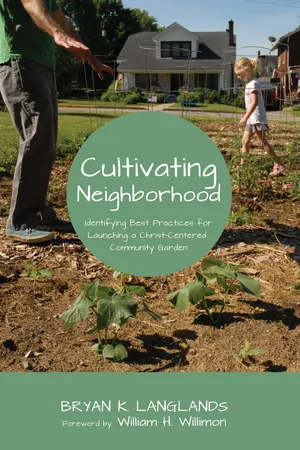
Cultivating Neighborhood
Identifying Best Practices for Launching a Christ-Centered Community Garden
- 122 pages
- English
- ePUB (mobile friendly)
- Available on iOS & Android
eBook - ePub
Cultivating Neighborhood
Identifying Best Practices for Launching a Christ-Centered Community Garden
About this book
Why have so many churches started community gardens over the past decade? Are they simply a fad? Or do community gardens somehow connect more deeply with the mission of the churches that launch them? What can churches and faith-based institutions interested in starting community gardens learn from those that have started their own gardens over the past decade? And what would it mean for a church to put Christ in the center of its community gardening efforts? In order to discern best practices for launching Christ-centered community gardens moving forward, Cultivating Neighborhood begins with a brief survey of the history of community gardens in the United States and builds a constructive theological framework for community gardening grounded in the practice of Christian hospitality. It continues with two case studies of church-sponsored community gardens and one case study of a community garden sponsored by a Christian college, all three of which were created between 2003 and 2011. The results of this research conclude with a new definition of Christ-centered community gardening and an outline of fifteen best practices for launching a Christ-centered community garden.
Information
Topic
Teologia e religioneSubtopic
Ministro del culto cristianochapter one
Churches, Christ-Centered Community Gardening and Radical Hospitality
I.
All of this discourse about the benefits of gardening and community gardening, though, does not answer the question as to why specifically so many churches have decided to launch community gardens. Is it merely a fad? Is it simply that the church is slow to catch up with cultural shifts and so is just now catching on to a trend in community gardening that found its feet back in the 1970s? Is it a trend that will die out as soon as social crises simmer down and the U.S. economy surges forward? Or is the church’s increasing openness to the possibility of community gardening as ministry a way of reconnecting with the agricultural practices and worldviews that are deeply embedded in the story of Israel? Can we interpret community gardening as a means of grace, a peculiar way of experiencing creation as sacrament? Who, exactly, constitutes the community of community gardening? What kind of community does a community garden seek to foster? And what role might a church-sponsored community garden play in mediating the relationship between a local church and her most proximate neighbors?
In the seventeenth century, the (anti)colonialist dissenter Roger Williams once wrote about the vital and lasting need for “a wall of separation between the Garden of Christ and the Wilderness of the World.”1 Of course, for Williams the metaphor of the Garden of Christ refers to the Church while the Wilderness of the World refers to the civil authority, namely, the state. Williams’s invocation of the need for a wall of separation between the church and the state sought to protect the church from interference and harassment by the civil authority’s violent policies of enforced conformity. This language of a wall of separation between the church and the state was later adopted by Thomas Jefferson and has influenced the history of the governance of the United States of America in a foundational and lasting way.
Although perhaps this wall of separation is an appropriate trope for the relationship between the church and the state, it is obviously not a model for the relationship between a church and its most immediate geographical neighbors. Yet, too often in churches today there is a de facto wall of separation between the church and nearby residents to the extent that the church is comprised of very few of them. Instead, in certain contexts increasingly the vast majority of people who show up on Sunday morning for worship commute in from somewhere else. This happens regularly, for example, to churches in established neighborhoods (particularly in historically white neighborhoods) that undergo transition. Even when these church members move out of the neighborhood (the phenomenon known as white flight), they will sometimes still return on Sundays for worship. This practice of commuting in for worship also prevails in contexts of suburban sprawl and necessarily with the recent rise of the mega-church. Obviously, when a church hosts fifteen-thousand people for worship on a Sunday morning, the vast majority of these attendees will be commuting in from other neighborhoods, other parts of the city, and indeed from other cities.
Not surprisingly, with the rise of people commuting in for worship from outside of the immediate environs, the trend for many local churches has involved an increasing estrangement from their closest geographical neighbors. It is important to note that this trend has increased despite the fact that most churches would genuinely claim to be open to receiving guests who live nearby. This genuine openness typically takes the form of programs that happen within the church building that may be advertised with signage out front, through advertisements in the newspaper, etc. Yet, despite this openness, churches are frequently left scratching their heads and wondering why nearby residents are not very interested in showing up to the programming that the church is offering.
A fundamental premise of this project is that in order to deconstruct the walls of separation that have formed between many of our local churches and their immediate neighbors, churches must consider engaging nearby residents in concrete ways outside of the church building so that the church can actually become a neighbor to its neighbors. How might churches effectively welcome nearby residents into new relationships and friendships? What might this form of engagement look like? If this engagement is going to take place outside of the church building, what is it going to look like? How can the church do a better job of meeting people where they are (both literally in time and space and spiritually)? How can the church discern both the assets of their nearest neighbors (and seek to learn from them) while also discerning the greatest needs of those same neighbors (and seek to serve them)?
As Christians have wrestled with these and similar kinds of questions over the past decade, the number of church-sponsored community gardens in the United States has increased dramatically.2 Primarily, these community gardens are creations of a local church (sometimes in partnership with another institutional entity) either on or near the church property in which nearby residents are invited to participate. Not surprisingly, the working hypothesis of this project is that church-sponsored and Christ-centered community gardens can help to provide answers to the important questions listed above. Indeed, a core contention of this project is that increasingly church-sponsored community gardens are serving as vehicles for churches to do the kind of outreach that is needed to connect with and to serve those who neighbor their church buildings. These gardens are well-positioned to help churches to meet and to serve their neighbors in novel ways by doing ministry outside of the walls of the church building.
In short, church-sponsored community gardens are proving to be fertile ground not only for the growth of fruits and vegetables, but for the extension of koinonia and the cultivation of neighborhood among those who inhabit proximate space but who are relationally distant from one another. Since koinonia is a gift that the church receives from God, the related concept of cultivating neighborhood here names the ways in which the church seeks to extend that gift by sharing it and tending it with others through community gardening. By neighborhood, I am invoking the parable of the Good Samaritan and a hope for the creation of a network of relationships characterized not by disinterested and anonymous strangers who live near one another yet “bowl alone.” Rather, neighborhood consists of persons who both encounter one another in a particular place regularly and whose habits of interaction are characterized by practices of looking one another in the eye and attending to each other in Christ-like ways. In essence, neighborhood names a pattern of possibilities of seeing and interacting with others that shifts one’s view of them from that of nearby resident or anonymous stranger to that of neighbor (i.e., one who has a claim on my time, my concern and my talents).
Along with the kinds of outreach and missional goals stated above, church-sponsored gardens are serving therapeutic and didactic goals as well. The kinds of therapeutic goals that these gardens serve were elaborated above, namely, the different ways in which gardens foster relaxation, soul restoration and recreation. The didactic goals of church-sponsored community gardens are similarly numerous. First, gardens can serve as a teaching tool that will help the Scriptures to come alive. Since the Israelites were an agricultural people, agricultural themes and metaphors pervade the Bible. Experience with gardening, therefore, deepens and energizes one’s understanding of stories such as the parable of the sower, the parable of the tares, the parable of the mustard seed and Jesus’ teachings about the harvest. When, for example, one is faced with the arduous task of trying to harvest by one’s self a garden full of cherry tomato plants (each plant producing hundreds of cherry tomatoes), Jesus’ teaching about the harvest being plentiful but the laborers being few (Matthew 9:37) is understood viscerally, not just intellectually.
Just as community gardening can serve as a teaching tool for grounding one’s study of the Bible, it can also serve to teach participants about creation care, stewardship and the importance of local food economies. Perhaps part of the social crisis that recent iterations of community gardening address involves the way in which increasingly people are concerned about the national obesity epidemic and the estrangement between people and their sources of food. As people over the past decade have learned more about the dangers of synthetic inputs, nitrogen run-off, pollution and synthetic pesticides, the organic movemen...
Table of contents
- Title Page
- Foreword
- Acknowledgments
- Introduction
- Chapter 1: Churches, Christ-Centered Community Gardening and Radical Hospitality
- Chapter 2: Cultivating Healing
- Chapter 3: Cultivating Learning
- Chapter 4: Cultivating Neighbors
- Chapter 5: Cultivating Multiplication
- Resources for Further Reflection
- Appendix
- Bibliography
Trusted by 375,005 students
Access to over 1.5 million titles for a fair monthly price.
Study more efficiently using our study tools.
Frequently asked questions
Yes, you can cancel anytime from the Subscription tab in your account settings on the Perlego website. Your subscription will stay active until the end of your current billing period. Learn how to cancel your subscription
No, books cannot be downloaded as external files, such as PDFs, for use outside of Perlego. However, you can download books within the Perlego app for offline reading on mobile or tablet. Learn how to download books offline
Perlego offers two plans: Essential and Complete
- Essential is ideal for learners and professionals who enjoy exploring a wide range of subjects. Access the Essential Library with 800,000+ trusted titles and best-sellers across business, personal growth, and the humanities. Includes unlimited reading time and Standard Read Aloud voice.
- Complete: Perfect for advanced learners and researchers needing full, unrestricted access. Unlock 1.5M+ books across hundreds of subjects, including academic and specialized titles. The Complete Plan also includes advanced features like Premium Read Aloud and Research Assistant.
We are an online textbook subscription service, where you can get access to an entire online library for less than the price of a single book per month. With over 1.5 million books across 990+ topics, we’ve got you covered! Learn about our mission
Look out for the read-aloud symbol on your next book to see if you can listen to it. The read-aloud tool reads text aloud for you, highlighting the text as it is being read. You can pause it, speed it up and slow it down. Learn more about Read Aloud
Yes! You can use the Perlego app on both iOS and Android devices to read anytime, anywhere — even offline. Perfect for commutes or when you’re on the go.
Please note we cannot support devices running on iOS 13 and Android 7 or earlier. Learn more about using the app
Please note we cannot support devices running on iOS 13 and Android 7 or earlier. Learn more about using the app
Yes, you can access Cultivating Neighborhood by Bryan K. Langlands in PDF and/or ePUB format, as well as other popular books in Teologia e religione & Ministro del culto cristiano. We have over 1.5 million books available in our catalogue for you to explore.