- 162 pages
- English
- ePUB (mobile friendly)
- Available on iOS & Android
eBook - ePub
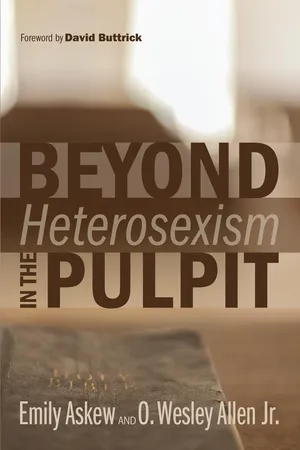
Beyond Heterosexism in the Pulpit
About this book
This book is not another volume attempting to persuade the reader of the rights of gays and lesbians in society and in the church. Instead it assumes the reader is a minister or student of ministry who already has a passion for this issue and is looking for better strategies to speak out of this passion in the pulpit.
Too often progressive preachers avoid speaking about issues related to sexual orientation out of fear of rejection from the congregation, or address them in ways that unintentionally alienates either gay or straight hearers. Askew and Allen offer preachers tools for recognizing and prophetically countering heterosexism in the pulpit while being pastoral toward those in the pews who may not hold the same view as the preacher.
The range of issues found at the intersection of homosexuality and the proclamation of the Christian gospel in light of the church's division and the changing landscape of society's attitudes is diverse and complex. Allen and Askew represent the combination of critical theology and contemporary homiletics needed to offer preachers new strategies for advocating against social and ecclesial discrimination directed at homosexuals and for the full inclusion of all in the church.
Information
Topic
Theology & ReligionSubtopic
Christian Ministry1
Anthropology and Soteriology
An engaged couple came to you for their final premarital counseling session in which they talked about the wedding service that would be used. The couple had requested a traditional service, but you pointed out how the father “giving away” the bride along with the promise to obey as part of the vows were demeaning to women and not the best way to characterize the marriage they had said they wanted to create in earlier counseling sessions. The couple agreed and modified the liturgy so that it was not sexist, and you were appropriately satisfied.
At the wedding, you proudly led the couple and their loved ones through the service piece by piece, beginning with the greeting:
Friends, we are gathered together in the sight of God
to witness and bless the joining together of Joan and Markus
in Christian marriage.
The covenant of marriage was established by God,
who created us male and female for each other.
At the reception after the service, the sister of the bride thanks you for all you have done for the couple, but then says, “Pastor, you may not know that I’m a lesbian. I love my sister and brother-in-law and want them to be as happy as humanly possible. So I would never miss being here at her wedding, even though it’s a ritual that’s not available to me and my partner. But I do wish that I didn’t have to be told at every wedding that I attend that God created me only to be with a man. Is that what you really think?” At that point, you realize that even though you have been adamant that no wedding you perform be sexist, you had never even noticed the way the language of the ceremony characterized all of humankind as created by God to be heterosexual, and only heterosexual. What theology and language can you turn to to correct this problem?
Theological Anthropology
At its core heterosexism in the church and in the pulpit is sustained by constructions of theological anthropology—questions of the worth, dignity, and responsibilities of human beings to themselves, to one another, and to God. From interpretations of our created nature come interpretations of how and why we sin and thus why and how we are saved. Heterosexist answers to the questions of creation, sin, and salvation assume limited interpretations of human sexuality and relationality. In this section we re-vision heterosexist interpretations of the worth and purpose of human sexuality (in creation, sin, and salvation) in ways that focus on the quality of human/divine and human/human relationships rather than on the necessity of genital complementarity.
Heterosexist Anthropology: Spirit-Body Duality
Different from the rest of the natural world, the creation story in Genesis 1 tells us that humanity is made in God’s image, and that God proclaimed us to be “very good.” Traditional heteronormative interpretations of the subsequent creation story in Genesis 2 assume the imago Dei is unpacked in terms of two theological mandates: 1) God privileges male and female partnerships over any other sexual pairing; and 2) the purpose of sexuality for humans, as for all of nature, is procreation. From these two theological mandates comes the standard definition of what is “natural” for human sexual relationships, the standard against which all other sexual relationships are judged, that is, the union of one man and one woman for the purposes of producing children.
Even though theologically progressive preachers argue against interpretations of the biblical “clobber passages” used by others to claim that homosexuality is a sin,3 we often unconsciously promote heteronormativity by assuming the paradigmatic validity of these interpretations of the opening chapters of Genesis. This granting of authority to the traditional reading may not seem to be the case, since contemporary Protestant thought has long abandoned procreation as the sole end of committed heterosexual sex.4 This move, however, is due mainly to the socioethical concerns for either heterosexual couples who cannot have or do not want to have children or about the problem of overpopulation. It is not, however, a rejection of the definition of “natural” sexual relationships as requiring the potential to procreate. In other words, the purpose of heterosexual sex is called into question but not the normative nature of heterosexuality itself. The move is heteronormative in that it focuses solely on redefining heterosexual relationships and not at all on the acceptance of same-sex relationships as a blessed part of God’s creation.5 To re-vision the good of our creation without relying on unspoken heterosexist assumptions we have to remember that our human nature is imprinted with the image of God. The history of the ways we have defined of the imago Dei shows us that there are important real-world consequences to how we define our likeness to God, but also that there is an openness in interpretation that is both consistent with the Christian tradition and relevant to our striving to be faithful, just, and compassionate in our contemporary service to God. Such an approach to biblical interpretation, relying on both tradition and the movement of the Spirit, is a direct application of the Protestant principle ecclesia reformata, semper reformanda (the church reformed, always reforming). This acceptance of evolving interpretations opens a door for us to propose and preach a nonheterosexist approach to the imago Dei.
Any theological formulation of what is to be considered “natural” human sexuality must include an interpretation of the biblical claim that humans—all humans—are made in God’s image as claimed in Genesis 1:26–28:
Then God said, “Let us make humankind in our image, according to our likeness . . .” So God created humankind in his image, in the image of God he created them; male and female he created them. God blessed them, and God said to them, “Be fruitful and multiply, and fill the earth and subdue it and have dominion over the fish of the sea and over the birds of the air and over every living thing that moves upon the earth.”6
In this text, the image of God imparted to humans is described in terms of our having “dominion” over the earth and the other animals (see also Psalm 8).7 This hierarchical distinction between humans and the rest of the animal world has been the key to Christian expansion of the interpretation of the imago Dei in that theologians and philosophers have focused on ways humans are created as part of the animal world and ways that they can be distinguished from the rest of the animal world. For centuries, they have interpreted the best of human creation to be our rational, spiritual natures (from God) over against our physical natures (from animals). Indeed, humans are able to reason and make existential meaning in a fashion other animals are not.
This interpretation of the imago Dei, however, has led to a dualism in which the physical, material aspects of life are denigrated, which, in turn, has been used to support patriarchy and misogyny. From ancient times on, men have characterized women as being more body-oriented in life, as seen in their physiological relation to reproduction (menstruation, gestation, childbearing, and lactation). Men have used this characterization to look down on and subjugate women as being controlled by emotions and physical forces. Men, on the other hand, who do not menstruate or give birth, have characterized themselves as being more intellectual and spiritual and thus as manifesting a stronger image of the divine than women do. The theological necessity of the male/female sexual pairing ensured that bodily, women would be successfully managed by their rational fathers and husbands in order that they not give over to their more mutable (and thus less Godlike) natures. In short, this interpretation has assumed that God made man in God’s image (through the breath breathed into Adam) and God made woman in man’s image (through the use of Adam’s rib).8
This elevation of the mind and the soul coupled with the denigration of the body has especially led to a view of sexuality as overflowing with the potential for sin. Sex is not interpreted as a reasoned encounter—it is bodily desire; it is physicality; it is dangerous. But it is also necessary for the propagation of humanity. Thus theologians have argued that the sexuality of fallen humanity has to be controlled by the moral forces of reason and spirit in order that it not remain or become “animalistic.” This control was exerted in the form of restricting “appropriate” sex (i.e., sex that is not sinful) to the reasonable confines of heterosexual marriage that holds the potential for procreation.
It is easy to see how this interpretation of human nature in relation to the imago Dei supports heterosexism. There is no place at all in this theological construct for homosexual sex, even in a loving, committed, and healthy relationship. It cannot be viewed as a good of creation. If heterosexual materiality, and especially sexuality, eclipses God-given reason, how much more sinful is homosexuality, which can be characterized by this viewpoint as not only unreasoned but also “unnatural,” i.e., as unable to produce offspring. The progression of the argument looks something like this:
1. Heterosexual sex within marriage is acceptable. It is natural because it can result in offspring and is morally appropriate because desires have been controlled.
2. Heterosexual sex outside of marriage is sinful. It is natural because it can result in offspring but is morally inappropriate because it has not been controlled.
3. Homosexual sex is terribly sinful. It is unnatural because it cannot result in offspring and is morally inappropriate because desires have not been controlled.
Thus one legacy of this traditional interpretation of the imago Dei and its resulting tension between the high valuation of reason and spirit and the perceived corruption of the physical is the unavoidable condemnation of homosexuality. Even though progressive Protestantism has cast aside procreation as the purpose of sexuality, the concept (at least in terms of the potential for reproduction) still plays a significant role as an unexplored subtext in our broader interpretation of the creation stories, the imago Dei, and “natural” human sexuality. The divine spark is safe only when human sexual practices are oriented toward procreation, or at the very least are performed in the context of a married (i.e., controlled) heterosexual union of one man and one woman where procreation is possible.
Nonheterosexist Anthropology: Hesed
Rethinking this interpretation of the imago Dei does not necessitate throwing out the baby of reason with the bathwater of heteronormativity. It does, however, require cleansing the baby of a hegemony rooted in an understanding of the human no longer tenable. In the ancient world, with its lack of any complex understanding of human physiology, differences between humans and other animals had to be explained in terms of a special gift God gave to humans alone (the God of the gaps approach is not a modern phenomenon!). But with the advances in evolutionary biology and neurology, these differences can be explained scientifically. We now know humans share most of our DNA with other animals. Popular thought immediately turns to primates, but we actually share about 97.5 percent of our genes with mice (which is why so much research targeted toward human needs is done on mice). We even share some 70 percent of our genes with sea sponges! At our core, we are more like the rest of the animal world than our prescientific forebears could have ever imagined.
Still, that 2.5 percent difference between us and mice is a genetic continental divide. Even though humans are made of the same stuff as our animal cousins, what we have achieved with that stuff as a species is beyond comparison with the basic, instinctual existence of other species. We can think abstractly; solve complex problems; use resources in new and varied ways; develop cultures and societies; make tools and technologies to advance progress; create visual and performance arts; communicate complicated ideas using complex language systems; and conceptualize the world in moral, ethica...
Table of contents
- Title Page
- Foreword
- Introduction
- Chapter 1: Anthropology and Soteriology
- Sample Sermon: “The End with a Capital E”
- Chapter 2: Ecclesiology
- Sample Sermon: “I Believe in the [cough] Church”
- Chapter 3: Gay Rights
- Sample Sermon: “Yet”
- Chapter 4: Weddings and Unions
- Sample Wedding Homily
- Chapter 5: Funerals and Memorial Services
- Sample Funeral Homily
- Glossary
Trusted by 375,005 students
Access to over 1.5 million titles for a fair monthly price.
Study more efficiently using our study tools.
Frequently asked questions
Yes, you can cancel anytime from the Subscription tab in your account settings on the Perlego website. Your subscription will stay active until the end of your current billing period. Learn how to cancel your subscription
No, books cannot be downloaded as external files, such as PDFs, for use outside of Perlego. However, you can download books within the Perlego app for offline reading on mobile or tablet. Learn how to download books offline
Perlego offers two plans: Essential and Complete
- Essential is ideal for learners and professionals who enjoy exploring a wide range of subjects. Access the Essential Library with 800,000+ trusted titles and best-sellers across business, personal growth, and the humanities. Includes unlimited reading time and Standard Read Aloud voice.
- Complete: Perfect for advanced learners and researchers needing full, unrestricted access. Unlock 1.5M+ books across hundreds of subjects, including academic and specialized titles. The Complete Plan also includes advanced features like Premium Read Aloud and Research Assistant.
We are an online textbook subscription service, where you can get access to an entire online library for less than the price of a single book per month. With over 1.5 million books across 990+ topics, we’ve got you covered! Learn about our mission
Look out for the read-aloud symbol on your next book to see if you can listen to it. The read-aloud tool reads text aloud for you, highlighting the text as it is being read. You can pause it, speed it up and slow it down. Learn more about Read Aloud
Yes! You can use the Perlego app on both iOS and Android devices to read anytime, anywhere — even offline. Perfect for commutes or when you’re on the go.
Please note we cannot support devices running on iOS 13 and Android 7 or earlier. Learn more about using the app
Please note we cannot support devices running on iOS 13 and Android 7 or earlier. Learn more about using the app
Yes, you can access Beyond Heterosexism in the Pulpit by Emily Askew,O. Wesley Allen Jr. in PDF and/or ePUB format, as well as other popular books in Theology & Religion & Christian Ministry. We have over 1.5 million books available in our catalogue for you to explore.