- 244 pages
- English
- ePUB (mobile friendly)
- Available on iOS & Android
eBook - ePub
About this book
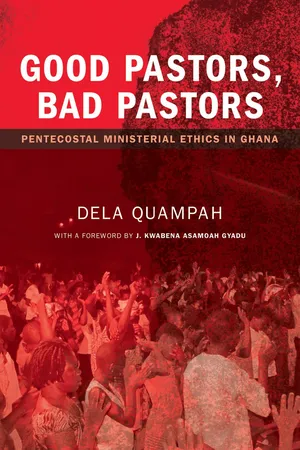
The emergence of Pentecostalism in Ghana has attracted a massive following and generated institutions that have significantly impacted Christian discourse and national life. The movement has produced prominent leaders who have developed exemplary Christian education programs and generated volumes of Christian literature unprecedented in Ghanaian Christianity. Nevertheless, public opinion often upbraids church leaders for unethical conduct.
Despite the concern for high moral standards set by Pentecostal church polity and ministerial ethical codes, reports of Pentecostal ministerial misconduct appear regularly in the media. Although congregation members and perceptive public observers appreciate the constructive moral impact of Pentecostal ministers, instances of promiscuity, power abuse, financial misappropriation, and superstition reveal a gap between ethical ideals and practice. As this research reveals, factors behind unethical ministerial conduct include inadequate training, poor accountability, and a general low level of ethical reflection. Good Pastors, Bad Pastors suggests that a multidimensional approach of responsible reportage, emphatic moral education, appropriate but sympathetic response to moral failure, and peer-review accountability could help uphold a higher standard of ministerial ethics.
Information
Topic
Theology & ReligionSubtopic
Christian Theology1
Background and Context
Introduction
The emergence of Pentecostal churches1 on the threshold of the twentieth century has marked a turning point in Ghanaian Christian discourse. Pentecostals can be regarded as the category of Christians who emphasize an ethos of sudden conversion, a belief in speaking in tongues as evidence of baptism in the Holy Spirit, and further demonstrations of the gifts of the Holy Spirit such as prophecy and healing. Elom Dovlo identifies the Pentecostal and charismatic churches as revivalist movements “who hold their activities to be under the dynamic guidance of the Holy Spirit and use His gifts and fruits to ‘minister’ to themselves and the Church.”2 A definition of Pentecostalism that hints at what is believed to be the Wesleyan Methodist holiness roots of the movement is offered by Bassett, who claims, “Pentecostalism emphasizes a postconversion experience of spiritual purification and empowering for Christian witness, entry into which is signaled by utterance in unknown tongues (Glossolalia/Speaking in Tongues).”3 Bassett’s reference to “spiritual purification” is pertinent to this work’s topic, for it gestures toward the Wesleyan Holiness teaching on sanctification, a theological category that deals mainly with character transformation.4
The Wesleyan tradition teaches that apart from having our sins pardoned through faith in Christ, our sinful nature can be removed through Christ’s atoning work, creating the possibility of living without sinning. In his famous transgenerational sermon on Christian perfection, John Wesley claimed, “It remains, then, that Christians are saved in this world from all sin, from all unrighteousness; that they are now in such a sense perfect, as not to commit sin, and to be freed from all evil thoughts and evil tempers.”5 As a result, sanctification has been understood to be a sudden operation of heart purification that follows regeneration but precedes Spirit baptism. Many Pentecostal groups continue to affirm this viewpoint. For example, it is declared in the Church of God’s statement of faith, “We believe . . . in sanctification subsequent to the new birth . . . [and in] the baptism with the Holy Ghost subsequent to a clean heart.”6 The Church of God thus subscribes to the “entire sanctification” doctrine wherein it is believed that one may attain sinless perfection as a precondition to baptism in the Holy Spirit. In such a context, sanctification is regarded as a definite discernible crisis event that should occur after conversion but before baptism in the Holy Spirit.
In his Theological Roots of Pentecostalism, Dayton endeavors to establish the Wesleyan Methodist Holiness tradition as the matrix that cradled the Pentecostal movement.7 Discourses on charismatic Christianity after the New Testament era trace its origins to the Montanist movement that emerged in Phrygia around a.d. 175 and was known as “the New Prophecy.”8 In his Pentecost outside Pentecostalism, Omenyo examines the trajectory of charismatic Christianity through the history of the church, from the Montanist era to the Azusa Street Revival.9 Although many Pentecostals would see their tradition as a novelty that emerged from the Azusa Street Revival, we must acknowledge that the revival was triggered by the prevailing religious climate in the United States.10 This revival was led by William Seymour, an African-American minister who in 1906 developed a spirituality that led to the Los Angeles Azusa Street Revival, an event most Pentecostal historians credit as the cradle of Pentecostalism.11 It is generally accepted that this revival was stimulated by the prevailing religious paradigm in America, to which Pentecostalism added a fresh dynamic. Dayton is convinced that in tracing the roots of Pentecostalism, we must begin with Methodism and “pick up the story in such a way as to demonstrate actual historical links and developments that will climax in Pentecostalism.”12 Walter Hollenweger also argues that Wesley left as his legacy the doctrine of sinless perfection to the first generation American Pentecostals, whose religious context was considerably influenced by Methodism.13
It is, however, noteworthy that not all Pentecostal churches subscribe to the doctrine of sinless perfection. The Assemblies of God (AG), which emerged from the Azusa Street Revival (and also happens to have been the first Pentecostal foreign mission in Ghana, having arrived in 1931) views sanctification as both given in salvation and progressive throughout the Christian life.14 Other churches that uphold this view on sanctification include the Elim Pentecostal Churches and the International Church of the Foursquare Gospel.
In Ghana, the classical Pentecostals have been churches with a history of considerable Western missionary effort in their formation—although some of them, such as Christ Apostolic Church (CAC), began as indigenous initiatives. They include the Assemblies of God, the Apostolic Church Ghana, and the Church of Pentecost (CoP). Their inception was signaled by the arrival of the first Assemblies of God missionaries in Ghana. Over the years, these churches have developed sustainable institutional structures to guide them in selecting and training leaders who, for the purpose of this work, are comprised of ordained clergy.
Closely linked to the classical Pentecostals, but slightly divergent in outlook, is a new strand of Pentecostal churches that Ghanaians refer to as “charismatic” churches. These churches emerged out of the evangelical revival of the late 1960s and 1970s and were founded—and are currently led—by significant charismatic individuals such as Bishop Charles Agyin Asare of Word Miracle Church International (WMCI), Rev. Christopher Titriku’s Redeeem Evangel Church (REC), Rev. Dr. Mensah Anamuah Otabil of the International Central Gospel Church (ICGC), Rev. Dr. Dag Heward-Mills of Lighthouse Chapel International (LCI), Archbishop Nicholas Duncan Williams of Christian Action Faith Ministry (CAFM), Rev. Nii Apiakai Tackie-Yarboi of Victory Bible Church International, Rev. Bob Hawkson of Jubilee Christian Centre, Rev. Dr. Robert Ampiah-Kwofie of Global Revival Ministry, among others.15 A difficulty in...
Table of contents
- Title Page
- Foreword
- Acknowledgments
- Introduction
- Abbreviations
- Chapter 1: Background and Context
- Chapter 2: Ghanaian Traditional Leadership Milieu and the Contextualization of Christianity
- Chapter 3: Selected Ethical Theories and Systems
- Chapter 4: Christian Ethics
- Chapter 5: Leadership Structure in Select Ghanaian Pentecostal Churches
- Chapter 6: Issues in Pentecostal Ministerial Ethics in Ghana
- Chapter 7: Analysis of Information on Pentecostal Ministers
- Chapter 8: Summary, Conclusions, and Recommendations
- Appendix 1: Apostolic Church Ghana End-of-Year Performance Review Form
- Appendix 2: Church of Pentecost Ministers Appraisal Form
- Appendix 3: Model Ministerial Code of Ethics of Grace Community Churches by Dela Quampah
- Appendix 4: Questionnaire on the Ethical Dimension of Pentecostal/Charismatic Church Leadership in Ghana
- Bibliography
Trusted by 375,005 students
Access to over 1.5 million titles for a fair monthly price.
Study more efficiently using our study tools.
Frequently asked questions
Yes, you can cancel anytime from the Subscription tab in your account settings on the Perlego website. Your subscription will stay active until the end of your current billing period. Learn how to cancel your subscription
No, books cannot be downloaded as external files, such as PDFs, for use outside of Perlego. However, you can download books within the Perlego app for offline reading on mobile or tablet. Learn how to download books offline
Perlego offers two plans: Essential and Complete
- Essential is ideal for learners and professionals who enjoy exploring a wide range of subjects. Access the Essential Library with 800,000+ trusted titles and best-sellers across business, personal growth, and the humanities. Includes unlimited reading time and Standard Read Aloud voice.
- Complete: Perfect for advanced learners and researchers needing full, unrestricted access. Unlock 1.5M+ books across hundreds of subjects, including academic and specialized titles. The Complete Plan also includes advanced features like Premium Read Aloud and Research Assistant.
We are an online textbook subscription service, where you can get access to an entire online library for less than the price of a single book per month. With over 1.5 million books across 990+ topics, we’ve got you covered! Learn about our mission
Look out for the read-aloud symbol on your next book to see if you can listen to it. The read-aloud tool reads text aloud for you, highlighting the text as it is being read. You can pause it, speed it up and slow it down. Learn more about Read Aloud
Yes! You can use the Perlego app on both iOS and Android devices to read anytime, anywhere — even offline. Perfect for commutes or when you’re on the go.
Please note we cannot support devices running on iOS 13 and Android 7 or earlier. Learn more about using the app
Please note we cannot support devices running on iOS 13 and Android 7 or earlier. Learn more about using the app
Yes, you can access Good Pastors, Bad Pastors by Dela Quampah in PDF and/or ePUB format, as well as other popular books in Theology & Religion & Christian Theology. We have over 1.5 million books available in our catalogue for you to explore.