eBook - ePub
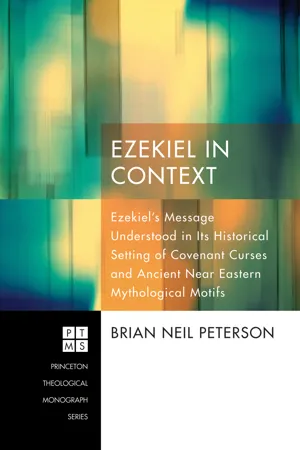
Ezekiel in Context
Ezekiel’s Message Understood in Its Historical Setting of Covenant Curses and Ancient Near Eastern Mythological Motifs
- 434 pages
- English
- ePUB (mobile friendly)
- Available on iOS & Android
eBook - ePub
Ezekiel in Context
Ezekiel’s Message Understood in Its Historical Setting of Covenant Curses and Ancient Near Eastern Mythological Motifs
About this book
One of the most perplexing and misunderstood books of the Bible, Ezekiel has left many scholars and exegetes scratching their heads regarding its message, coherency, and interpretation. Brian Peterson's look at the book of Ezekiel as a unified whole set within an exilic context helps explain some of the more difficult symbolic aspects in the book and makes Ezekiel as a whole more intelligible. Drawing on ancient Near Eastern concepts and motifs such as covenant and treaty curses, the various gods that made up the Babylonian pantheon, and the position that Israel held as the people of Yahweh, Peterson enlightens readers by showing that Ezekiel can only be understood in its original context. By placing the book first in its historical context, Peterson demonstrates how the original hearers of its message would have understood it, and how this message can be appreciated and applied by people today as well.
1
Methodology and Literary Technique
Introduction
Scholars have long recognized the inherent difficulties in interpreting Ezekiel’s visions.1 The book’s seemingly random visions and sign acts have often been interpreted independently of each other as oracles for a particular time and purpose with questions concerning multiple authorship often stemming from the debate (as per Hölscher).2 However, when viewed in light of the ancient Near Eastern setting within which Ezekiel ministered, a better understanding of his message and purpose becomes clear. In an era when covenant treaties (viz., Hittite, Babylonian, and Assyrian) dominated political alliances between ruling countries and their vassals, Ezekiel steps onto the prophetic scene in Babylon with a message rooted in a similar covenant treaty format which had been established between Israel and her God.3 Hillers comments, “Although the Pan-Babylonian School was guilty of ridiculous excesses in claiming that everything worthwhile in Hebrew literature was derived from Mesopotamia, it is still generally recognized that certain elements in biblical literature are related to Mesopotamian prototypes. Innumerable instances of Canaanite influence on the Old Testament have already been pointed out, and new examples are constantly being discovered. Since this is so, it is not a priori far-fetched to propose . . . that passages in the Hebrew prophets may show dependence on originally foreign treaty-curses.”4
From this perspective, one can pose the argument that Ezekiel may have chosen to formulate his prophetic announcements using treaty-curse language. Interestingly, according to Hillers, of all the prophetic books, Jeremiah contains the most occurrences of the treaty curse parallels.5 Now beyond the obvious fact that Ezekiel and Jeremiah were contemporaries, Ezekiel appears to have also adopted this form of prophetic address by embracing his new exilic setting. Using the symbolism and mythological motifs readily available in Babylon,6 the heart of ANE politics and culture at this time, Ezekiel fashioned his message of warning, doom, and future hope for the exiles in Babylon and those left in Jerusalem.7 Judah had broken covenant with her Suzerain, Yahweh, and as Yahweh’s spokesman (cf. 3:1–3), Ezekiel painted an intricate but unified picture of the nation’s covenant breaches. His use of oracles, allegory, and covenant lawsuit language, shrouded in symbols and imagery, helped shake a lethargic people into the stark reality of what was ahead for Jerusalem and why many were already in exile in a foreign land. By understanding this methodological approach of Ezekiel as a literary artist in his own right, one can better appreciate the wake-up call that the prophet delivered to his nation.8
In this monograph I will contend that Ezekiel’s visions and extended metaphors have to be seen through the interpretive lens of the covenant lawsuit format (viz., treaty curses) placed within a literary framework that many times reflects ANE mythological coloring. From this perspective it is possible to understand the book as a relatively coherent work in which one can discern the indictment of Yahweh and the cry of the prophet’s heart to his people.
General Approach
Because I will focus on a broad approach to the issues of the rhetorical strategy of Ezekiel coupled with the motifs of covenant, curse, and Mesopotamian influences, a typical history of scholarship will not be undertaken.9 Rather, a history of pertinent scholarship as it applies to my topic will be addressed in particular sections as needed. In this vein, the purpose of this opening chapter is to introduce the reader to the main issues handled in subsequent chapters. These issues include: 1) methodological factors including historical setting for the book, cross-cultural textual and motif analysis, motif/metaphor blending, the rhetorical strategy of the prophet, and the theological purpose of the message; 2) the possible evidence of direct Mesopotamian influence on Ezekiel; 3) the plausibility that Ezekiel was reeducated and had access to Mesopotamian literature and/or art10 from which he borrowed; and 4) how Ezekiel used covenant curses from ANE and OT covenant(s) and law. Note, however, that the final three issues will all be handled under the appropriate methodological sections.
Methodology Defined
As I analyze the message of Ezekiel, I will incorporate five different methodological approaches. These include 1) historical, 2) cross-cultural textual and motif analysis, 3) motif/metaphor blending, 4) rhetorical/literary, and 5) theological. While at points these approaches will appear well-defined, most of the time they will be blended, with the exception of the theological aspect which may have a separate section assigned to it in a given chapter where necessary. Also, while some scholars seek to reconstruct certain texts for their discussions, I will assume a literary coherency and integrity for each unit as I address them unless there is overwhelming evidence to warrant emendation. Thus, I will quote and base my work upon the text of the BHS as it stands.
Historical
Before we can discuss any of the main issues of the book of Ezekiel as they relate to Babylonian influences, cross-cultural borrowing of literature and motifs and the like we need to determine the possibility of an actual Babylonian setting for the book. Furthermore we need to decide whether Ezekiel ministered solely in Babylon or whether he had a split ministry between Judah and the land of his exile.11 Methodologically, it is important to scrutinize the main arguments in this regard and determine if we can proceed within a solid consensus of scholarship.
Thomas Renz has summarized the heart of the historical debate by formulating two questions that need to be answered. First, “was the book meant for a specific audience, and if so was this audience an exilic one? Secondly, does the book portray the ministry of a prophet who was (exclusively) active in Babylonia, or, more precisely, . . . is the picture drawn by the book accurate?”12 Scholars have approached these questions from various perspectives and presuppositions and have argued for a particular position based on literary content, possible historical setting, and prophetic perspective.13 In an effort not to reinvent the proverbial wheel I will summarize the meticulous work of Renz and update his research from the date of his publication in 1999. Renz highlights the six prevailing stances and their proponents.14
1. The majority of scholars at present view the book of Ezekiel as being written in Babylon with minor revisions in the post-exilic era. This position is held not only by Renz himself but also by scholars such as, Cooke, Fohrer, Wevers, Eichrodt, Freehof, Greenberg, Zimmerli, Maarsingh, Hals, Allen, Block, Kutsko, Mein, Wright, Odell, Joyce, and Launderville.15
2. Ezekiel ministered in Jerusalem before being taken into exile in 597 bce (e.g., Spiegel, Auvray, Robinson, Mays, and Steinmann).16 This explains some of the problematic material in the first half of the book that deals with Jerusalem in detail. This view had some following in the 1930s to the 1950s but has since lost much of its appeal, although a few scholars are still willing to suggest at least small portions of the book may have been written by Ezekiel in Judah (e.g., Fuhs, Blenkinsopp, Rabinowitz).17
3. Next, some posit that Ezekiel did in fact minister in Babylon. However, while the book might have had its beginnings in Babylon with the prophet, since then, the bulk of the book has had a Palestinian reworking. This stance was tak...
Table of contents
- Title Page
- Preface
- Acknowledgments
- Abbreviations
- Introduction
- Chapter 1: Methodology and Literary Technique
- Chapter 2: God’s Glory Revealed
- Chapter 3: The Awesome Deity’s Judgment
- Chapter 4: The Awesome Deity’s Love
- Chapter 5: The Awesome Deity Returns
- Chapter 6: Conclusions and Implications
- Appendix: Ezekiel and Apocalyptic
- Bibliography
Trusted by 375,005 students
Access to over 1.5 million titles for a fair monthly price.
Study more efficiently using our study tools.
Information
Publisher
Pickwick PublicationsYear
2012Topic
Theology & ReligionPrint ISBN
9781608995240
9781498256636
Subtopic
Biblical CommentaryeBook ISBN
9781630878061
Frequently asked questions
Yes, you can cancel anytime from the Subscription tab in your account settings on the Perlego website. Your subscription will stay active until the end of your current billing period. Learn how to cancel your subscription
No, books cannot be downloaded as external files, such as PDFs, for use outside of Perlego. However, you can download books within the Perlego app for offline reading on mobile or tablet. Learn how to download books offline
Perlego offers two plans: Essential and Complete
- Essential is ideal for learners and professionals who enjoy exploring a wide range of subjects. Access the Essential Library with 800,000+ trusted titles and best-sellers across business, personal growth, and the humanities. Includes unlimited reading time and Standard Read Aloud voice.
- Complete: Perfect for advanced learners and researchers needing full, unrestricted access. Unlock 1.5M+ books across hundreds of subjects, including academic and specialized titles. The Complete Plan also includes advanced features like Premium Read Aloud and Research Assistant.
We are an online textbook subscription service, where you can get access to an entire online library for less than the price of a single book per month. With over 1.5 million books across 990+ topics, we’ve got you covered! Learn about our mission
Look out for the read-aloud symbol on your next book to see if you can listen to it. The read-aloud tool reads text aloud for you, highlighting the text as it is being read. You can pause it, speed it up and slow it down. Learn more about Read Aloud
Yes! You can use the Perlego app on both iOS and Android devices to read anytime, anywhere — even offline. Perfect for commutes or when you’re on the go.
Please note we cannot support devices running on iOS 13 and Android 7 or earlier. Learn more about using the app
Yes, you can access Ezekiel in Context by Brian Neil Peterson in PDF and/or ePUB format, as well as other popular books in Theology & Religion & Biblical Commentary. We have over 1.5 million books available in our catalogue for you to explore.