eBook - ePub
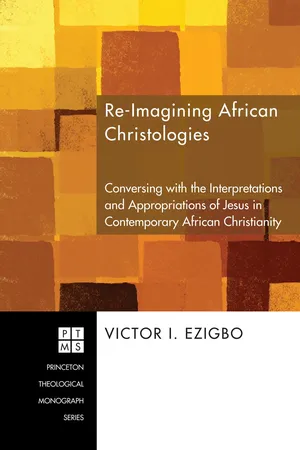
Re-imagining African Christologies
Conversing with the Interpretations and Appropriations of Jesus in Contemporary African Christianity
- 356 pages
- English
- ePUB (mobile friendly)
- Available on iOS & Android
eBook - ePub
Re-imagining African Christologies
Conversing with the Interpretations and Appropriations of Jesus in Contemporary African Christianity
About this book
"Who do you say that I am" (Mark 8:29) is the question of Christology. By asking this question, Jesus invites his followers to interpret him from within their own contexts-history, experience, and social location. Therefore, all responses to Jesus's invitation are contextual. But for too long, many theologians particularly in the West have continued to see Christology as a universal endeavor that is devoid of any contextual influences. This understanding of Christology undermines Jesus's expectations from us to imagine and appropriate him from within our own contexts. In Re-imagining African Christologies, Victor I. Ezigbo presents a constructive exposition of the unique ways that many African theologians and lay Christians from various church denominations have interpreted and appropriated Jesus Christ in their own contexts. He also articulates the constructive contributions that these African Christologies can make to the development of Christological discourse in non-African Christian communities.
Information
Topic
Theology & ReligionSubtopic
Christian Churchpart one
Jesus-Talk in Contemporary African Christianity
1
Major Presuppositions of African Christologies
In the introduction, I showed that the Taylorian christological presupposition has provoked some serious christological conversations among African Christian theologians.1 A critical examination of these conversations unveils some other complex presuppositions that inform and shape most of the existing christological models in African Christianity. The following three observations are noteworthy.
First, the theologians and the lay Christians I will examine here cannot be categorized neatly under any of these presuppositions. This is because some of them draw insights from all or most of the presuppositions, albeit in different ways.2 In addition, although the presuppositions have their unique contents and agendas, they overlap. For example, they share the ideology of contextualization. I will highlight their points of difference and agreement throughout the chapter. Second, I will discuss the contents and the implications of these Christologies extensively in chapters two and three. However, it is important to examine first the presuppositions that function as the backdrop to these Christologies. Without these presuppositions it will be difficult to understand and appreciate the contemporary interpretations and appropriations of the Christ-Event in African Christianity. And third, these presuppositions should not be confused with the actual contents of each of the christological models that I will examine in chapters two and three. Also, the presuppositions should not be conceived as being independent of the christological models. Instead, they should be taken as the general assumptions and ideologies that underlie the interpretations and appropriations of Jesus the Christ.
Every theologian operates with some assumptions. In some cases, these assumptions are clearly defined and the theologian is able to detect them and manage their influence on the texture of his or her work. Sometimes the theologian fails to clearly identify and articulate his or her assumptions and, therefore, is unable to properly manage them. Some African theologians and the majority of Christian laity hardly bother to articulate clearly the presuppositions that shape their understandings of the Christ-Event. This makes it difficult and sometimes daunting for people who are not familiar with African Christianity to understand and appreciate the emerging Christologies. The presuppositions I examine in this chapter have emerged from the struggles of many Christians to construct an adequate engagement with the Christian faith and the indigenous religions, and to practice their faith within their multicultural, multi-religious, political, and socio-economic context. I will classify and explore these presuppositions under four major categories: namely, Gap and Fulfillment, Destructionist, Reconstructionist, and Solution.
Gap and Fulfillment Presupposition
The gap and fulfillment presupposition is one of the oldest apologetic tools that some African theologians have employed to engage with the theological tension that emerges as they try to set out a theological meeting point for Christianity and the indigenous religions.3 This presupposition posits that there are gaps in the indigenous religious understandings of God’s revelatory activities. The proponents of this view argue that there is a necessity to fill these religious gaps if African peoples are to make sense of God’s purpose and salvific history, and also to appreciate the purpose and limits of their God-given cultures and traditions. For them, the indigenous religions contain only some fragments of divine truth, and as such, are incomplete and are in dire need for a supreme and definitive fulfiller.4 The majority of the theologians who operate with this mindset contend that the Christ-Event can effectively and definitively fill these religious gaps. Consequently, they introduce Jesus as the only one who can bring to a total fulfillment the religious aspirations of Africans which they struggle to fulfill through some indigenous religious ways.
In the gap and fulfillment presupposition, Jesus does not need to destroy all the core values and beliefs of the indigenous religions. The majority of the theologians and lay Christians who employ the gap and fulfillment presupposition have continued to agitate for the need to recognize the existence of God’s imprints in the indigenous religions. The backdrop to this agitation is the attempt to discredit the view that considers the indigenous religions to be completely incompatible with Christianity. Therefore, it is important to articulate the content of the so-called divine imprints in the indigenous religions and to examine how they relate to Christianity’s views of the Christ-Event.
The Nigerian theologian Luke Mbefo, for example, has called upon African Christians to excavate the divine imprints in their cultures and religions. He challenges them to engage in this enormous task with a positive mindset: “instead of a negative inference from the criticism of the early missionary Christianity, we are reminded with force and vigor of the values and the meanings of the heritage that is properly African—which were never called into dialogue in the colonial period of Christianity.”5 By heritage, Mbefo means the religious and cultural traditions that the ancestors embodied. Since these traditions define the identity of African peoples, to require them to dissociate themselves from such traditions almost entails requiring them to forego their identity. For him, it is the determination to retain this identity that inspired some theologians to warn their colleagues against the danger of making Christianity a foreign and superficial religion in Africa.6
But what precis...
Table of contents
- Title Page
- Foreword
- Preface
- Acknowledgements
- Abbreviations
- Introduction
- Part One: Jesus-Talk in Contemporary African Christianity
- Chapter 1: Major Presuppositions of African Christologies
- Chapter 2: Constructive Christologies of Contemporary African Christianity
- Chapter 3: Grassroots Christologies of Contemporary African Christianity
- Part Two: A Revealer Christology: Towards a New Christological Model
- Chapter 4: A Revealer Christology for the African Contexts
- Chapter 5: Revealing Divinity
- Chapter 6: The Malevolent Spirits in the Christologies of African Christianity
- Chapter 7: Revealing Humanity
- Conclusion
- Appendix 1
- Appendix 2
- Bibliography
Trusted by 375,005 students
Access to over 1.5 million titles for a fair monthly price.
Study more efficiently using our study tools.
Frequently asked questions
Yes, you can cancel anytime from the Subscription tab in your account settings on the Perlego website. Your subscription will stay active until the end of your current billing period. Learn how to cancel your subscription
No, books cannot be downloaded as external files, such as PDFs, for use outside of Perlego. However, you can download books within the Perlego app for offline reading on mobile or tablet. Learn how to download books offline
We are an online textbook subscription service, where you can get access to an entire online library for less than the price of a single book per month. With over 1.5 million books across 990+ topics, we’ve got you covered! Learn about our mission
Look out for the read-aloud symbol on your next book to see if you can listen to it. The read-aloud tool reads text aloud for you, highlighting the text as it is being read. You can pause it, speed it up and slow it down. Learn more about Read Aloud
Yes! You can use the Perlego app on both iOS and Android devices to read anytime, anywhere — even offline. Perfect for commutes or when you’re on the go.
Please note we cannot support devices running on iOS 13 and Android 7 or earlier. Learn more about using the app
Please note we cannot support devices running on iOS 13 and Android 7 or earlier. Learn more about using the app
Yes, you can access Re-imagining African Christologies by Victor I. Ezigbo in PDF and/or ePUB format, as well as other popular books in Theology & Religion & Christian Church. We have over 1.5 million books available in our catalogue for you to explore.