eBook - ePub
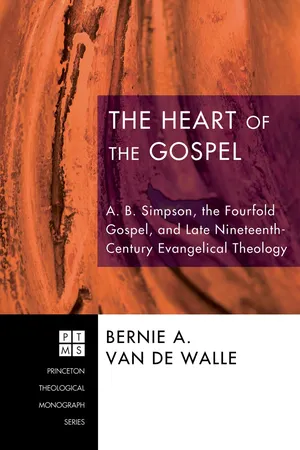
The Heart of the Gospel
A. B. Simpson, the Fourfold Gospel, and Late Nineteenth-Century Evangelical Theology
- 228 pages
- English
- ePUB (mobile friendly)
- Available on iOS & Android
eBook - ePub
The Heart of the Gospel
A. B. Simpson, the Fourfold Gospel, and Late Nineteenth-Century Evangelical Theology
About this book
The Fourfold Gospel, most often associated with Albert B. Simpson, founder of The Christian and Missionary Alliance, which focuses on the doctrines of Christ as Savior, Sanctifier, Healer, and Coming King, has been identified as a key contributing factor to the birth and development of the modern Pentecostal movement. Through a close observation of the doctrinal themes of select and renowned Evangelical leaders in America (A. J. Gordon of Boston, D. L. Moody of Chicago, A. T. Pierson of Philadelphia/Detroit, and A. B. Simpson of New York), this work shows that the Fourfold Gospel and, therefore, the theological source for modern Pentecostalism, rather than being a marginal movement within late nineteenth-century Evangelicalism was, instead, its very heart.
Information
Topic
Theology & ReligionSubtopic
Christian Theology1
The Legacy of Albert Benjamin Simpson
Albert Benjamin Simpson was born in Cavendish, Prince Edward Island, in December 1843, to staunch Scottish Presbyterian parents. As a result of a series of traumatic personal events, including grave illness, he dedicated his life to ministry and to the pursuit of holiness early in life. In October 1861, young Albert enrolled at Knox College at the University of Toronto, the leading seminary of Canadian Presbyterianism,1 with the blessing of his family but without their financial support. Simpson excelled at his studies, winning prizes for papers defending the historic Calvinism of the denomination. Upon graduation in 1865, he began his service as the pastor of Canada’s second-largest Presbyterian church, Knox Church in Hamilton, Ontario. During his ministry there, church attendance more than doubled “from 297 to 646.”2 Simpson left Hamilton in 1874 to become the minister of a large Presbyterian church in Louisville, Kentucky, where he saw “the same gratifying results he had known in Hamilton.”3 In 1879 he moved to the bustling and rapidly expanding metropolis of New York City to take up what would be his last Presbyterian charge. It was in New York City that Simpson would achieve his greatest success, but it would not come as a Presbyterian minister. Indeed, he left the Presbyterian Church in 1881, having come to doubt the very doctrines that he had so staunchly and ably defended while a student. He went on to found a movement that would become his corporate legacy—The Christian and Missionary Alliance.4
Denominational Founder
Simpson never intended to start a new denomination: the C&MA simply came into being as the practical institutional outworking of his newfound convictions. He began, in fact, by establishing two fraternal parachurch organizations: the Christian Alliance, to support and encourage the “Deeper Christian Life”; and the Evangelical Missionary Alliance, to promote the evangelization of the world.5 He believed that any move to denominationalism or sectarianism would short-circuit the very purpose of these Alliances, as is evident from the following extract from one of his editorials.
One of the greatest dangers in the Alliance movement is to isolate ourselves from the great currents of Christian thought and life among the churches by getting into exclusive circles and trying to build up a petty work which scarcely differs in its spirit from a sectarian movement. While in many cases a local work requires to be organized and maintained as a mission or an independent church, let us always be careful to avoid the mistake of representing this as an Alliance church or antagonizing other churches or pastors. God has called us in this work to an interdenominational mission and has a message through us for all his people.6
The very name “Alliance” gives an indication of the nature of the organizations Simpson sought to develop. He did not try to found another denomination or to steal away people from existing churches. Rather he simply wanted to bring together Christians “of whatsoever evangelical name”7 who were longing to experience the Christian life more deeply. This fraternal union that would become the C&MA was to supplement, not replace, the work of legitimate evangelical churches. He sought to found “not an ecclesiastical body, but a fraternal body of believers, in cordial harmony with Christians of every name.”8 He did not despise denominations but felt that they were not meeting all of the church’s needs. “There is no antagonism whatever in the Alliance to any of the evangelical churches,” he insisted, “but a desire to help them in every proper way, and to promote the interests of Christ’s kingdom in connection with every proper Christian organization and work.”9 Simpson always conceived of the Alliance as a partner and not a competitor with the denominations in the fulfilling of the Great Commission.
The two societies which were afterwards merged into The Christian and Missionary Alliance were organized at Old Orchard, Maine, in the summer of 1887, for the purpose of uniting in Christian fellowship and testimony, in a purely fraternal alliance, the large number of consecrated Christians in the various evangelical churches, who believe in the Lord Jesus as Saviour, Sanctifier, Healer and coming Lord, and also of uniting their efforts in the special aggressive work of word-wide evangelization.10
For this reason, under the leadership of Simpson, the Alliances never sought to become denominations in their own right.
Simpson’s own vision was not that the denominations would be left behind by the popularity and “righteousness” of the Alliances, but that through the invigorating influence of the Alliances, the ministry of the denominations themselves would flourish. Simpson describes this anticipated animating influence as “the most significant feature of the . . . work,” for it stimulates “faith in God and earnest aggressive work for our fellowmen among other Christian organizations as well as individuals.”11
In order to foster this ecumenical and cooperative spirit, the regulations for membership in the first group—the Christian Alliance—were quite open. One needed only to hold to the evangelical essentials12 and the “Fourfold Gospel” as taught by Simpson and the Alliance.13 Both the early leadership of the Alliance and those invited to speak at its Tabernacle, conventions, and classes reflect the ecumenical diversity for which Simpson hoped. Many of Simpson’s closest confidants within the Alliance did not share his Presbyterian background, nor did he insist that they must. Frederic Farr, who served as Dean of the Missionary Training Institute and as a member of the Board of Managers, was an ordained Baptist minister; William MacArthur, one of Simpson’s closest friends and partners was also a Baptist; William Fenton, the inaugural vice president of the Evangelical Missionary Alliance, had Brethren ties; Albert Funk, a Mennonite minister, was the first secretary of the Alliance’s Foreign Department and also became superintendent of the Institute; George Pardington, the Alliance’s first professional theologian, received his degree from Drew Theological School (a Methodist institution), was the son of a Methodist minister, and was a Methodist minister himself for a time; Henry Wilson, an Episcopal priest, was especially close to Simpson, and the two would often participate together in services, with Simpson preaching and Wilson serving the Eucharist; finally, Paul Rader, who succeeded Simpson as president, was the son of a Methodist minister and he himself served for awhile as a Congregationalist minister.14
The guest spea...
Table of contents
- Title Page
- Foreword
- Acknowledgements
- Chapter 1: The Legacy of Albert Benjamin Simpson
- Chapter 2: Christ, Our Savior
- Chapter 3: Christ, Our Sanctifier
- Chapter 4: Christ, Our Healer
- Chapter 5: Christ, Our Coming King
- Chapter 6: Conclusion:The Heart of the Gospel
- Bibliography
Trusted by 375,005 students
Access to over 1.5 million titles for a fair monthly price.
Study more efficiently using our study tools.
Frequently asked questions
Yes, you can cancel anytime from the Subscription tab in your account settings on the Perlego website. Your subscription will stay active until the end of your current billing period. Learn how to cancel your subscription
No, books cannot be downloaded as external files, such as PDFs, for use outside of Perlego. However, you can download books within the Perlego app for offline reading on mobile or tablet. Learn how to download books offline
Perlego offers two plans: Essential and Complete
- Essential is ideal for learners and professionals who enjoy exploring a wide range of subjects. Access the Essential Library with 800,000+ trusted titles and best-sellers across business, personal growth, and the humanities. Includes unlimited reading time and Standard Read Aloud voice.
- Complete: Perfect for advanced learners and researchers needing full, unrestricted access. Unlock 1.5M+ books across hundreds of subjects, including academic and specialized titles. The Complete Plan also includes advanced features like Premium Read Aloud and Research Assistant.
We are an online textbook subscription service, where you can get access to an entire online library for less than the price of a single book per month. With over 1.5 million books across 990+ topics, we’ve got you covered! Learn about our mission
Look out for the read-aloud symbol on your next book to see if you can listen to it. The read-aloud tool reads text aloud for you, highlighting the text as it is being read. You can pause it, speed it up and slow it down. Learn more about Read Aloud
Yes! You can use the Perlego app on both iOS and Android devices to read anytime, anywhere — even offline. Perfect for commutes or when you’re on the go.
Please note we cannot support devices running on iOS 13 and Android 7 or earlier. Learn more about using the app
Please note we cannot support devices running on iOS 13 and Android 7 or earlier. Learn more about using the app
Yes, you can access The Heart of the Gospel by Bernie Van De Walle in PDF and/or ePUB format, as well as other popular books in Theology & Religion & Christian Theology. We have over 1.5 million books available in our catalogue for you to explore.