Recognized as a leading interpreter of major movements in American Christianity such as Evangelicalism, Pentecostalism, and the Holiness movement, Donald W. Dayton has produced a body of work spanning four decades and diverse areas of inquiry. In From the Margins, friends and colleagues respond to major essays by Dayton (several published here for the first time) so as to celebrate and reflect on this diverse and rich body of work. The essays highlight the breadth of Dayton’s contribution while also revealing a methodological core. The latter could be described as Dayton’s deconstructive reading of standard scholarly narratives in order to short-circuit their domesticating effects on the more radical aspects of American Christianity. Dayton’s work has challenged long-held assumptions about the “conservative” nature of American Christianity by showing that both in their history and in their deeper theological substructures, traditions such as Evangelicalism and Pentecostalism are far more radical and productive of social change than was previously imagined.
eBook - ePub
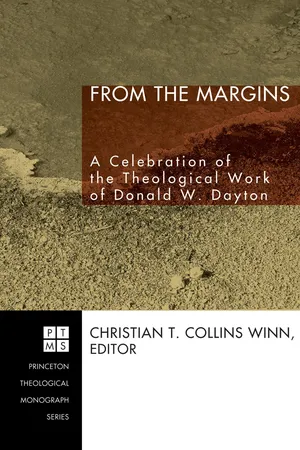
From the Margins
A Celebration of the Theological Work of Donald W. Dayton
- 458 pages
- English
- ePUB (mobile friendly)
- Available on iOS & Android
eBook - ePub
From the Margins
A Celebration of the Theological Work of Donald W. Dayton
About this book
Information
Subtopic
Église chrétienne1
Women’s Studies
In 1995, Dayton was invited to participate in a session of the Society of Biblical Literature devoted to celebrating the centennial publication of The Woman’s Bible—a project headed by the famous suffragist and feminist Elizabeth Cady Stanton. Dayton responded to the invitation with the plenary address “A Neglected Tradition of Biblical Feminism” here published for the first time.
This essay takes up a number of themes that Dayton had begun to explore early in his career with Lucille Sider and Nancy Hardesty as found in “Women in the Holiness Movement: Feminism in the Evangelical Tradition” in Rosemary Reuther and Eleanor McLaughlin’s Women of Spirit: Female Leadership in Religion, Past and Future (New York: Simon and Schuster, 1978).
A Neglected Tradition of Biblical Feminism
Introduction
I have had some ambivalence about this assignment. I understand this session as part of a larger celebration of the centennial of The Woman’s Bible, the first volume of which was published a century ago by Elizabeth Cady Stanton and colleagues. I have some fear, as a friend on the SBL program committee put it, that the invitation may have been an effort to avoid the appearance of “ladies day at the SBL.” Even if this be the case, perhaps it is appropriate to thank the program committee for the honor of being a token male to break that pattern.
Many of my earliest scholarly articles might be considered contributions to the discipline of “women’s studies.” I began to back away from this work nearly two decades ago when I discovered that I was not particularly welcome in the “women’s studies” group in the theological consortium in my city. It was clear there that “women’s studies” was not defined by discipline but as a gender-specific caucus and support group. At that time, I concluded that my best contribution to “women’s studies” might be made by withdrawing from the discipline, but I was delighted to receive this invitation as both an opportunity to pick back up this work and as a sign that in a new climate men may make a contribution to the discipline of “women’s studies.”
With regard to the role of this session in our larger commemoration of The Woman’s Bible, I take my clues from the Divinity School of the University of Chicago where I was privileged to devote over a decade to my doctoral studies—a rather average period of time for that particular institution. It was part of the methodological commitment of the Divinity School, expressed in the requirements of the doctoral program, that a phenomenon could only be understood when put in a larger context, historically and culturally, and even more by comparison with related and contrasting phenomena of the same period. Before we proceeded to dissertations on a given figure we were required to pass doctoral exams on a contrasting figure from the same period. I think there was wisdom in this requirement, and in its light, I take it that the function of this session is to illumine the tradition of The Woman’s Bible by holding it up to the mirror of contemporary movements whose feminist commitments took them in a distinctly different direction. It is this function that Evelyn and I hope to perform.
“Christianity” and “Feminism”
Before turning more directly to those currents of nineteenth century feminism that produced The Woman’s Bible, we should perhaps make some more orienting comments about the complex nest of issues that cluster around any effort to understand the relation of the Christian tradition to a variety of “feminisms.” This relationship is far too complicated to be reduced to any slogan or cliché.
I count as feminist any position that affirms the fundamental equality of women with men and I take it as a key sign of the integrity of such a position in a religious context the extent to which women are granted access to priestly and ministerial roles on an equal basis with men. Usually this is symbolized by ordination, though not always. Not all Christian churches practice ordination in this sense, and, as a “lay theologian,” I have some affinity with those who make this case. But in what follows, I shall be primarily concerned with the question of a “biblical feminism” that has manifested itself in the practice of women’s ministry and ordination.
Christianity may finally be one religion, but its rich tapestry of colors and nuances must be distinguished to understand the issues surrounding the ministry of women in the church. As I have reflected on these questions, it has seemed possible to distinguish several Christian currents that have been in the language of modern “computerese” particularly “women- friendly.” Among these would be the following:
(1) Perhaps the strongest impulse to women’s ministry has occurred in those more “pneumatically” oriented movements in the Christian church. An affirmation of the power of the Holy Spirit to call and bestow gifts independently of human claims to authority has often opened the way for the ministry of women—sometimes in the style of a prophetess, though history shows that this impulse may produce something approximating modern feminism as well. Montanism, for example, might illustrate the role of the prophetess, and some forms of Quakerism the possibility of this dynamic moving in the direction of feminism. Pentecostalism has moved in both directions, but primarily in the former line.
(2) Experientially oriented traditions have often unwittingly created a situation in which women have felt compelled to testify to their religious experience and to take on a form of “teaching ministry.” The conventicles of “Pietism” provided space for women’s collegial ministry but shied away from ordination, while classical Methodism veered closer to a formal endorsement of the ministry of women and became an early advocate of ordination of women among “mainline American denominations.”
(3) “Low church” traditions have often assimilated the ministry of women more easily than “high Church” ones—in part because the line between clergy and laity is already permeable, creating a situation in which women may more easily cross into formal roles of ministry. Thus if one arranges the Christian churches in order roughly according to “high Church” and “sacramental” orientation, one will approximate the relative difficulty each has had in adopting the ministry of women. Thus Catholic and Orthodox traditions still do not accept the practice, the Anglicans have only recently moved in this direction, not long after the churches of the “Magisterial Reformation” who followed the Methodists and the Baptists by a couple of decades, while it was the modern and more sectarian churches of the last century or so who pioneered the practice—the various Holiness and Pentecostal churches, in particular.
(4) Christian movements, like Methodism, that have been carriers of “perfectionism” have often given expression to this impulse in their powerful sense of a grace that is restoring the fallen creation to its pre-fallen state. In such traditions, which often saw women’s subordination as a result of the “curse” of the Fall in Genesis, the church was being drawn forward to an eschatological vision that restored the Edenic equality of women, especially in the sphere of redemption in the church.
(5) The sectarian impulse has often supported the ministry of women, since only at the margins of a patriarchal society has it been possible for women to have major religious roles. Thus the nineteenth century saw many religious movements founded by women: from Mother Ann Lee of the Shakers who claimed to be a feminine incarnation to Mary Baker Eddy of the Christian Science Movement and Ellen White of the Adventists and finally to a variety of important women in the founding of the Holiness and Pentecostal movements within American Christianity—such as Phoebe Palmer, Hannah Whitall Smith, and Aimee Semple McPherson.
(6) One should also notice the role in the churches of a modern enlightenment-based “egalitarianism” devoted to the extension of “human rights” to an ever-increasing circle of those once denied them. Early eighteenth century feminism, largely outside the church, was largely rooted in this dynamic, which was incorporated into the churches in the nineteenth century in the Unitarian and Universalist churches that were early pioneers of feminism and the ministry of women.
This rough outline of “women friendly” currents in the Christian tradition has many exceptions and cannot be applied with too heavy a hand. But it does indicate the extent to which these issues are complex and must be so treated. I would also like to suggest that this analysis does illumine the history of women in the church and provides clues to understanding the emergence of a form of Christian and biblical feminism in the nineteenth century.
The Emergence of Nineteenth Century Christian Feminism
One of the remarkable features of the nineteenth century is the way in which these currents converged in a cumulative and reinforcing way to lay the foundation for the emergence of a Christian feminism. The enlightenment vision of progress and human rights provided the backdrop and helped lay the foundation for the optimism of the new nation and the social experiments that Alice Felt Tyler describes in her book Freedom’s Ferment. Pietism and Methodism brought a new experiential orientation to American religion and initiated the “age of Methodism” in America—the century that ended with the First World War. By the Civil War Methodists had become the numerically dominant Protestant denomination and had convinced half the rest of Protestantism and some Catholics to act like Methodists. Presbyterian evangelist Charles Grandison Finney, for example, read the founders of Methodism and moved toward what came to be called “Oberlin Perfectionism.” Methodism incarnated a “gospel egalitarianism” and a poor man’s “optimism of grace” that reinforced enlightenment themes of progress and helped create the sense that one could start anew and carve new paths in history. The use of laity in Methodist patterns of ministry broke traditional patterns of clerical authority and opened doors to new roles through which lay women as well as lay men could walk.
This ferment was the womb of Christian feminism. It is probably still Alice Rossi who has made the closest study of the religious background of the nineteenth century feminists, including developing “sociograms” of the intimate relationships of the various players. Beverly Wildung Harrison comments on her work as follows:
The fact is that the social origins of the woman’s rights movement in America will not be fully or adequately understood, nor the early feminists rightly appreciated, until the connection is duly acknowledged between the woman’s movement and left-wing Reformation evangelicalism in America. It is to Rossi’s credit that she is one of the first contemporary feminists to identify the connection between the Second Great Awakening, in which Charles Finny himself was moved to support woman’s right to pray and testify, and the woman’s rights movement.1
I have never understood Harrison’s use of the expression in this context of “left-wing Reformation evangelicalism”—unless it be playing to the galleries of the Southern Baptist journal in which her article was published. I believe it is possible to be both more precise and more radical in articulating her thesis about the social and religious origins of the nineteenth century feminist movement.
It is certainly astounding the number of key moments in the emergence of feminism that cluster around Finney and his institutions. As Harrison indicates, under Finney’s ministry, women began to testify and pray in the mid 1820s. This practice became a major issue between Finney and the more conservative and “theocratic” evangelists of New England. And the New Lebanon Conference of 1827 called to negotiate this and other issues failed to resolve the issue or cause Finney to back away from the practice. Finney’s Oberlin College founded in 1835 became the first co-educational college, probably the reason that a number of the early feminists chose Oberlin for their education. Among these feminists was Antoinette Brown from a Finney-influenced Congregational home; Brown studied theology at Oberlin (though not with everyone’s approval) and became the first woman to be ordained. Theodore Weld, Finney’s assistant under whom the women had begun to pray and testify, led the rebellion at Lane Seminary in Cincinnati that provided the abolitionist and radical student body at Oberlin—and later married Angelina Grimké, one of the famous feminist Grimké sisters.
For some reason Rossi sets Elizabeth Cady Stanton of The Woman’s Bible outside the “revivalist” influence, perhaps because of her radical rejection of this tradition later. But as a fifteen year old girl she attended Finney’s meetings for a six-week period and experienced a profound conversion under his ministry. And Henry Stanton, her husband, was a colleague of Weld’s in the “Lane rebellion” and went to Oberlin for a period before moving on to become one of the famous “Seventy” abolitionist itinerant lecturers for the Anti-Slavery Society.
But Rossi’s thesis can be extended and radicalized by attention to another strand in the period that has not been well understood, but is actually the same line as Oberlin and gives more weight to Rossi’s thesis. I am speaking here of the Wesleyan Methodist Connection formed in 1843 out of the abolitionist Methodists who felt marginalized by Methodist bishops for their agitation of the slavery question. Rossi and other historians of the period do not seem to understand the significance of the fact that the first women’s rights convention of 1848 was held in the Wesleyan Methodist chapel in Seneca Falls. And similarly, when Antoinette Brown was to be ordained in a Congregationalist Church in 1853, she had to turn outside her own denomination to find someone willing to preach her ordination sermon. She finally turned to Luther Lee, a radical abolitionist founder of the Wesleyan Church.
If Oberlin (and its theological expression as “Oberlin Perfectionism”) represented a Methodistic and perfectionist wing of Presbyterian and Congregationalist revivalism, the Wesleyans represented the Oberlinite wing of Methodism, committed to the same values of “Oberlinism”: abolitionists, peace activism, revivalism, health reform, etc. As later theological developments confirm, these lines were essentially the same movement and the fountainhead of those currents...
Table of contents
- Title Page
- Acknowledgements
- Introduction
- 1: Women’s Studies
- A Neglected Tradition of Biblical Feminism
- • Response by Nancy A. Hardesty
- • Response by S. Sue Horner
- 2: The Social Role of the Church
- Piety and Radicalism: Ante-Bellum Social Evangelicalism in the U.S.
- • Response by Douglas M. Strong
- • Response by Jim Wallis
- 3: The Theology of Wesley
- Law and Gospel in the Wesleyan Tradition
- • Response by Howard Snyder
- • Response by William J. Abraham
- 4: Methodist Studies
- “Good News to the Poor”
- 5: The Holiness Movement
- Pneumatological Issues in the Holiness Movement
- • Response by Melvin Easterday Dieter
- • Response by David Bundy
- 6: Pentecostal Studies
- Revisiting the “Baptism with the Holy Spirit” Controversy
- • Response by Bill Faupel
- • Response by Amos Yong
- 7: The Pietist Impulse
- The Pietist Theological Critique of Biblical Inerrancy
- • Response by Frank D. Macchia
- • Response by Scott Kisker
- 8: American Popular Religious Culture
- James Dean, Popular Culture and Popular Religion
- • Response by Woodrow W. Whidden II
- • Response by William Kostlevy
- 9: Re-Thinking Evangelicalism
- “The Search for the Historical Evangelicalism”
- • Response by Robert K. Johnston
- • Response by Clark H. Pinnock
- 10: Toward a More Inclusive Ecumenism
- Yet Another Layer of the Onion
- • Response by Bother Jeff Gros, FSC
- • Response by Cecil M. Robeck Jr.
- 11: Interpreting Karl Barth
- Karl Barth and the Wider Ecumenism
- • Response by Christian T. Collins Winn
- • Response by James S. Nelson
- 12: Re-Interpreting Christianity in Korea
- The Four–Fold Gospel
- • Response by Myung Soo Park
- • Response by Dawk-Mahn Bae
- 13: Donald Dayton as Teacher
- 1998 Drew University Graduate School
- 14: An Autobiographical Response
- Select Bibliography
- Contributors
Trusted by 375,005 students
Access to over 1.5 million titles for a fair monthly price.
Study more efficiently using our study tools.
Frequently asked questions
Yes, you can cancel anytime from the Subscription tab in your account settings on the Perlego website. Your subscription will stay active until the end of your current billing period. Learn how to cancel your subscription
No, books cannot be downloaded as external files, such as PDFs, for use outside of Perlego. However, you can download books within the Perlego app for offline reading on mobile or tablet. Learn how to download books offline
Perlego offers two plans: Essential and Complete
- Essential is ideal for learners and professionals who enjoy exploring a wide range of subjects. Access the Essential Library with 800,000+ trusted titles and best-sellers across business, personal growth, and the humanities. Includes unlimited reading time and Standard Read Aloud voice.
- Complete: Perfect for advanced learners and researchers needing full, unrestricted access. Unlock 1.5M+ books across hundreds of subjects, including academic and specialized titles. The Complete Plan also includes advanced features like Premium Read Aloud and Research Assistant.
We are an online textbook subscription service, where you can get access to an entire online library for less than the price of a single book per month. With over 1.5 million books across 990+ topics, we’ve got you covered! Learn about our mission
Look out for the read-aloud symbol on your next book to see if you can listen to it. The read-aloud tool reads text aloud for you, highlighting the text as it is being read. You can pause it, speed it up and slow it down. Learn more about Read Aloud
Yes! You can use the Perlego app on both iOS and Android devices to read anytime, anywhere — even offline. Perfect for commutes or when you’re on the go.
Please note we cannot support devices running on iOS 13 and Android 7 or earlier. Learn more about using the app
Please note we cannot support devices running on iOS 13 and Android 7 or earlier. Learn more about using the app
Yes, you can access From the Margins by Christian T. Collins Winn, Collins Winn in PDF and/or ePUB format, as well as other popular books in Théologie et religion & Église chrétienne. We have over 1.5 million books available in our catalogue for you to explore.