- 302 pages
- English
- ePUB (mobile friendly)
- Available on iOS & Android
eBook - ePub
About this book
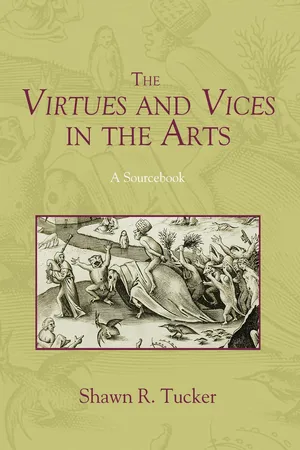
The seven deadly sins are pride, envy, anger, sloth, gluttony, greed, and lust. The seven virtues are prudence, fortitude, temperance, justice, faith, hope, and love. This book brings all of them together and for the first time lays out their history in a collection of the most important philosophical, religious, literary, and art-historical works.
Starting with the Greco-Roman and Judeo-Christian antecedents, this anthology of source documents traces the virtues-and-vices tradition through its cultural apex during the medieval era and then into their continued development and transformation from the Renaissance to the present. This anthology includes excerpts of Plato's Republic, the Bible, Dante's Purgatorio, and the writings of Friedrich Nietzsche and C. S. Lewis. Also included are artworks from medieval manuscripts; paintings by Giotto, Veronese, and Paul Cadmus; prints by Brueghel; and a photograph by Oscar Rejlander. What these works show is the vitality and richness of the virtues and vices in the arts from their origins to the present.
You can continue this book's conversation by visiting http://www.virtuesvicesinthearts.blogspot.com/. There you can join conversations, find out more, and meet other scholars and artists interested in this vibrant tradition.
Information
Topic
Theology & ReligionSubtopic
Philosophy History & TheoryPart I
Foundations
It is the simple yet profound question of human nature: are humans naturally good? Are truth, wisdom, and virtue already inside of us, just waiting for the proper conditions to grow and flourish? Is the default state of human moral character set at the right balance and only loses its equilibrium by accident? Or are we fulfilled and right when we are properly aligned with something higher, larger, or deeper? Are humans born complete, or at least very potentially complete in themselves, or is there a “God-shaped hole” in everyone? This question has a direct connection with virtue and vice. It also helps us understand the works in this book’s first section.
Human Potential and Protection I
Plato, Aristotle, and Cicero would generally agree that humans have within them all of the tools that they need to live a fully satisfying life. There is even a phrase that we use with Plato’s writing to describe how humans have all they need within them and that they merely need to develop those aspects. That phrase is the Maieutic method, and it is derived from the Greek word for midwife. Socrates, the speaker in Plato’s writings, describes himself as a midwife who is there to assist in the “birth” or emergence of truth that is already inside the learner. The Republic is an extended birthing session, where Socrates coaxes his learners through the sometimes difficult and even painful process of bringing the truth to light. What is brought to light is how the ideal state is based upon people following their best innate inclinations. Those inclinations are for everyone to do what they are best equipped to do, with those best equipped to look after the entire state acting as social guardians and facilitators.
Aristotle has a similarly optimistic view of human beings. His idea is that with proper training, one can acquire the habits of a virtuous life. In fact, Aristotle’s view sounds like what we generally think of when we think of Eastern medicine. The emphasis with both is on the proper balance. For humans to be successful, they must have the properly balanced response to any human experience or impulse. Everyone, for example, experiences fear, but the courageous respond to it properly. Those who are overly confident in the face of fear are rash or foolhardy, while those who are overly afraid are cowards. Aristotle catalogs the whole gamut of human experience and impulses to show how deficiencies and excesses make one morally unhealthy in the same way that an excess or deficiency of protein, iron, or calcium would make one physically ill. Rational self-examination with an eye on the healthiest individuals can help one see where those excesses or deficiencies lie, and then it is fully within one’s power to correct them by finding the proper balance. Of course rational self-examination requires proper training. Children, for example, do not know how to find a proper balance, but with the right training people can form the best habits to bring to life their innate potential.
What does not come through in the excerpts from Plato and Aristotle is that sometimes life just stinks. There is pain, suffering, and difficulties. There are ironic reversals, where just when everything seemed to be just right, it all falls apart. A view of life’s excruciating reversals, not to mention its utter unreliability, must have been especially clear to Romans like Cicero. In the face of so much social and personal decline and disappointment, Romans like Cicero adapted a fierce devotion to what they could control—themselves. The emphasis on personal integrity, a steady resilience and fortitude in spite of all, and a levelheadedness in the face of any potential persuasions by pleasure or pain are the hallmarks of the approach known as Stoicism. If Plato and Aristotle’s view is human expansion, human development from the growth of latent powers, Cicero’s outlook is virtue’s fortress in the midst of a siege, a soul that can remain still and safe with its internal resources and integrity.
Human Potential and Protection II
The first three works in this section are from Athens, so to speak: from the humanistic Greeks and Romans, who held the view of humans naturally following their best innate inclinations to achieve their highest potential. The last four works are from Jerusalem, from the theocentric Jewish and Christian cultures centered on belief that one’s highest potential came from a proper relationship with God. God is the standard by which human potential is measured in the theocentric works. That Being is also the one who guarantees the specific theocentric promise: eternal life. It is the divine instead of the human foundation and standard of virtue and vice that distinguishes Jerusalem from Athens.
Proverbs are wise sayings precisely because they reinforce how real wisdom comes from a proper respect and reverence for God. These sayings set up the contrast between the wise, who submit their will and understanding to God via obedience, against those who deviate, who stray, or who believe that they know themselves. Peace, power, and protection come to those who live by the covenant no matter what the circumstance (like Joseph, who was sold into Egypt, and who is mentioned later on in this book, in the introduction to Proverbs). Isaiah extends this in his description of a great leader or Messiah, who, because of His faithfulness to the covenant, would embody the greatest human and divine qualities and would subsequently bless the entire human race.
The greatest contrast between Athens and Jerusalem comes in Jesus’s description of the blessed. Aristotle’s “blessed” are those whose ambition has combined with innate talents to make them powerful, magnanimous, and universally admired. Jesus asserts that the poor in spirit, the meek, and those who mourn are the ideal. In Paul’s writings we find a similar contrast. In Athens being virtuous means following one’s best tendencies and in being balanced and healthy. For Paul, being virtuous is a constant and heated battle, and it is a battle that requires weaponry that only God through the Spirit can provide. Paul’s view of the Spirit’s work against sin seems closer to Western medicine’s view of antibodies, which destroy attacking viruses. Aristotle seeks balance, the golden mean between too much and too little, whereas Paul seeks absolute victory and triumph. Plato may hear the momentary cries of virtue’s birth, but Paul hears the tumultuous clamor of virtue and vice’s life-or-death struggle.
Plato’s The Republic
Introduction
Plato’s Republic is haunted by sheep—fat, lazy, and stupidly obedient sheep. Behind those sheep are greedy and selfish shepherds who care for them, keeping them safe, happy, and well-fed long enough to let them reproduce, to sheer them, and to butcher them. The reason that sheep haunt the Republic is that the discussion that we are most interested in is about the nature of justice. What is justice? What does it mean to be just, and where can we find justice? And, to get to the problem, who does justice benefit—the rulers or the ruled? Could it be that what passes for justice is simply a cover that the powerful use to take advantage of the powerless? Is justice the shepherd’s crook that oppressive rulers use to keep the herded masses stupid and subservient to their selfish ends?
We hear the ghost sheep in the first book of The Republic. The Republic is a discussion between Socrates and various speakers, and in the first book we meet Thrasymachus, someone who seems to really have it in for Socrates. Thrasymachus can hardly contain himself as the discussion of justice begins. When he finally gets a chance to interrupt, he calls Socrates an immature, snot-nosed child who does not know how the world really works. He offers this lesson:
You fancy that the shepherd or neatherd [cowherd] fattens or tends the sheep or oxen with a view to their own good and not to the good of himself or his master; and you further imagine that the rulers of states, if they are true rulers, never think of their subjects as sheep, and that they are not studying their own advantage day and night. Oh, no; and so entirely astray are you in your ideas about the just and unjust as not even to know that justice and the just are in reality another’s good; that is to say, the interest of the ruler and stronger, and the loss of the subject and servant; whereas the reverse holds in the case of injustice; ...
Table of contents
- Title Page
- Figures
- Acknowledgments
- Introduction
- Part I: Foundations
- Part II: Codification of the Virtues and Vices
- Part III: The Medieval Apex
- Part IV: The Transformation of the Virtues and Vices
- Part V: The Tradition Extended
- Appendix: Key Virtues and Vices Works
- Bibliography
- Acknowledgment of Copyright
Trusted by 375,005 students
Access to over 1.5 million titles for a fair monthly price.
Study more efficiently using our study tools.
Frequently asked questions
Yes, you can cancel anytime from the Subscription tab in your account settings on the Perlego website. Your subscription will stay active until the end of your current billing period. Learn how to cancel your subscription
No, books cannot be downloaded as external files, such as PDFs, for use outside of Perlego. However, you can download books within the Perlego app for offline reading on mobile or tablet. Learn how to download books offline
Perlego offers two plans: Essential and Complete
- Essential is ideal for learners and professionals who enjoy exploring a wide range of subjects. Access the Essential Library with 800,000+ trusted titles and best-sellers across business, personal growth, and the humanities. Includes unlimited reading time and Standard Read Aloud voice.
- Complete: Perfect for advanced learners and researchers needing full, unrestricted access. Unlock 1.5M+ books across hundreds of subjects, including academic and specialized titles. The Complete Plan also includes advanced features like Premium Read Aloud and Research Assistant.
We are an online textbook subscription service, where you can get access to an entire online library for less than the price of a single book per month. With over 1.5 million books across 990+ topics, we’ve got you covered! Learn about our mission
Look out for the read-aloud symbol on your next book to see if you can listen to it. The read-aloud tool reads text aloud for you, highlighting the text as it is being read. You can pause it, speed it up and slow it down. Learn more about Read Aloud
Yes! You can use the Perlego app on both iOS and Android devices to read anytime, anywhere — even offline. Perfect for commutes or when you’re on the go.
Please note we cannot support devices running on iOS 13 and Android 7 or earlier. Learn more about using the app
Please note we cannot support devices running on iOS 13 and Android 7 or earlier. Learn more about using the app
Yes, you can access The Virtues and Vices in the Arts by Shawn R. Tucker in PDF and/or ePUB format, as well as other popular books in Theology & Religion & Philosophy History & Theory. We have over 1.5 million books available in our catalogue for you to explore.