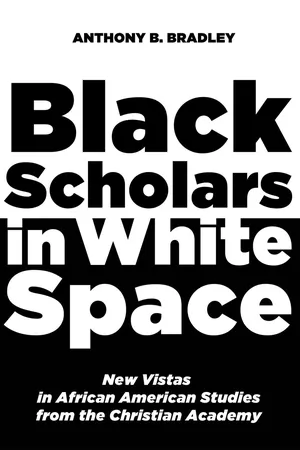
eBook - ePub
Black Scholars in White Space
New Vistas in African American Studies from the Christian Academy
- 232 pages
- English
- ePUB (mobile friendly)
- Available on iOS & Android
eBook - ePub
Black Scholars in White Space
New Vistas in African American Studies from the Christian Academy
About this book
Never before in American history have we seen the number of African Americans teaching at Christian Colleges as we see today. Black Scholars in White Space highlights the recent research and scholarly contributions to various academic disciplines by some of America's history-making African American scholars working in Christian Higher Education. Many are the first African Americans or only African Americans teaching at their respective institutions. Moreover, never before have this many African American female scholars in Christian Higher Education had their research presented in a single, cross-disciplinary volume. The scholars in this book, spanning the humanities and social sciences, examine the issues in public policy, church/state relations, health care, women's issues in higher education, theological anthropology, affirmative action, and black history that need to be addressed in America as we move forward in the 21st century. For these reasons and more Black Scholars in White Space offers timely and historic contributions to the discourse about making the black community a place where men and women thrive and make contributions to the common good.
Information
Topic
Scienze socialiSubtopic
Teologia cristiana1
Prophetic and Priestly: The Politics of a Black Catholic Parish
Dr. Larycia A. Hawkins, Wheaton College
Introduction
The black church has been defined almost exclusively in terms of historic black Protestantism (Lincoln and Mamiya 1990; Raboteau 1995). While this definition certainly squares with the thrust of black religious activity since slavery, it fails to inculcate the reality of mainline black churches outside the ambit of the historic black church and black Catholic parishes. These churches remain a puzzle because as political scientists have sought to understand how black Christianity provides micro and macro resources for black politics, they have focused solely upon the historic black church.
Black political churches are typified by the messages that flow from the pulpit as much as they are by actual political activity. As leaders of the central institution of black life, pastors of black churches exert an enormous influence upon the political and civic views of black congregants. Indeed, black congregants expect, as a matter of course, that pastors utilize their pulpits to express views on issues of social and political import (Pew 2009). Pastors, then, are important political elites in the black community, affecting African American public opinion, whether or not that opinion is translated into direct political action or civic activity.
Of course, much scholarship indicates that the black church does indeed serve as an incubator of civic skills and as a venue for the translation of civic messages into civic action. Much of this evidence comes from aggregate level data rather than church-level statistics, but it is reasonable to conclude that pastoral civic and political messages matter for black politics, both in terms of opinion formation and in terms of political mobilization (Harris 1999).
To understand religion and politics, we need to understand how race mediates this relationship. For example, scholars who study Catholics and politics have noted the importance of distinguishing the politics of Latino Catholics from those of white Catholics (Wilson, 2008). Furthermore, we need to ascertain how understudied denominations and institutions of black religion, like black Catholic churches and black churches in historically white mainline denominations differ from or converge upon the black church. The current study examines the dynamics of one black Catholic parish and asks: 1) how does the black Catholic experience compare to the black church experience in terms of theology, worship, and polity, 2) what types of civic and political messages are proffered from the priestly pulpit and promulgated in parish level activities, and 3) what role does the priest play in promulgating civic and political activity?
Methodology
The current study primarily utilizes the participant observer method. As I sought to gain an in-depth knowledge of racial and political dynamics at the parish level, a single case, St. Sabina Catholic Church, was selected for study. I attended services over the course of three years, from June 2009 to February 2012. During this time, I observed two different priests presiding over mass. After my first visit in June 2009, I decided to attend mass on the first Sunday of the month, termed Unity Sunday, because Unity Sunday is the only Sunday where the entire parish attends one service. On other Sundays, mass is offered twice a day.
One scholar notes the importance of understanding Christianity in local context (Howell 2008). Only by disaggregating religionists can scholars behold the unique dynamics of faith as affected by context. The location of St. Sabina in the economically-depressed, South side Chicago neighborhood of Auburn Gresham, therefore, is assumed to affect the tone and tenor of congregational politics. Furthermore, the universal nature of the Catholic Church is presumed to matter for parish politics, but the nature, extent, and efficacy of top-down dictates is observed best at the parish level.
Finally, it is important to note that I have sought in previous scholarly work to understand the unique dynamics of the historic black denominations in their complexity. In previous work, I have attended the services of black Baptist churches, the African Methodist Episcopal church, and the Church of God in Christ, which all range in their theology, worship and polity. Thus, the current study builds upon previous participant observation and study of the black church writ large, as it seeks to understand the dynamics of black Catholicism as they relate to the politics of black Catholics.
Come to Black Jesus: Black Church Message with Catholic Church Vessel
If you visit a handful of Catholic churches, you would likely notice a pattern—holy water at the entrances and a crucifix prominently displayed in the front of the church. Catholic faithful kneeling in prayer and crossing in reverence. At St. Sabina, however, this is not the case. Ethnic African print adorns banners and African flags hang from the rafters. Praise dancers follow the traditional processional where the cross and the sword of the spirit are the most prominent elements. Standing and shouting to gospel music, as opposed to kneeling and genuflecting silently, is the congregational norm. Holy water flows through the serendipitous style and flow of the service rather than as a purification ritual at the beginning of mass. Shouting and raising of hands in affirmation of the priest’s sermon replaces crossing during liturgy.
The dynamic of St. Sabina can only be explained by its geographic, and thus its cultural, location. St. Sabina Catholic Church is situated in the Auburn Gresham neighborhood of Chicago, a neighborhood which is over 95 percent black and where 32 percent of the population is below the poverty line, compared to 24 percent of the population of Chicago families and 12.38 percent of the U.S. population (City Data 2013). Parishes are purposefully local institutions. Thus, Catholics, unlike Protestants, are deprived of choice in church—they are assigned to the most proximate local congregation. Given patterns of racial and ethnic segregation in the United States, it should come as little surprise that ethnically and racially homogenous parishes persist in the United States. Thus, even if the color of the parish changes—St. Sabina was originally founded in 1916 as an Irish-American parish and became increasingly black with the Great Migration of the 1940s (McGreevy, 1996, 25–26)—the fact of racial homogeneity may be one of the most enduring factors of parish life. Of 356 Catholic parishes in the city of Chicago, thirty-seven are predominantly black (Chicago Archdiocese 2011; National Catholic Register 2012). Of course, the priest and laity can take pains to counter parish ethnic exclusivity and anyone who visits St. Sabina Catholic Church realizes quickly that whether black or white, no one is a stranger at St. Sabina. Visitors are greeted and hugged, and invited to sit with regular members when sitting alone. As evidence of Catholic universalism, the church broadcasts to seventy countries around the world.
St. Sabina reflects the contours of the local, racialized context. Inside the church, a portrait of a lively black Jesus hangs where a bloody crucified Christ would normally be ensconced, signifying immediately that this is not a traditional Catholic church. If the black Christ does not signal the uniqueness of the place, perhaps the neon Jesus sign hanging prominently over the choir loft and lectern bespeaks the gospel-centric, liberation-laden moments to come. Of course, some facets of the mass at St. Sabina are thoroughly Catholic in cast and tone—the priestly vestments, the processional where incense is diffused and the cross is lifted high, the presentation of the gospel where congregants bow in deference to the living word, and the Eucharist where individuals cross themselves after partaking of the body and blood of Jesus. Very few icons are present and those that exist, including a statue of the Virgin Mary, are relegated to an ancillary position in the church decor. Despite these elements of Catholicism, one familiar with the traditional black church would feel rather at home during a St. Sabina service. St. Sabina’s thorough fusion of a black worship style, a liberation theology approach, and a Catholic sensibility render its religion as well as its politics of particular interest.
Despite the fact that 51 percent of Chicago Catholics are non-white, including 3 percent who are black and Catholics, diversity among Catholic priests is more rare (Archdiocese of Chicago 2011). There are 40,000 priests in the United States, but only 250 are African American (USCCB 2012). While there are sixteen African American bishops, only six dioceses in the United States are headed by an African American bishop (USCCB 2012). Perhaps, then, it comes as little surprise that a white priest has presided at the helm of St. Sabina Catholic Church since 1981. Father Michael Pfleger, a baby boomer ordained in 1975, came of age in the civil rights era and was enamored with black preaching and had mentors in the black church despite his seminary training in Catholic institutions. Father Pfleger is a charismatic figure to whom congregants respond with marked and visible enthusiasm. His charisma does not emanate from a cult-of-personality, but rather flows from congregational loyalty to a white priest who has displayed deep devotion to the predominantly black, Auburn Gresham community over the years. Father Pfleger has adopted three black sons (one of whom died due to stray gunfire). He has been disciplined by the Chicago Archdiocese both for adopting children and for remarks he made about Hillary Clinton during the 2008 presidential primaries. Most recently, Pfleger said that he would leave the Catholic Church if the Diocese decided to reassign him to the helm of a nearby Catholic school, St. Leo’s. The fact that Pfleger has served as parish priest for over 30 years i...
Table of contents
- Title Page
- Preface
- Acknowledgments
- Chapter 1: Prophetic and Priestly: The Politics of a Black Catholic Parish
- Chapter 2: Jesus and Justice: The Moral Framing of the Black Policy Agenda
- Chapter 3: Reading is Not Simply Black and White: Comparisons of Health and Non-Health Literacy in African Americans and Caucasians
- Chapter 4: African American Women Scholars in Christian Higher Education: A Perspective on Sistah-hood
- Chapter 5: Becoming an African American Academic Leader on a Predominately White Christian Campus: The Use of Autoethnography as a Method for Exploring Mentoring Processes
- Chapter 6: Ain’t I a Student? Thinking through Spaces for Black Female College Students
- Chapter 7: Erasing Race: Racial Identity and Theological Anthropology
- Chapter 8: “An Open Door and a Welcome Hand”: Lewis Garnet Jordan’s Ethiopian Vision
- Chapter 9: What Do These Stones Mean? Civil Rights Movement Tourism as an Act of Remembrance
- Chapter 10: Affirmative Action and Conceptions of Fairness: Jonathan Haidt and the Righteous Black Community
- Bibliography
- Contributors
Trusted by 375,005 students
Access to over 1.5 million titles for a fair monthly price.
Study more efficiently using our study tools.
Frequently asked questions
Yes, you can cancel anytime from the Subscription tab in your account settings on the Perlego website. Your subscription will stay active until the end of your current billing period. Learn how to cancel your subscription
No, books cannot be downloaded as external files, such as PDFs, for use outside of Perlego. However, you can download books within the Perlego app for offline reading on mobile or tablet. Learn how to download books offline
Perlego offers two plans: Essential and Complete
- Essential is ideal for learners and professionals who enjoy exploring a wide range of subjects. Access the Essential Library with 800,000+ trusted titles and best-sellers across business, personal growth, and the humanities. Includes unlimited reading time and Standard Read Aloud voice.
- Complete: Perfect for advanced learners and researchers needing full, unrestricted access. Unlock 1.5M+ books across hundreds of subjects, including academic and specialized titles. The Complete Plan also includes advanced features like Premium Read Aloud and Research Assistant.
We are an online textbook subscription service, where you can get access to an entire online library for less than the price of a single book per month. With over 1.5 million books across 990+ topics, we’ve got you covered! Learn about our mission
Look out for the read-aloud symbol on your next book to see if you can listen to it. The read-aloud tool reads text aloud for you, highlighting the text as it is being read. You can pause it, speed it up and slow it down. Learn more about Read Aloud
Yes! You can use the Perlego app on both iOS and Android devices to read anytime, anywhere — even offline. Perfect for commutes or when you’re on the go.
Please note we cannot support devices running on iOS 13 and Android 7 or earlier. Learn more about using the app
Please note we cannot support devices running on iOS 13 and Android 7 or earlier. Learn more about using the app
Yes, you can access Black Scholars in White Space by Anthony B. Bradley in PDF and/or ePUB format, as well as other popular books in Scienze sociali & Teologia cristiana. We have over 1.5 million books available in our catalogue for you to explore.