eBook - ePub
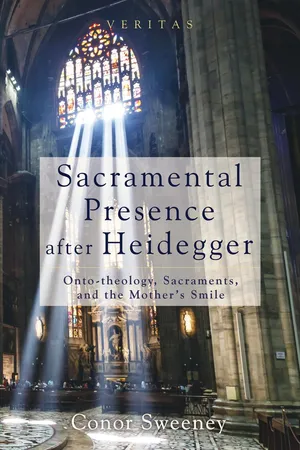
Sacramental Presence after Heidegger
Onto-theology, Sacraments, and the Mother’s Smile
- 268 pages
- English
- ePUB (mobile friendly)
- Available on iOS & Android
eBook - ePub
About this book
Theology after Heidegger must take into account history and language as constitutive elements in the pursuit of meaning. Quite often, this prompts a hurried flight from metaphysics to an embrace of an absence at the center of Christian narrativity. In this book, Conor Sweeney explores the "postmodern" critique of presence in the context of sacramental theology, engaging the thought of Louis-Marie Chauvet and Lieven Boeve. Chauvet is an influential postmodern theologian whose critique of the perceived onto-theological constitution of presence in traditional sacramental theology has made big waves, while Boeve is part of a more recent generation of theologians who even more wholeheartedly embrace postmodern consequences for theology.
Sweeney considers the extent to which postmodernism a la Heidegger upsets the hermeneutics of sacramentality, asking whether this requires us to renounce the search for a presence that by definition transcends us. Against both the fetishization of presence and absence, Sweeney argues that metaphysics has a properly sacramental basis, and that it is only through this reality that the dialectic of presence and absence can be transcended. The case is made for the full but restless signification of the mother's smile as the paradigm for genuine sacramental presence.
Information
Topic
Theology & ReligionSubtopic
Philosophical Hermeneutics1
Postmodern Soundings
Introduction
The purpose of this first chapter is to gain a greater understanding of the “riot of diversity”61 that has been called postmodernism. The following overview is geared to the particular postmodern problematic facing contemporary discourse on sacramental presence, and in this sense is meant to be a preparation for the question of how postmodern thought is made productive for the Christian tradition by contemporary theology. In this, as we have already seen, Heidegger’s relationship to postmodernism will be accented insofar as his critique of Western thought emerges as an important catalyst for postmodern sacramental theology. At the end of this first chapter, we hope to have facilitated an adequate understanding of the key elements at stake in any construal between postmodernism and the Christian tradition, and to have adequately set up the following chapters’ more thematic treatment of sacramental presence.
The plan for this chapter is as follows. After a brief outline of the some of the rudimentary characteristics of postmodernism, we shall turn to a more detailed genealogical examination by recounting the key moments, or “turns”—and their contemporary interpretations—which have brought us to the postmodern turn, beginning from the alleged high point of the Western tradition. We will chart a path from this high point through the “nominalist turn,” the “turn to the subject,” and the “phenomenological turn,” citing various contemporary interpretations of these turns along the way, and making preliminary connections between these turns and the theme of sacramental presence. This path will highlight the key moments leading from the medieval synthesis through to modernity and postmodernity. Upon completion of this selective genealogy, we will then turn to evaluate its relationship to contemporary Christian theology, accenting the diverse ways the latter’s tasks are construed vis-à-vis the Heideggerean problematic. In all of this, we hope to provide an introduction to the general milieu of ideas informing the theme of sacramental presence in order to adequately frame the thought of Chauvet and Boeve.
Postmodern Soundings62
Any commentator of postmodernism faces the daunting task of attaining a manageable working definition of the term. It is perhaps helpful to begin by perusing a few preliminary descriptions of postmodernism, in order to acquaint ourselves with some of its basic characteristics, but also to illustrate the very postmodern observation that one should speak of postmodernisms rather than Postmodernism.63 What makes postmodernism such a nebulous term is its complex history and distinctive characteristics, factors which give rise to any number of not necessarily complementary interpretations. In order to offer an interpretation of postmodernism, one must make infinitely delicate judgments in regard to the whole raft of intellectual history that precedes it.
Be that as it may, we may nevertheless briefly catalogue some of the more elementary characteristics of postmodernism. In certain respects, postmodernism resists definition,64 as it is less a body of positive doctrines than it is a series of fundamental critiques. Kevin Vanhoozer follows Jean-Francois Lyotard in calling postmodernity a “condition” rather than a “position.”65 Lyotard famously defined postmodernism as “incredulity towards metanarratives,” something he explains as being precipitated primarily by the “crisis of metaphysical philosophy.”66 For Lyotard, this crisis is represented by a loss of confidence in the great narratives of reason. “The grand narrative has lost its credibility, regardless of what mode of unification it uses, regardless of whether it is a speculative narrative [philosophy] or a narrative of emancipation [politics].”67 What Lyotard refers to here is the particular aporia of modernity already pointed out with such force by Nietzsche, that of the perceived impossibility of grounding the particular in the universal, something which can also be expressed in terms of the non-identity of the signifier and the signified. The response to this metaphysical crisis of representation is not therefore another “position”—another fixed, universal account of how the world works—but is rather a “condition” characterized by suspension, deferral, and openness.
This condition of being-without-confidence, and therefore being compelled to perpetually defer reason’s aspirations to commensurability with its object can be described in many ways. Neville Wakefield describes the unstable vacuum created by the loss of objective standards of rationality: “The universe once again becomes unsteady as we find that we have built structures (whether born of rationalist positivism or apocalyptic fatalism), that are too rigid, too coherent and too explicatory to survive in a world of flux.”68 He construes this situation as “a phase marked by a new sort of promiscuity in which the various strands of human activity jostle, intermingle, and exchange amongst one another.”69 Instead of the existence of a single, unitary, “master” narrative that provides meaning, the pursuit of meaning becomes something of a free-for-all between competing positions and interests with no ultimate arbitrator. James C. Livingston uses the following phrases to characterize postmodernism: “emptiness of self,” “absence,” “loss of self,” “the movement toward silence,” “the unrepresentable,” “the crisis of legitimation.”70 He notes postmodernism’s subsequent emphasis on “the discovery of difference, diversity, and pluralism.”71 The twilight of certainty means that dimensions once dismissed as irrelevant or unworthy of consideration all suddenly become equally worthy of consideration, given the relativizing of the standards of traditionally privileged modes of discourse.72 It becomes respectable to intellectually pursue anything “from the margins.” As we will see, the greatest casualty of postmodernism is metaphysical discourse. Schmitz points out how “postmodernism has rendered ontological discourse (understood as metaphysics) problematic and raised its problematicity to the issue of the nature of philosophy itself.”73
To close this section, we will briefly consider the effect of this demise of ontological discourse on four classical metanarratives, as told by Vanhoozer. Vanhoozer claims that there are four major metanarratives towards which postmoderns are incredulous: those of reason, truth, history, and self. First, characteristic of a move away from certainty, postmoderns embrace “reason” rather than “Reason.”74 Rationality is limited, contextual, and relative. Human thinking “is always situated within particular narratives, traditions, institutions, and practices.” Second, this produces an account of truth that directly challenges the fundamental philosophical aspiration of modernity, “namely, the project of mastering natural reality in a comprehensive conceptual scheme.”75 Any assertion of absolute truth belies little more than hidden ideology and the will to power (Foucault, Nietzsche). Third, this version of truth expands to inform po...
Table of contents
- Title Page
- Preface
- Acknowledgments
- Introduction: Context, History, Object
- Chapter 1: Postmodern Soundings
- Chapter 2: Sacramental Presence in Louis-Marie Chauvet
- Chapter 3: Sacramental Presence in Lieven Boeve
- Chapter 4: The Praxis of Sacramental Presence after Heidegger
- Chapter 5: Reimagining Metaphysics after Onto-Theology
- Conclusion: Sacramental Presence and the Mother’s Smile
- Bibliography
Trusted by 375,005 students
Access to over 1.5 million titles for a fair monthly price.
Study more efficiently using our study tools.
Frequently asked questions
Yes, you can cancel anytime from the Subscription tab in your account settings on the Perlego website. Your subscription will stay active until the end of your current billing period. Learn how to cancel your subscription
No, books cannot be downloaded as external files, such as PDFs, for use outside of Perlego. However, you can download books within the Perlego app for offline reading on mobile or tablet. Learn how to download books offline
Perlego offers two plans: Essential and Complete
- Essential is ideal for learners and professionals who enjoy exploring a wide range of subjects. Access the Essential Library with 800,000+ trusted titles and best-sellers across business, personal growth, and the humanities. Includes unlimited reading time and Standard Read Aloud voice.
- Complete: Perfect for advanced learners and researchers needing full, unrestricted access. Unlock 1.5M+ books across hundreds of subjects, including academic and specialized titles. The Complete Plan also includes advanced features like Premium Read Aloud and Research Assistant.
We are an online textbook subscription service, where you can get access to an entire online library for less than the price of a single book per month. With over 1.5 million books across 990+ topics, we’ve got you covered! Learn about our mission
Look out for the read-aloud symbol on your next book to see if you can listen to it. The read-aloud tool reads text aloud for you, highlighting the text as it is being read. You can pause it, speed it up and slow it down. Learn more about Read Aloud
Yes! You can use the Perlego app on both iOS and Android devices to read anytime, anywhere — even offline. Perfect for commutes or when you’re on the go.
Please note we cannot support devices running on iOS 13 and Android 7 or earlier. Learn more about using the app
Please note we cannot support devices running on iOS 13 and Android 7 or earlier. Learn more about using the app
Yes, you can access Sacramental Presence after Heidegger by Conor Sweeney in PDF and/or ePUB format, as well as other popular books in Theology & Religion & Philosophical Hermeneutics. We have over 1.5 million books available in our catalogue for you to explore.