eBook - ePub
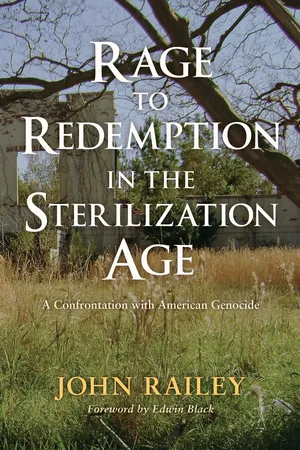
Rage to Redemption in the Sterilization Age
A Confrontation with American Genocide
- 198 pages
- English
- ePUB (mobile friendly)
- Available on iOS & Android
eBook - ePub
About this book
Nial Cox Ramirez, rendered barren in 1965 by one of America's most aggressive sterilization programs, made nationwide news in the 1970s as she fought for redress. Her landmark case fizzled in the early 1980s. Nial went on, raising a successful daughter, the one child she gave birth to before the state got to her. She never surrendered her dream of justice, but what happened to her and more than 7,600 others in "progressive" North Carolina receded into the background, buried under the cheery press releases the state program relied on before it closed down in 1974.
Then, in 2002, a team of reporters at the Winston-Salem Journal gained access to records that exposed, for the first time, the brutal inner workings of this sterilization program that had been backed by their paper. One of those reporters, John Railey, became the editorial page editor of the Journal and made victim compensation his cause. He joined forces with Ramirez, other victims, and state legislator Larry Womble, who kept fighting even after he was almost killed in a car wreck. This is the story of their victory. It's the story of Ramirez and Railey, two unlikely friends joined forever on a faith-based justice journey.
Information
part i
Another Place, Another Time
All the cruel and brutal things, even genocide, start with the humiliation of one individual.
—Former U.N. Secretary General Kofi Annan of Ghana, 2013
1
The Girl
Years later, Nial would sit in her small, neat apartment outside Atlanta and wonder at the trajectory: from her dirt-poor childhood to making it on her own in the 1970s in New York, meeting the man from South America who became her husband and learning to speak Spanish, converging with the lawyers, Gloria Steinem, and all the rest. Then finally returning to the South, not to her hated hometown but to a new South that she and so many others had helped craft.
She drew strength from her Christian faith. And from her unshakeable belief that she’d one day get justice. She watched sermons on TV, her favorite being that skinny but handsome white preacher with the animated style, the well-dressed one with the curly black hair who always started off with a joke, Joel Osteen. And she watched CNN, which often reported on cases of overdue justice finally delivered. Brothers who’d spent lifetimes in prison for rapes and murders they didn’t commit, finally freed by DNA testing. Klansmen who murdered civil rights workers in the bad old days finally convicted. Then the shows would go off and the commercials would come on. Nial would hit her remote and cut it off. None of those cases were like hers, anyway.
She’d study the framed pictures on her walls and in the stack of scrapbooks she’d spent so much time on, carefully pasting in photos. All those pictures of friends, family and coworkers jumping out at her, many now dead. But some weren’t. She’d linger longest over the faces of the babies, touching their likenesses with her fingertips. She’d sit there in her apartment, near the tall wood cabinet that held her collection of almost a hundred dolls from all over the world, each one with a name Nial had given, winking at her through the glass. She’d think about how much she loved her one baby the state allowed her to have, and how much she’d wanted more babies. She’d think about the children she could have had, “the might-have-beens.” She’d think what they might have gotten done, who they might have loved and who they might have hated.
She’d find herself back in a place and time from which she could not escape.
She was born Nial Ruth Cox in coastal Washington County, North Carolina, on September 26, 1946, the oldest girl among seven children. A midwife delivered her in the family’s run-down rent house. The midwife pulled Nial out. She let out a cry. Her mama lay back in the bed, hot and weary. Her other children scrambled about.
It was Indian summer. Back in the woods near the shack, fat water moccasins sunned on moss-covered logs. The stench of mildew hung in the air. Flies whizzed in and out of the open windows. Dogs and children played outside in the dirt yard under patched and faded clothes strung out to dry. There was no TV and no icebox. Heat in the winter came from a woodstove. There was no inside bathroom, just a sagging wooden outhouse that was inconvenient, dirty and smelly. Especially in the summer. Nial was always scared a snake would bite her out there. And it was freezing in the winter.
One neighbor would later say, “We were all poor, but Nial’s family was really poor.”
Nial’s maternal grandfather told stories about his father being a slave, about him being beaten.
Nial’s mother, Devorah Cox, drew strength from her battered Bible. An aunt had gotten Nial’s middle name, Ruth, from there. The name Nial probably came from the Bible as well, an alternate spelling of the Egyptian river. But Nial was never sure about the derivation of her name, that story having been lost like so much else in the family’s struggle. White folk wrote the history. Black folk lived it.
Nial’s childhood wasn’t living. It was just surviving. An announcement of her birth didn’t run in the local paper. Even if it had, it would have been relegated to the “Colored News” section, as most Southern papers did at the time. The Civil War had been over for almost one hundred years. Slavery was long gone. But change was as slow in coming as that old river that ran by Plymouth.
Nial was a second-class citizen. It was all she would know for the first nineteen years of her life.
She would live out those years in stark contrast to many of the whites whom the law had long separated her from. Their lush fields of peanuts and corn stretched almost to the door of her family’s shack. Her family and friends tilled the fields and worked in the white folks’ houses and mansions. Later, Nial would too. When their beat-up cars died, Nial and her family and friends could be seen walking the roads in their old clothes, past trash-littered ditches, as well-dressed whites in fine cars with stylish fins flew by. Nial’s earliest memories were of being hungry, and of the rare and special days when her mother would walk her to the grocery store and buy her ice cream.
Her mother, a county native, was a housewife who made it to the eighth grade. She was large and, by necessity, tough. She tried to do right by her children. Nial’s father, Leroy Cox, who’d also grown up in the county, was a field hand and millworker with a second-grade education. He was neither bright nor nice.
His friends loved to pick on him, often telling him at work that Devorah was entertaining a man at their house. Leroy would cut out and rush home, only to find Devorah doing what she was always doing: trying to raise their growing brood of children.
Leroy was usually oblivious to his family and their needs. One night, he came home with a buddy, screaming about how hungry he was, his shouts echoing out through the shack’s open windows. But his friend said: Wait a minute, Leroy, you just ate three pans of beans. For Devorah, who really was hungry, as were her children, that was too much. She picked up a heavy frying pan and hit him in the head, in front of the children.
Nial grew up in a time and place where natural beauty was one layer over brutality. Butterflies fluttered as people got screwed.
Washington County takes in portions of the slow-moving Roanoke River, the Albemarle Sound and what is now the Pocosin Lake National Wildlife Refuge. It’s part of a region that Bland Simpson lovingly and eloquently describes in Into the Sound Country: A Carolinian’s Coastal Plain:
This is the wet and water-loving land of eastern Carolina’s coastal plain, where rivers go sliding off into swamps and gliding by grand bluffs, ancient forests drown slowly in the rotting shred of peat in baylands and pocosins, new grasses green up each spring in marshes both saltwater and fresh. It is the land of greater sounds—Currituck, Albemarle, Pamlico, Core, and Bogue—and lesser—Croatan, Roanoke, Back, Stump, Topsail, Middle, Greenville, Masonboro, Myrtle Grove, and Shallotte. Below them is only low country, sea islands, and Florida.
The Atlantic drains into the sounds and wetlands, creating fecund breeding grounds for crabs, fish, oysters, ducks, and any number of other creatures. Seagulls dart and whirl over glittering water. Blue herons scream and flap away at the approach of boats. Water moccasins float insolently on top of the water. At night, raccoons on beaches, their eyes shining in moonlight, open shellfish with dainty paws. Whitetail deer, bucks in pursuit of does, frolic in the water.
It’s a region of wondrous sunrises and sunsets over water and woods, a place where the ancient and carefully manicured homes of landed gentry line quiet streets and waterways in the towns. In the country, flat fields of peanuts, soybeans, corn and cotton fall off to secret swamps guarded by venerable cypress trees.
In colonial days, the region had been the base of the state’s power and money. The state capital had been Bath, a town near Plymouth, where Blackbeard the pirate partied with the governor.
By the time Nial was growing up, the whites of the Sound Country still wielded power in state politics; they were “gentleman farmers” who left it to hired help and sharecroppers to work their land. They had the luxury on late afternoons of riding their new pickup trucks down yellow-dirt paths that split the fields, surveying the black laborers and “white trash” at work. They’d share a splash of bourbon out of the bottle, chased with a slurp of soda, and conclude that life was good.
In winter they warmed their hands by fires in metal barrels as their workers butchered hogs: hams, sausage and bacon for market and their homes. They hunted deer with shotguns and hounds, rumbling down rural roads in big trucks with dog boxes in the back. As the hunting commenced in the fall, their dogs could be heard from far away, barking and yelping and tearing through the woods and cutovers. Their masters’ shotguns would boom, bringing down bucks and does. The masters would take a knee by their trophies, baptized in the blood, cigarettes hanging from their mouths and shotguns in hand, giving a big grin for the Kodak.
In spring they might stuff themselves into suits and spend a few days in New York with their wives, drinking while the women shopped, bitching about the city, later having a fancy dinner and taking in a Broadway show. They summered with their families in decadently aristocratic cottages, complete with rooms off the porch for “the colored help,” on the Nags Head beach, about two hours east. They’d frolic with their children in the ocean. And come late summer, they’d ready their teenage sons and daughters for the start of the school year at the best prep schools in North Carolina and Virginia. It was a life often structured around the Episcopal Church, as long as the priests didn’t get too liberal.
The lives of the landed gentry were based on the passing of fortunes from one generation to another. Some of those fortunes had begun with slave labor. In the town of Creswell, just down the road from Plymouth, a hundred slaves and more had worked the vast fields of Somerset Place plantation. The whites of the region didn’t always sleep easily. In the dog days of August 1831, just a couple of hours across the coastal plain, in Southampton County, Virginia, the black slave preacher Nat Turner led the only sustained slave revolt in American history, killing almost sixty white men, women, and children before he and his men were caught. Turner was hung, as were most of his men, but whites throughout the region c...
Table of contents
- Title Page
- Foreword
- Prologue
- Part 1: Another Place, Another Time
- Part 2: Newspapermen
- Part 3: The Reckoning
- Epilogue
- Acknowledgments
- Bibliography
Trusted by 375,005 students
Access to over 1.5 million titles for a fair monthly price.
Study more efficiently using our study tools.
Frequently asked questions
Yes, you can cancel anytime from the Subscription tab in your account settings on the Perlego website. Your subscription will stay active until the end of your current billing period. Learn how to cancel your subscription
No, books cannot be downloaded as external files, such as PDFs, for use outside of Perlego. However, you can download books within the Perlego app for offline reading on mobile or tablet. Learn how to download books offline
Perlego offers two plans: Essential and Complete
- Essential is ideal for learners and professionals who enjoy exploring a wide range of subjects. Access the Essential Library with 800,000+ trusted titles and best-sellers across business, personal growth, and the humanities. Includes unlimited reading time and Standard Read Aloud voice.
- Complete: Perfect for advanced learners and researchers needing full, unrestricted access. Unlock 1.5M+ books across hundreds of subjects, including academic and specialized titles. The Complete Plan also includes advanced features like Premium Read Aloud and Research Assistant.
We are an online textbook subscription service, where you can get access to an entire online library for less than the price of a single book per month. With over 1.5 million books across 990+ topics, we’ve got you covered! Learn about our mission
Look out for the read-aloud symbol on your next book to see if you can listen to it. The read-aloud tool reads text aloud for you, highlighting the text as it is being read. You can pause it, speed it up and slow it down. Learn more about Read Aloud
Yes! You can use the Perlego app on both iOS and Android devices to read anytime, anywhere — even offline. Perfect for commutes or when you’re on the go.
Please note we cannot support devices running on iOS 13 and Android 7 or earlier. Learn more about using the app
Please note we cannot support devices running on iOS 13 and Android 7 or earlier. Learn more about using the app
Yes, you can access Rage to Redemption in the Sterilization Age by John Railey in PDF and/or ePUB format, as well as other popular books in History & North American History. We have over 1.5 million books available in our catalogue for you to explore.