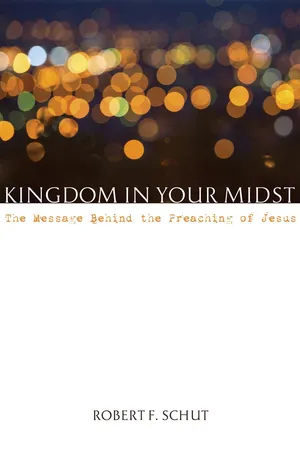
- 116 pages
- English
- ePUB (mobile friendly)
- Available on iOS & Android
eBook - ePub
About this book
Our clture is changing almost daily in our world. This creates a lot of confusion as to where the believer and the church fit into this changing culture. How do we maintain our Christian identity in such a world that requires us to compromise our most cherished beliefs? This book offers an old solution that has stood the test of time, but has eluded many present-day believers.
The original message of Jesus is no longer considered relevant in our culture by many today. This book challenges that idea by making Jesus' message about the kingdom of heaven not only relevant, but also necessary. It is time that we listen again to the underlying message of the greatest prophet and teacher who has ever lived and not only make his teaching relevant, but the teacher as well.
Information
1
Introduction
As a Bible teacher I find it an ongoing challenge to take stories, letters, and sayings from the Bible and present them with interesting insights into their meaning. I have to check authorities, commentaries, and even consider the original languages in order to validate old as well as justify new ideas to be discussed. One of the most difficult challenges, however, is to take scripture meant for the first-century Jewish culture and make it applicable for today’s generation.
Perhaps one of the most difficult topics to make relevant today is Jesus’ teachings on the kingdom of heaven, which is also referred to as the kingdom of God. It is this topic that I wish to address in this small, but hopefully concise book.
Why is the kingdom of heaven so mysterious that Jesus would only speak of it in parables? Is it something that is so beyond the average person’s understanding that only saints, gurus, or mystics can understand it?
Perhaps it is because the kingdom of heaven addresses our deepest sense of who we are. But it is not just the sense of self of which Jesus is speaking; it is the relationship of that self as it comes to know God in a very special and unique way. He describes the way that we will begin to see ourselves, others, and God as we live in God’s kingdom where this self takes on a whole new value based upon God’s system and not our own.
Jesus spoke about the kingdom of heaven more as a reign of power than as a place.1 He also spoke about how this will affect the way we perceive ourselves and others now that we are under this new rule and protection of God’s lordship. This new evaluation is often the complete opposite of what we might expect in our present-day world. Many of our values today are turned upside-down. Those things which we consider to be of greatest importance are really of least importance in God’s kingdom. It is for this reason that many of us may feel a sense of conflict between our faith and our everyday lives.
In our world the poor, persecuted, and mournful are considered to be those who have been cursed by God—but in his kingdom these very same people are actually the blessed!
Although Jesus was a teacher, he was not explaining what the kingdom was from the point of view of a philosopher or a theologian. He was teaching it from the viewpoint of one who lives every moment in this kingdom. He tries to give us a sense of what he experienced through situations experienced in everyday life which create in us and in his audience the same sense of wonder and awe that are created in God’s kingdom—perhaps though on a smaller scale.
The point of Jesus’ parables was not to entertain us with little stories or create some poetic imagery from which to compose elaborate interpretations. He told these stories to make us aware that there was a whole other worldliness higher and greater than this one where God ruled over everything and everyone. It was not simply a pie-in-the-sky vision of some fantasy place or even a place that might someday exist in the future. It is a place that exists here and now—in their midst as well as ours. It is the experience of having the right attitude towards God which all people can potentially have, though many have failed to realize and exhibit.
Jesus’ declaration is that such a kingdom has already come upon us. It has come upon us in the form of a man who would show us the way not by merely talking about it, but by becoming it. If we walk as he walked, we too will experience the awe and wonder of this kingdom of God.2
One enters into such a kingdom, not only through the confession of God’s almighty power, but by recognizing and seeking after God’s righteousness as displayed in and by Jesus, his Christ. Therefore, we must always keep in mind that God’s kingdom is not only a kingdom of power and glory, but also one of righteousness.
What then does the kingdom of God mean to us today? Is Jesus’ teaching really relevant to us in modern times? I believe the answer is “Yes,” but we must seek out his kingdom as it presents itself to us in our reality today. The kingdom of God still exists today just as it did in the first century. We simply have to look for it in the events that surround our existence. But we must not only seek it out, we must also live it out with the intent upon it becoming our ultimate true reality. We must make treasures for ourselves now that will last for eternity, and by doing so we will reassure ourselves of our place in this kingdom.
Now some might think that this is all just another idea enabling Christians to escape from the real world and its problems, but rather it is God’s way of engaging the real world, his world, with a new sense of hope and confidence. Today, too many Christians feel overwhelmed by their problems and feel hopeless and even worthless as they struggle through those problems. The kingdom of God brings to us a new vision of those problems as well as a way to overcome those self-defeating thoughts that accompany such problems.
According to Leon Morris “the kingdom is the most important topic in Jesus’ teaching.”3 And Seyoon Kim claims that the kingdom of God is “the central theme of Jesus’ preaching.”4 The kingdom of God gives us a world-view that God has created for those who believe in his Son. It gives us a new perspective of who we are and a sense of self-worth not only as believers, but as sons and daughters of God.
Now the kingdom of heaven is different than most other subjects. Most of the books that I have in my library contain a lot of facts backed by other facts and so on. In some books the footnotes take up more room than the text. For certain subjects this is really the best and maybe the only way for the author to present his opinions. Although this works for many subjects, I think that it is a mistake to try to present the kingdom of heaven using this same format.
The kingdom of heaven is unique and presenting it to the reader by overwhelming him with historical and theological facts may not be the best approach. It certainly was not Jesus’ approach, in that he particularly chose stories or parables by which to communicate it.
Stories such as parables tend to engage the reader or listener in the process of truth as he is confronted face to face with his own ideas and prejudices. This was the power of the parable in the hands of Jesus. He led his listeners to the point of truth by exposing their true feelings through their own response. This is the beginning of truth no matter how stark and sobering it might be.
In the same manner, though much less prophetic, I will try to engage you as the reader in a dialogue as we both seek towards the truth together. It is my hope that the following chapters bring greater clarity to your vision of God’s kingdom and inspire many to seek it out with a passion that will take them into a deeper relationship with God than they ever thought possible.
Discussion Questions
1. What is your current understanding of the kingdom of heaven?
2. Why do you think Jesus used parables about the kingdom rather than plainly tell his disciples what the kingdom was?
3. Do you think it’s possible to live in Jesus’ kingdom in today’s world?
4. What things seem different in God’s kingdom than in man’s kingdom?
5. Do you consider trials and tribulations in your life to be curses or blessings? (Be honest now)
6. How do you seek the kingdom of heaven today?
7. How can this new vision of the kingdom help us live out our faith?
Notes...
Table of contents
- Title Page
- Preface
- Abbreviations
- Chapter 1: Introduction
- Chapter 2: Where Is the Kingdom?
- Chapter 3: What Is the Kingdom Like?
- Chapter 4: When Will the Kingdom Come?
- Chapter 5: How Do We Get into the Kingdom?
- Chapter 6: Who Can Get into the Kingdom?
- Chapter 7: Why Should We Seek the Kingdom?
- Chapter 8: The Kingdom and the Law
- Chapter 9: The Kingdom and the Cross
- Chapter 10: The Kingdom and the Church
- Chapter 11: Summary and Final Thoughts
- Chapter 12: Conclusion: Love God
- Chapter 13: A New Beginning
- Recommended Reading for Further Study
- Bibliography
Trusted by 375,005 students
Access to over 1.5 million titles for a fair monthly price.
Study more efficiently using our study tools.
Frequently asked questions
Yes, you can cancel anytime from the Subscription tab in your account settings on the Perlego website. Your subscription will stay active until the end of your current billing period. Learn how to cancel your subscription
No, books cannot be downloaded as external files, such as PDFs, for use outside of Perlego. However, you can download books within the Perlego app for offline reading on mobile or tablet. Learn how to download books offline
Perlego offers two plans: Essential and Complete
- Essential is ideal for learners and professionals who enjoy exploring a wide range of subjects. Access the Essential Library with 800,000+ trusted titles and best-sellers across business, personal growth, and the humanities. Includes unlimited reading time and Standard Read Aloud voice.
- Complete: Perfect for advanced learners and researchers needing full, unrestricted access. Unlock 1.5M+ books across hundreds of subjects, including academic and specialized titles. The Complete Plan also includes advanced features like Premium Read Aloud and Research Assistant.
We are an online textbook subscription service, where you can get access to an entire online library for less than the price of a single book per month. With over 1.5 million books across 990+ topics, we’ve got you covered! Learn about our mission
Look out for the read-aloud symbol on your next book to see if you can listen to it. The read-aloud tool reads text aloud for you, highlighting the text as it is being read. You can pause it, speed it up and slow it down. Learn more about Read Aloud
Yes! You can use the Perlego app on both iOS and Android devices to read anytime, anywhere — even offline. Perfect for commutes or when you’re on the go.
Please note we cannot support devices running on iOS 13 and Android 7 or earlier. Learn more about using the app
Please note we cannot support devices running on iOS 13 and Android 7 or earlier. Learn more about using the app
Yes, you can access Kingdom in Your Midst by Robert F. Schut in PDF and/or ePUB format, as well as other popular books in Theology & Religion & Biblical Criticism & Interpretation. We have over 1.5 million books available in our catalogue for you to explore.