- 176 pages
- English
- ePUB (mobile friendly)
- Available on iOS & Android
eBook - ePub
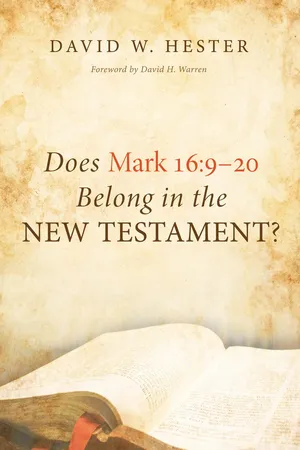
Does Mark 16:9–20 Belong in the New Testament?
About this book
For almost fifty years, much has been written concerning Mark 16:9-20. During the same time period, evidence once counted against Mark 16:9-20 was shown to be otherwise. In this study, David W. Hester surveys modern scholarship (1965-2011) surrounding the passage. He examines the passage itself--the external evidence, with particular attention paid to the manuscripts and the patristics, especially those of the second and third centuries; and the internal evidence, featuring details that are problematic as well as those that favor Markan authorship. Finally, a proposal concerning the origin of the passage is presented. The first edition of Mark's Gospel ended at 16:8, resulting in the manuscript tradition that omits the passage, but this was not his intended ending. Later, his associates attached Mark's notes and published a second edition of the Gospel with the last twelve verses. This led to its inclusion. Given that the passage is cited by second- and third-century witnesses and attributed to Mark, along with the biblical prohibition against adding to or taking from Scripture, it is doubtful that an anonymous second-century author could have been successful in adding his own composition and it being widely accepted by the early church.
Information
Chapter 1
Modern Scholarship on Mark 16:9–20, 1965–2011
From the late 1800s to the late 1950s, the scholarly consensus eventually solidified against inclusion of Mark 16:9–20. In 1965, that began to change.
The SBL Presidential Address of Kenneth W. Clark
On December 30, 1965, the Society of Biblical Literature held its annual meeting at Vanderbilt University. Kenneth W. Clark delivered the presidential address on that occasion.19 While not arguing for the acceptance of Mark 16:9–20 as genuine, Clark said: “On the other hand, the restoration of the traditional ending of Mark is a wholesome challenge to our habitual assumption that the original Mark is preserved no further than 16:8 . . . Witnesses both for and against the CE restoration as genuine are early and impressive, and we should consider the question still open and perhaps ‘insoluble at present.’”20
Perhaps overlooked were his earlier remarks concerning bias, which could have elicited a strong reaction from his audience: “It is also a false assurance, offered by many, that textual criticism can have no effect upon Christian doctrine. This insistent comfort implies that the text, in any form, deals only with the periphery of doctrine. It also implies a fear that emendation of the text might have evil, but never good, theological consequences. And yet it is impossible for any scholar to provide assurance to any Christian that textual studies will not affect his beliefs, even for the better.”21
Clark’s remarks were controversial; William Farmer made mention of them in the Preface to his book, The Last Twelve Verses of Mark, yet Clark would be mentioned by only one other scholar.22 Over the next fifteen years, numerous books and articles were written concerning the passage that took the study into new directions. Most still denied that verses 9–20 should be included in the Gospel of Mark, save one.
1964–72: Metzger, Meye, Farmer, Linnemann, Schweizer, Schmithals, Trompf, Elliott, Van der Horst
Bruce M. Metzger had penned an overview of the textual issues of the New Testament in 1964.23 Concluding that the passage was not from the hand of Mark, Metzger asked, “But did Mark intend to conclude his Gospel with the melancholy statement that the women were afraid?”24 In arguing against such a position, Metzger (perhaps) unwittingly anticipated scholars who would follow after him. He made three significant points in this regard: first, such a conclusion is not an appropriate ending; second, to terminate a Greek sentence with the word γάρ is rare; third, Metzger said that it is possible that in verse 8 Mark meant to write “they were afraid of”—thus indicating that something else is needed to finish the sentence.25 This was the first, but by no means the last, time that Metzger would address textual issues concerning the passage.
Robert P. Meye advocated the view that the Gospel ended prior to 16:9–20.26 At the outset, he clearly stated his position: “This essay is written with the conviction that the history of Marcan and Gospel studies has provided us with ample evidence to compel the conclusion that Mark 16:8 was indeed the original and intended ending of the Gospel.”27 Meye then acknowledged two central problems with this position: first, “it is thought improbable that a Gospel would conclude without a narrative of the resurrection appearance(s) of Christ.” The second “has to do with the apparent abruptness of an ending at 16:8.”28 In response, Meye said first that “Mark 16:1–8 clearly articulates the resurrection of Christ.”29 He also said that the response of fear of the women at the tomb pointed to “a sign that the women were at the scene of the ultimate mystery.”30 In addressing the second problem, Meye pointed to the beginning of Mark’s Gospel for a proposed solution. “Markan clues are of crucial significance in the search for a solution to the Markan ending.”31 He suggested ...
Table of contents
- Title Page
- Foreword
- Introduction
- Chapter 1: Modern Scholarship on Mark 16:9–20, 1965–2011
- Chapter 2: External Evidence
- Chapter 3: Internal Evidence
- Chapter 4: A Proposal Concerning the Origin of Mark 16:9–20
- Bibliography
Trusted by 375,005 students
Access to over 1.5 million titles for a fair monthly price.
Study more efficiently using our study tools.
Frequently asked questions
Yes, you can cancel anytime from the Subscription tab in your account settings on the Perlego website. Your subscription will stay active until the end of your current billing period. Learn how to cancel your subscription
No, books cannot be downloaded as external files, such as PDFs, for use outside of Perlego. However, you can download books within the Perlego app for offline reading on mobile or tablet. Learn how to download books offline
Perlego offers two plans: Essential and Complete
- Essential is ideal for learners and professionals who enjoy exploring a wide range of subjects. Access the Essential Library with 800,000+ trusted titles and best-sellers across business, personal growth, and the humanities. Includes unlimited reading time and Standard Read Aloud voice.
- Complete: Perfect for advanced learners and researchers needing full, unrestricted access. Unlock 1.5M+ books across hundreds of subjects, including academic and specialized titles. The Complete Plan also includes advanced features like Premium Read Aloud and Research Assistant.
We are an online textbook subscription service, where you can get access to an entire online library for less than the price of a single book per month. With over 1.5 million books across 990+ topics, we’ve got you covered! Learn about our mission
Look out for the read-aloud symbol on your next book to see if you can listen to it. The read-aloud tool reads text aloud for you, highlighting the text as it is being read. You can pause it, speed it up and slow it down. Learn more about Read Aloud
Yes! You can use the Perlego app on both iOS and Android devices to read anytime, anywhere — even offline. Perfect for commutes or when you’re on the go.
Please note we cannot support devices running on iOS 13 and Android 7 or earlier. Learn more about using the app
Please note we cannot support devices running on iOS 13 and Android 7 or earlier. Learn more about using the app
Yes, you can access Does Mark 16:9–20 Belong in the New Testament? by David W. Hester in PDF and/or ePUB format, as well as other popular books in Theology & Religion & Biblical Criticism & Interpretation. We have over 1.5 million books available in our catalogue for you to explore.