- 172 pages
- English
- ePUB (mobile friendly)
- Available on iOS & Android
eBook - ePub
About this book
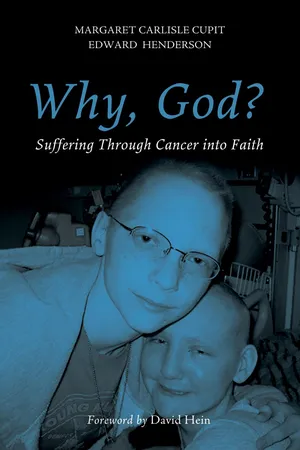
A nineteen-year-old chemistry major at Rhodes College is selected to spend the summer after her freshman year doing research at St. Jude Children's Research Hospital. Instead, she finds herself a patient there, fighting a life-threatening form of pediatric cancer and suffering through a year of aggressive chemotherapy and surgery. Refusing to believe what many tell her--that the cancer was all part of "God's plan"--she finds solace in journaling and begins a discussion with her grandfather, a university professor specializing in philosophy of religion. Through her experiences and writing about them, the student discovers that she may be a person of faith after all--just not in the way she expected. Her grandfather has selected and arranged the journal entries and their faith conversation and has commented on them in order to bring out the spiritual dimensions of her experience. He learns from his granddaughter that faith comes more through experience than through ideas. The coauthors hope the book will help other sufferers recognize the presence of a loving God in the midst of pain, uncertainty and death.
Information
Topic
Teologia e religioneSubtopic
Teologia cristiana1
The Hard Rocks of Reality
MCC, June, 2011
My freshman year at Rhodes College was glorious, the happiest year I had ever had, the most challenging, most provocative, and the most fruitful. I learned how to solve differential equations, how to rationally explain my vegetarianism, and how to write a college paper. I learned how to titrate acids and bases, how to read ancient texts, and how to write a short story. I learned why the sugar trade was important to Great Britain and slavery, why Gandhi had such an effect on his people, and why Christianity spread so quickly. I began to learn who I was, what a true friend looked like, and how truly inspiring a college professor could be. I gained a few pounds, a hundred friendships, and twenty role models. I acted out Sophocles’ plays in the amphitheater, helped win a ninth-place trophy at Mock Trial Nationals, and journeyed to the top of Palmer Hall to talk and eat cookies with my very English professor who taught me British Literature. I held a work-study position in the college president’s office where I actually got to know the president of the college, won the freshman chemistry award, made a 4.0, and was selected for a research fellowship at St. Jude Children’s Research Hospital. Overwhelmed with success and excitement, I emailed my Grandpapa, a Rhodes graduate himself, to tell him that I loved Rhodes so much that I wished I could stay there forever. But on what should have been my first day as a research fellow at St. Jude, I found myself as a patient there instead, beginning chemotherapy for a life-threatening form of bone cancer called Ewing’s sarcoma. Nearly four years have passed, and although I have a titanium tibia and knee as well as a fierce battle scar from my thigh to my ankle, I am healthy—free of cancer. I am graduating from Rhodes College, and I will begin medical school in the fall in hopes of becoming a pediatric oncologist. My life is rich. Filled with excitement for my future, I am content.
My battle with cancer, however, was not one of contentment, for there were always questions running through my mind. Why me? What did I do to deserve cancer? If children and babies, the least deserving, get cancer, then where is God? Why does God let that happen? Does God cause cancer? Does everything happen for a reason? Do people die long, painful deaths after tons of miserable chemo because God wants them to, because that is God’s plan for them? Sometimes I felt like God was too far away from everything I was experiencing, that surely God didn’t care about me if he’d allowed cancer to happen to me.
I began praying the moment I found out cancer was a possibility. While I would like to say my urge to pray was a result of my faith, it is likely that it was a result of my upbringing and desperation. I clung to God because God was the only one who could change my diagnosis. “Don’t let it be cancer. Please, don’t let it be cancer, God. I know you wouldn’t let that happen to me. I have too many plans.” I thought that things would go back to normal soon, that I would wake up from the terrible nightmare I was having and resume a normal life. I never did wake up, and gradually I realized that I was inside of my actual life, not inside of a dream. God did not step in and reverse my diagnosis.
I’ve always had doubts. I can’t remember an age when I didn’t question my faith, at least from time to time. I’ve never been good at pushing thoughts away or hiding them. I’ve been curious for my whole life, and I’ve always asked a lot of questions. These things haven’t made faith easy for me. Still, though, I have always yearned for a spiritual connection and searched for religious affirmation, unable to abandon such a quest of utmost importance and unable to give up on believing or looking for the answers to my questions. When I received the diagnosis, however, and when I began cancer treatment and everything that came with it, my faith was shaken as never before.
I could have given up on God and the idea of God, but I didn’t. It wasn’t fear that kept me from closing off my mind to the possibility of God. In my mind, giving up on God without a thorough search was just as silly as believing in God without a thorough search.
EHH
My granddaughter Maggie’s diagnosis and treatment for Ewing’s sarcoma pressed questions about God and God’s ways with the world, pressed them on Maggie, of course, but also on those who love her. With encouragement and input from Tricia, my wife and Maggie’s step-grandmother (Maggie knows her as Nini, and she will be so named hereafter), I proposed a “faith conversation,” which Maggie and I could conduct mainly through email and on Nini’s and my occasional trips to Memphis to visit her at St. Jude Children’s Research Hospital.
Even as our faith conversation was taking place, it became clear to me that Maggie’s growth in faith had far more to do with the painful and frightening experience she was going through than with abstract theological thinking. Maggie (and her family and friends) had run into the hard rocks of reality. This collision made Maggie’s experience a most important part of her search for God. By the time she was able to return to college more than a year later, she had suffered both physical and mental pain, lived through the deaths of several young friends, and faced the possibility of her own early death.
Maggie had not expected that the search for God would be so much like science. As science only advances when hypotheses are tested against stubborn facts, so it is with matters of the spirit. No faith in God can advance unless its beliefs are tested against the stubborn facts of life. For Maggie, cancer became the fact against which the search for God and for faith to trust God would have to go forward. Only in this case the stubborn fact is not one from which one can gain objective distance as one might from facts in a lab; nor can one come to a conclusion that might be accepted by all. In this case the “proof” involves one in an ongoing act of courage and commitment.
As she suffered through the hard realities of a year of cancer treatment, Maggie was embedded in a wealth of relationships. These included a new and deeper relationship with family and friends, especially with her mother, her two sisters, her stepfather, her grandmother, her uncle, and with Nini and me. Beyond these newly shaped relationships with her immediate family are the relationships that developed with the doctors, nurses, therapists, others on the St. Jude staff, an Episcopal priest, and, most powerfully, with other patients; for it was with these young fellow-sufferers that Maggie confronted the pain, the uncertainty, the possibility, and, for some, the reality of death.
These relationships became the matrix within which Maggie was nurtured and sustained as she suffered into faith. The term “matrix” is important. A matrix is literally a womb, which is a living system of interacting members through which something new is brought to life, not simply as the passive recipient of causally inflicted effects, but as a living agent actively receiving and using the nurture provided in the matrix and in turn reciprocally affecting the other members. As Maggie suffers into faith, those around her find themselves also suffering and growing. But this is Maggie’s story. The focus will be on her.
We will enter into Maggie’s story with what she wrote in the summer of 2011 when her year of chemotherapy and surgery was over and she had been declared “cancer free.” These reflections will be followed by selections from her CaringBridge journal and by emails constituting the “faith conversation” Maggie and I carried on. These emails and journal entries were written in the midst of the physical pain and mental anguish of treatment, when she did not know what was coming next or what the outcome was to be. It is in them that we best see the working of the matrix: the relationships with family, friends, and therapists, the theological questioning and thinking, and the relationships with the other patients and their families. In this working we will see Maggie suffering into faith.
One of the things the journal entries will show is the enormous role other patients play in Maggie’s spiritual growth. Maggie found herself going out to them and in this powerful thing that was happening to her she began to sense and then to know that her wound was sacred. As she began to see God in her fellow sufferers, she was able to see meaning in the suffering, to find that God was in it and with her cooperation would make it count for good, and this without seeing God as intentionally causing her to have cancer as part of some detailed divine plan for her life. Maggie’s faith was not structured by particular doctrines of Christian theology, but she came to see the effective presence of God, especially in the lives of the people around her, and to know that the matrix in which she lived was in fact the hidden kingdom of God.
But philosophical and theological thinking are also at work in the matrix. Thinking, questioning, wondering, doubting, receiving and weighing ideas, responding, seeing new ways to understand, even appreciating the limits of every way of thinking and the limits of all ideas: these are part of life. Such inclusion in life does not in itself negate thought’s ability to know truly. In Maggie’s case, I believe that the thinking she did in her writing and in dialog with others was helpful in removing obstacles to faith and helping her to form a faith that is able to include doubt and different ways of understanding without making faith into a fearful adherence to comforting beliefs. Such faith, I believe, allows one to trust in and depend on God rather than on doctrines.
As we follow Maggie through the year of her treatment and attend to her reflections, we see God at work forming and transforming, doing what C. S. Lewis called “surgery” on her soul.1 By the eve of her return to college life, we find Maggie affirming a faith that has made friends with doubt, disappointment, and uncertainty while declaring hope that the mysterious God intends good for us and can be trusted to accomplish it even through suffering and death. This is by no means to say that Maggie, any more than the rest of us, is a finished product. Maggie’s epilogue, written just after her graduation from Rhodes College, shows that her life of faith continues to seek understanding even as she continues to intersect with ever new facets of reality.
The diagnosis came in mid-May 2010; the first treatment came shortly after. It was in the setting of that suffering that Maggie faced in an intensely concrete way the questions philosophers of religion discuss in distant and abstract ways. Let the questioning and answering unfold in the telling of her story. It all began in the spring semester of her first year at Rhodes College . . .
1. Lewis, Till We Have Faces, 253–54.
2
But I Have Plans
MCC, June, 2011
He looked down at the papers on his lap. “It looks like there is some abnormal tissue in your leg.”
How did I get to that point? How did my normal, seemingly perfect life turn into something else? How did my biggest worry go from making good grades to surviving? Had I done something wrong? How had God let this happen to me? These were questions for which I had no answers. I guess I’ll just start from the beginning.
I had just finished the most exciting half-year of my entire eighteen years of life: my first semester of college. If you think it was because of the alcohol and freedom, you’re wrong. I had never had a drink in my life. I was the type of person who loved college because of my two biggest life passions: people and learning. College happened to be full of both things. For me, college was my idea of heaven. I had a high GPA, a dozen best friends, and, for the first time in my life, a fully stimulated mind. Rhodes College was the perfect place for me in every way possible.
Halfway through that first year, the pain started. While I was visiting a college friend and her family over winter break in Rhode Island, my right knee began to throb. I didn’t think anything of it. After all, I had just taught a yoga session to the whole family that morning, right in front of the Christmas tree. Yes, I was a bit of a show-off, and I had worked extra hard to demonstrate my yoga abilities, so I figured I had just pulled a muscle or was extra sore. I took some ibuprofen and waited. When we watched a movie later that night, I couldn’t take my mind off the pain in my leg long enough to focus. The next day, I woke up in pain. I continued to take ibuprofen, which worked for the time being.
I don’t remember exactly how many days went by between then and the next time my leg started hurting, but it was long enough for me to lose track of time. Let me make one thing clear: I have never been much of an athlete. I tried to make myself exercise to stay somewhat in shape during my freshman year, and my exercise routine usually entailed a mile or two of fast-paced uphill walking followed by a mile of running. I would do yoga when I felt like it, but it was often for relaxation rather than physical fitness. On this particular day, I noticed that running the mile was incredibly difficult, even more difficult than usual. “It must have been a really long time since my last run,” I thought to myself as I walked to the water cooler across the gym, struggling to make it across the room. As I walked back across campus through the cold, I pulled a sweatshirt over my sweaty head and cringed from the pain in my leg. I blamed the pain on the pulled muscle I never got checked out, made it back to my room, and took an ibuprofen. I turned on the shower to let the water heat up and began undressing in the mirror. As I scanned my body, I noticed that my right knee was slightly bigger than my left.
The pain went away after a few days, and I forgot all about it. A few weeks later, my mock trial team headed to Missouri for a regional tournament. We loaded the van excitedly, and I began practicing my characters, complete with accents, as soon as we left the parking lot. After a few hours, I noticed that my leg felt like it needed stretching. This made sense; we’d been driving without any stops. Not too much later, we stopped for a bathroom break somewhere be...
Table of contents
- Title Page
- Foreword
- Acknowledgements
- Introduction
- Chapter 1: The Hard Rocks of Reality
- Chapter 2: But I Have Plans
- Chapter 3: This Place is St. Jude
- Chapter 4: Of Squirrels and Theology
- Chapter 5: Why, God?
- Chapter 6: Sacramental Experiences
- Chapter 7: The Hidden Kingdom
- Chapter 8: Choosing Life, Staying the Course
- Chapter 9: Something I Can’t See
- Bibliography
- Suggested Theological Reading
Trusted by 375,005 students
Access to over 1.5 million titles for a fair monthly price.
Study more efficiently using our study tools.
Frequently asked questions
Yes, you can cancel anytime from the Subscription tab in your account settings on the Perlego website. Your subscription will stay active until the end of your current billing period. Learn how to cancel your subscription
No, books cannot be downloaded as external files, such as PDFs, for use outside of Perlego. However, you can download books within the Perlego app for offline reading on mobile or tablet. Learn how to download books offline
Perlego offers two plans: Essential and Complete
- Essential is ideal for learners and professionals who enjoy exploring a wide range of subjects. Access the Essential Library with 800,000+ trusted titles and best-sellers across business, personal growth, and the humanities. Includes unlimited reading time and Standard Read Aloud voice.
- Complete: Perfect for advanced learners and researchers needing full, unrestricted access. Unlock 1.5M+ books across hundreds of subjects, including academic and specialized titles. The Complete Plan also includes advanced features like Premium Read Aloud and Research Assistant.
We are an online textbook subscription service, where you can get access to an entire online library for less than the price of a single book per month. With over 1.5 million books across 990+ topics, we’ve got you covered! Learn about our mission
Look out for the read-aloud symbol on your next book to see if you can listen to it. The read-aloud tool reads text aloud for you, highlighting the text as it is being read. You can pause it, speed it up and slow it down. Learn more about Read Aloud
Yes! You can use the Perlego app on both iOS and Android devices to read anytime, anywhere — even offline. Perfect for commutes or when you’re on the go.
Please note we cannot support devices running on iOS 13 and Android 7 or earlier. Learn more about using the app
Please note we cannot support devices running on iOS 13 and Android 7 or earlier. Learn more about using the app
Yes, you can access Why, God? by Margaret Cupit-Link,Edward Hugh Henderson in PDF and/or ePUB format, as well as other popular books in Teologia e religione & Teologia cristiana. We have over 1.5 million books available in our catalogue for you to explore.